

What is the morning cortisol peak?
It is a natural, pronounced rise in cortisol in the 30 to 45 minutes after waking up, known as the cortisol awakening response. It happens with or without coffee, and is part of how the body normally works.
Cortisol is produced by the adrenal glands, under the control of a hormonal circuit that starts in the brain: the hypothalamic-pituitary-adrenal axis. Its level follows a 24-hour rhythm: low late in the evening, it rises again toward the end of the night, then climbs sharply right after you wake up. Specialists call this the cortisol awakening response, or CAR.
A panel of experts from the International Society of Psychoneuroendocrinology, in guidelines published in 2016, describes it as the marked increase in cortisol secretion during the first 30 to 45 minutes after waking. The same experts stress a point that matters for what follows: measuring it correctly is difficult. It relies on saliva samples taken at home, and a few minutes' delay between waking up and the first sample is enough to skew the result.
What is this peak for? Nobody knows for sure. A 2009 review points out that its exact function has not been worked out, that it varies with sex, health status, lifestyle and perceived stress, and puts forward the hypothesis that it prepares the body for the day ahead. Morning cortisol is therefore not some "stress" you need to get rid of: it is a normal wake-up signal.
Does coffee really raise cortisol?
Yes, in people who don't usually consume it, a dose of caffeine clearly raises cortisol for several hours. The effect has been measured in placebo-controlled trials, with caffeine in capsules as well as with coffee.
Three studies are the main references on the subject:
- Lovallo et al., 2005 (Psychosomatic Medicine): 48 men and 48 women, a four-week double-blind trial. After five days with no caffeine at all, three 250 mg doses during the day (at 9 a.m., 1 p.m. and 6 p.m.) caused a clear rise in salivary cortisol throughout the day, compared with placebo.
- Gavrieli et al., 2011 (Journal of Nutrition): 16 healthy men were given, with a breakfast snack, 200 ml of caffeinated coffee (3 mg of caffeine per kilo), decaffeinated coffee or water. Blood cortisol was higher after caffeinated coffee than after water from 60 minutes onward. On the other hand, appetite, the amount eaten at the next meal, blood sugar and inflammation markers did not change.
- Lovallo et al., 2006 (Pharmacology Biochemistry and Behavior): caffeine added to the effect of mental stress, raising cortisol even further, and an exercise session that did not raise it on its own did increase it when preceded by caffeine.
Keep the scale in mind: 250 mg per dose is more than two and a half mugs of drip coffee in one go. These trial conditions look nothing like a habitual drinker's morning cup, which brings us to the next question.

Also read: How much coffee per day without going over the limit. Too much coffee: the warning symptoms.
Why does the effect fade in regular drinkers?
Because the body partly gets used to it: in people who consume caffeine every day, the cortisol rise after the morning coffee can disappear. But the adaptation is not complete, and it does not necessarily hold for the whole day.
Lovallo's 2005 study was designed precisely to answer this question. For five days, the volunteers took either a placebo, 300 mg or 600 mg of caffeine per day. On the sixth day, they were given the 250 mg test dose, and their cortisol was measured eight times between 7:30 a.m. and 7 p.m.
- After five days without caffeine: a strong rise in cortisol, as expected.
- After five days at 300 or 600 mg per day: the 9 a.m. dose no longer raised cortisol.
- But after the second dose, at 1 p.m., cortisol rose again and stayed up until the evening.
- In every case, it came back down to placebo levels in the evening.
The authors' conclusion is nuanced: in healthy young adults who consume caffeine every day, the cortisol response is reduced, but not eliminated.
A more recent study adds another nuance. Published in 2024 in Psychosomatic Medicine on two groups of young adults (128 and 148 people), it put participants through a lab stress test. Those who habitually consumed caffeine showed a stronger cortisol reaction to stress, while caffeine taken on the day itself changed nothing. This is an association, not proof of cause, and the authors themselves question what it means. It simply reminds us that habit does not reset everything to zero.

What do the measurements show about coffee on an empty stomach?
Much less than you might read. Trials have measured the effect of caffeine in the morning or with a snack, but as far as we know, no trial has directly compared cortisol after coffee on an empty stomach with cortisol after the same coffee taken with food.
The idea that coffee on an empty stomach makes cortisol "skyrocket" is everywhere. Here is what the research we read actually says:
- in Lovallo's study, the first dose was given at 9 a.m., with no comparison between an empty and a full stomach;
- in Gavrieli's study, the coffee was drunk with a breakfast snack, and cortisol still went up;
- a PubMed search on November 12, 2026 did not turn up any trial isolating the effect of fasting on the cortisol response to coffee.
What bothers some people about coffee on an empty stomach often has more to do with the stomach than with cortisol, and here too the data are modest: a 2014 meta-analysis of 15 studies found no significant association between coffee and reflux.
Practical takeaway: if coffee on an empty stomach makes you jittery or burns your stomach, drink it after eating. If you tolerate it well, nothing in the published measurements says you have to change your habit.

Should you wait 90 minutes before your first coffee?
Nothing proves it. This rule is based on reasoning (not stacking caffeine on top of the natural cortisol peak), not on a trial that compared the two approaches.
The idea was popularized by an American neuroscience PhD student, Steven Miller, and has since been picked up by many media outlets: you would be better off waiting for cortisol to come down, around mid-morning, to get the full benefit of caffeine and avoid building a tolerance. The reasoning has never been tested as such, and the data complicate it: in regular drinkers, the morning dose no longer raises cortisol (Lovallo, 2005).
What you can do, however, is run a personal test:
- for one week, have your first coffee an hour after getting up;
- the following week, go back to your usual routine;
- compare your energy level in late morning, your jitteriness and how much you crave a second cup.
If you feel better pushing it back, keep doing it. But that will be your answer, not a universal biological rule.
What can you conclude without overinterpreting?
That caffeine raises cortisol temporarily, especially in people who are not used to it and at high doses, and that nothing shows the morning coffee throws the stress hormone off balance over the long term in a healthy adult.
Three common myths deserve to be put in their place:
- "Coffee wears out your adrenals." "Adrenal fatigue" is not recognized by any endocrinology society. A 2016 systematic review that analyzed 58 studies concludes that no data support it as a real medical condition.
- "Cortisol from coffee makes you store belly fat." The "cortisol belly" trend gets a lot of attention, but we did not find a single study linking morning coffee to abdominal fat gain. In the 2011 trial, caffeinated coffee changed neither appetite, nor the amount eaten, nor blood sugar.
- "A rise in cortisol is always bad." Cortisol also rises naturally when you wake up, during exercise or ahead of a deadline. In Lovallo's study, it was back to control levels by the evening.
That does not make caffeine harmless: at high doses, it takes a toll on sleep, jitteriness and heart rate (see the symptoms of too much coffee). But to judge your intake, your total amount and the quality of your sleep tell you more than cortisol does.
Which morning drinks contain less caffeine than coffee?
Decaf, tea and low-caffeine chicory-based drinks let you keep your morning ritual with far less caffeine than a mug of drip coffee, which contains about 95 mg.
The doses used in cortisol studies are much higher than those in an ordinary cup. The table below puts them in perspective against what you drink.
| Dose | Caffeine | What it corresponds to |
|---|---|---|
| One dose in Lovallo's study (2005) | 250 mg | More than two and a half mugs of drip coffee in one go |
| The coffee in Gavrieli's study (2011) | 3 mg per kilo | About 210 mg for a 70 kg man |
| A mug of drip coffee (237 ml) | About 95 mg | USDA data |
| A cup of black tea (220 ml) | About 50 mg | EFSA data |
| A cup of Brainstoorm Coffee (Mush N Go) | 20 mg | Brand's product sheet |
| A mug of decaf coffee | About 2 mg | USDA data |
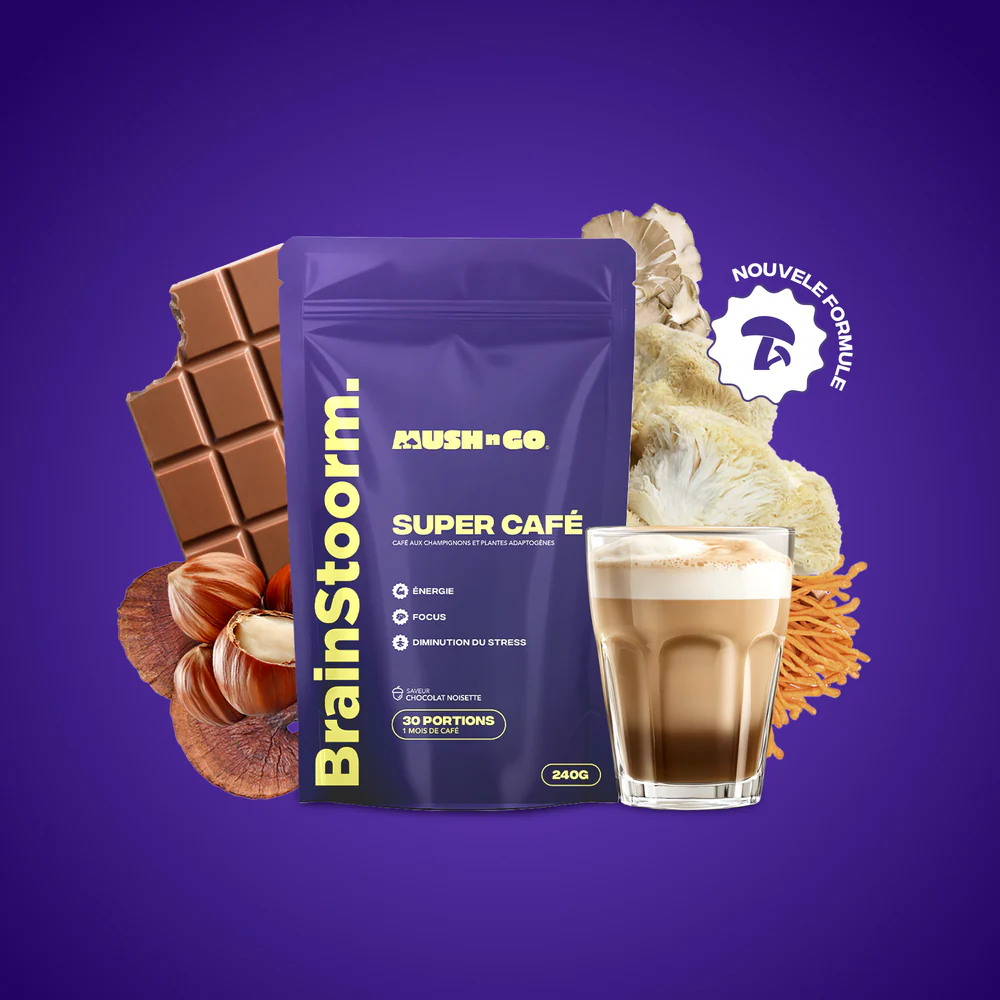
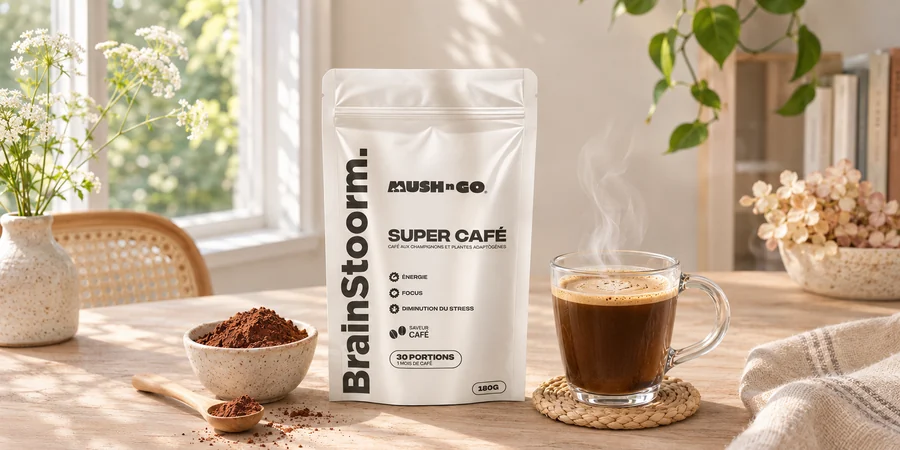
If you want a roasted flavor with a little stimulation, Brainstoorm Coffee by Mush N Go is an option worth a look. It is not coffee: its base is roasted chicory (3,500 mg per cup) with a coffee flavor, enriched with extracts of lion's mane, cordyceps and chaga (1,000 mg declared for each), maca and 40 mg of ashwagandha. Each cup provides 20 mg of caffeine, compared with about 95 mg for a mug of drip coffee, nearly five times less.
Let's be honest: no cortisol measurements have been published on Brainstoorm, and we cannot claim it changes anything about your stress hormone. No health claims are authorized for the mushrooms it contains. What can be verified is that it provides much less caffeine than the doses tested in the studies. The brand recommends one cup per day at most, and advises against it for children and pregnant or breastfeeding women; if you are on medication, ask your doctor. Expect to pay €42.71 for 30 servings at the reference price (indicative price checked on November 12, 2026), with 10% off with the partner code LMC15 at the Mush N Go store. More details on the Brainstoorm Coffee product page. ☕
What about ashwagandha for stress?
It is the most studied herb for stress, and two trials measured a drop in cortisol, but the evidence remains limited and no health claim has been approved for it in Europe to date.
Claims about ashwagandha are among the botanical claims awaiting evaluation at the European level: a manufacturer can use them on its own responsibility, under the transitional measures of Regulation (EC) No 1924/2006, but they are not approved. Here is what the trials actually measured:
- Chandrasekhar et al., 2012: 64 adults under chronic stress, 600 mg per day of a concentrated root extract for 60 days, versus placebo. Stress scores and blood cortisol dropped more in the ashwagandha group. Single-center trial.
- Lopresti et al., 2019: 60 stressed adults, 240 mg per day of another standardized extract for 60 days. A greater drop in clinician-rated anxiety and in morning cortisol, but the effect was only close to significance on another questionnaire. The authors call for larger studies.
Mush N Go designed its Anti-Stress formula for high-pressure periods. One capsule a day provides ashwagandha (5,000 mg dried-herb equivalent, with a 50:1 extraction ratio, or about 100 mg of extract), reishi, holy basil, schisandra and 2 mg of vitamin B6. Note that the dose of ashwagandha extract is well below those of the two trials cited: their results cannot be transposed to it. Vitamin B6, on the other hand, has official claims: it contributes to the regulation of hormonal activity, to the normal functioning of the nervous system and to normal psychological function.
The precautions, which the brand's product page does not display, are those of ANSES (the French food safety agency). In its April 2024 opinion, the agency advises against ashwagandha for pregnant or breastfeeding women, people under 18, people with endocrine disorders (thyroid in particular), liver or heart conditions, and those taking medication that slows down the central nervous system. It also advises against it when driving. These precautions apply to Anti-Stress, and to the ashwagandha in Brainstoorm. To compare options, see our guide to ashwagandha at the pharmacy, our feature on anti-stress herbs and our comparison of anti-stress supplements.
Frequently asked questions about coffee and cortisol
Does coffee make you gain weight because of cortisol?
Nothing shows that it does. In the 2011 trial, caffeinated coffee raised cortisol without changing appetite, the amount eaten at the next meal or blood sugar. We found no study linking morning coffee to belly fat gain through cortisol.
Does decaf coffee raise cortisol?
In Gavrieli's trial, it was caffeinated coffee that stood out from water. Decaf contains about 2 mg of caffeine per mug according to the USDA, very far from the doses that trigger a cortisol response in studies.
Do stress and coffee add up?
Yes, in the lab. In Lovallo's 2006 study, caffeine further raised cortisol that was already elevated by mental stress, and raised it during exercise that did not raise it on its own. On a busy day, there is no point adding extra cups.
What is the best time to drink coffee?
Whenever it does not interfere with your sleep. EFSA states that 100 mg of caffeine close to bedtime can already disrupt sleep in some adults, and a 2013 trial showed that a high dose taken six hours before bed still disturbed sleep. In the morning, the exact time matters much less.
Key takeaways
Caffeine raises cortisol, especially in people who are not used to it and at high doses; in regular drinkers, the effect of the morning coffee fades considerably, without disappearing over the whole day. The rules about coffee on an empty stomach or waiting 90 minutes are not based on trials. What matters is your total caffeine intake and your sleep. If you are dealing with significant or long-lasting stress, talk to a doctor: what you need is medical advice, not a rule about coffee. 🌿
Dietary supplements are not a substitute for a varied, balanced diet and a healthy lifestyle. This article is for information only and does not constitute medical advice.
Scientific references
- Stalder T et al. Assessment of the cortisol awakening response: Expert consensus guidelines. Psychoneuroendocrinology, 2016: pubmed.ncbi.nlm.nih.gov
- Fries E, Dettenborn L, Kirschbaum C. The cortisol awakening response (CAR): facts and future directions. International Journal of Psychophysiology, 2009: pubmed.ncbi.nlm.nih.gov
- Lovallo WR et al. Caffeine stimulation of cortisol secretion across the waking hours in relation to caffeine intake levels. Psychosomatic Medicine, 2005: pubmed.ncbi.nlm.nih.gov
- Lovallo WR et al. Cortisol responses to mental stress, exercise, and meals following caffeine intake in men and women. Pharmacology Biochemistry and Behavior, 2006: pubmed.ncbi.nlm.nih.gov
- Gavrieli A et al. Caffeinated coffee does not acutely affect energy intake, appetite, or inflammation but prevents serum cortisol concentrations from falling in healthy men. Journal of Nutrition, 2011: pubmed.ncbi.nlm.nih.gov
- Cole EL, Grillo AR, Vrshek-Schallhorn S. Habitual Caffeine Use Is Associated With Heightened Cortisol Reactivity to Lab-Based Stress in Two Samples. Psychosomatic Medicine, 2024: pubmed.ncbi.nlm.nih.gov
- Cadegiani FA, Kater CE. Adrenal fatigue does not exist: a systematic review. BMC Endocrine Disorders, 2016: pubmed.ncbi.nlm.nih.gov
- Kim J et al. Association between coffee intake and gastroesophageal reflux disease: a meta-analysis. Diseases of the Esophagus, 2014: pubmed.ncbi.nlm.nih.gov
- Chandrasekhar K, Kapoor J, Anishetty S. A prospective, randomized double-blind, placebo-controlled study of safety and efficacy of a high-concentration full-spectrum extract of ashwagandha root in reducing stress and anxiety in adults. Indian Journal of Psychological Medicine, 2012: pubmed.ncbi.nlm.nih.gov
- Lopresti AL et al. An investigation into the stress-relieving and pharmacological actions of an ashwagandha (Withania somnifera) extract. Medicine (Baltimore), 2019: pubmed.ncbi.nlm.nih.gov
- ANSES, Opinion on the risks associated with the consumption of food supplements containing ashwagandha, request 2021-SA-0077, April 19, 2024: anses.fr
- EFSA, EFSA explains risk assessment: caffeine, 2015: efsa.europa.eu
- Drake C, Roehrs T, Shambroom J, Roth T. Caffeine effects on sleep taken 0, 3, or 6 hours before going to bed. Journal of Clinical Sleep Medicine, 2013: pubmed.ncbi.nlm.nih.gov
- Regulation (EU) No 432/2012 establishing a list of permitted health claims made on foods: eur-lex.europa.eu

LMC content is written by our editorial team from the information published by the brands. Scores out of 10 follow a public grid of 5 criteria*, supplemented by LMC’s editorial assessment.
To support LMC, some links are affiliate links: LMC earns a commission at no extra cost to you, and some of the brands featured are partners. By using the site, you accept our terms of use and our editorial policy.