
Where to buy ashwagandha: pharmacy, drugstore or supermarket?
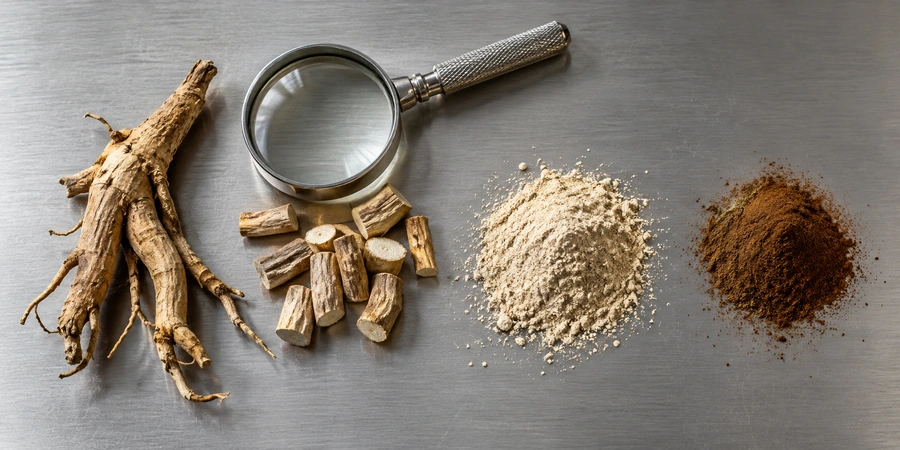
Ashwagandha (Withania somnifera) is sold as a dietary supplement, not as a medicine. No prescription is needed, and the rules are the same everywhere: the plant appears on the list of plants permitted in supplements published by the DGCCRF (the French consumer protection authority), and every product must be declared before it goes on the market (decree No. 2006-352). So a box bought at the pharmacy is not "more authorized" than a box bought online.
What really changes from one channel to another:
- Advice: at the pharmacy, the pharmacist knows your medications or can ask about them. With ashwagandha, this is not a minor detail, as we will see below.
- The range: pharmacies mostly stock lab brands (Arkopharma, Granions, Be-Life, Santarome, Nat&Form, Vit'All+), often organic and with KSM-66 extract.
- The price: it varies almost twofold for the same box. Online pharmacies often list prices 15 to 40% below the brand's recommended retail price.
Outside pharmacies, you will also find ashwagandha at Aroma-Zone, in organic stores (Biocoop, Naturalia, La Vie Claire), in supermarket drugstore aisles such as Leclerc or Carrefour, and on Amazon. On marketplaces, check who the actual seller is: a box shipped by an unknown reseller does not offer the same traceability as an identified brand.
Which ashwagandha brands are found in pharmacies, and at what price?
On October 13, 2026, we checked the prices of seven products sold in online pharmacies. To compare like with like, the table shows the amount of extract actually provided per day (at the maximum dose recommended by the brand), the withanolides when they are listed, and the cost per day.
| Brand | Box | Extract per day | Withanolides per day | Price checked | Cost per day |
|---|---|---|---|---|---|
| Arkopharma Arkogélules Bio | 60 capsules | 600 mg of KSM-66 (2 capsules) | 30 mg | €14.50 | €0.48 |
| Granions Bio 1200 mg | 60 tablets | 1,200 mg of KSM-66 (3 tablets) | 60 mg | €16.88 | €0.56 to €0.84 |
| Be-Life 5000 Bio | 90 capsules | 500 mg of 10:1 extract (2 capsules) | 25 mg | €19.90 | €0.44 |
| Santarome Ashwagandha+ 3000 | 60 capsules | 300 mg of extract (2 capsules), plus magnesium | 4.5 mg | €10.96 | €0.37 |
| Nat&Form Bio | 60 capsules | 600 mg of aqueous extract (2 capsules) | 30 mg | €10.69 | €0.36 |
| Vit'All+ Bio 600 mg | 60 capsules | 600 mg of KSM-66 (1 capsule) | 30 mg | €26.00 | €0.43 |
| New Nordic gummies | 60 gummies | 300 mg of extract (2 gummies) | Not listed | €21.10 | €0.70 |
Indicative prices checked on 10/13/2026 in online pharmacies. They change from week to week and from site to site.
Three lessons stand out. Most pharmacy products rely on a KSM-66 root extract at 600 mg per day, the most studied dose. The price per day stays modest, between €0.36 and €0.84. And two products stand out: Santarome, which shows "3,000" but provides 300 mg of extract (we explain why just below), and the New Nordic gummies, more expensive per day and with no withanolides listed.
The Granions ashwagandha is taken with a gradual increase: 1 tablet for the first ten days, then 2, then 3. So the box lasts a month at first, which explains the cost range. Outside pharmacies, Nutrimea, an LMC partner, also offers online an organic KSM-66 at 600 mg per day, sold for €18.90 for a 45-day course (€0.42 per day), with 10% off with the code LMC on nutrimea.com.
Other brands are also found in pharmacies without appearing in our table: Solgar, Waam, Nutrivie (in capsules and ampoules), Pharmanutrics, or Superdiet, which pairs ashwagandha with saffron. Ladrôme offers a liquid version, a fresh plant extract to dilute, handy if you have trouble swallowing capsules but harder to compare in milligrams. Apply the same checklist to them: actual extract, withanolides, price per day.

How to read the label: extract, plant equivalent and withanolides?
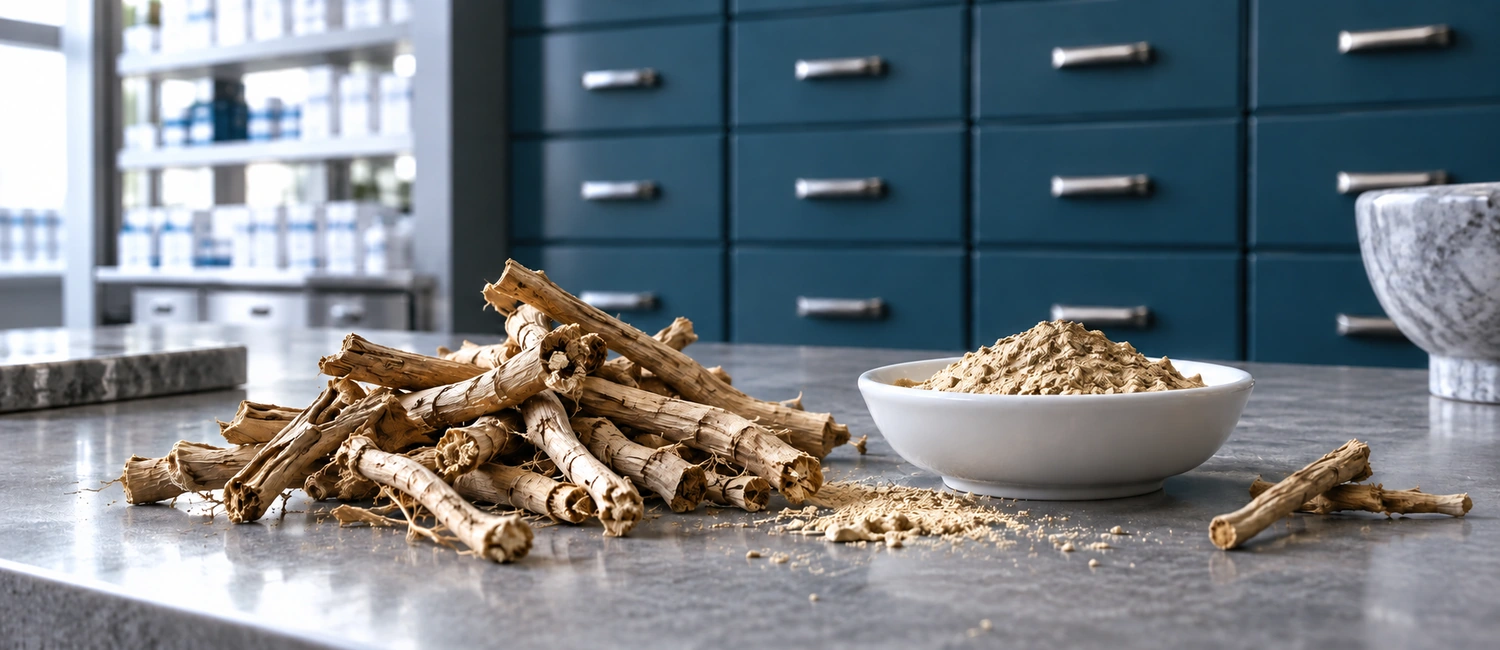
Ashwagandha, also called Indian ginseng (with no botanical link to true ginseng), is an Ayurvedic plant of which mainly the root is used. On a box, you will find it in three forms: root powder (the root simply ground), extract (the root's compounds concentrated), and standardized extract, whose withanolide content is guaranteed. Withanolides serve as a quality marker: they are the most studied family of compounds in the plant.
The name KSM-66 comes up everywhere in pharmacies. It is a patented, root-only extract, standardized to at least 5% withanolides. It is not a guarantee of results, but it is a quality benchmark that stays consistent from one brand to another.
The real trap is the dried plant equivalent. An extract concentrated 10 times (10:1 ratio) allows a box to say "2,500 mg" when the capsule contains 250 mg of extract. It is legal, but misleading if you compare figures that do not measure the same thing:
- Santarome shows "3,000": in reality 300 mg of extract for 2 capsules, and 4.5 mg of withanolides.
- Be-Life shows "5000": 2 capsules of 250 mg of a 10:1 extract, or 500 mg of extract and 25 mg of withanolides.
- Conversely, Vit'All+ shows "600 mg" and does provide 600 mg of KSM-66 extract in a single capsule.
💡 The foolproof method: look on the label for the "extract" line and the "of which withanolides" line for the daily dose, then divide the price by the number of days. Organic is a plus for farming, not a guarantee of dosage.
What dose of ashwagandha should you take, and at what time of day?
Clinical trials give a benchmark. In the often-cited 2012 study, 64 adults took 300 mg of root extract twice a day for 60 days, or 600 mg per day. A 2022 meta-analysis pooling 12 trials and just over 1,000 participants places the doses studied between 300 and 600 mg of extract per day, and its authors rate the certainty of the evidence as low. In other words, the research exists, but it remains limited.
On the manufacturers' side, dosages revolve around these amounts: Arkopharma recommends 2 capsules in the morning with a meal, Vit'All+ one capsule a day, Granions a gradual increase spread across morning, noon and evening. Taking it with a meal is the most common approach. Morning or evening? Both are done, but if the plant makes you drowsy, avoid taking it before driving. To learn more about what is known about the plant, read our article on the benefits of ashwagandha.
The form matters less than the dose. Capsules and tablets are the easiest to dose; gummies are pleasant but often provide less extract and contain sweeteners (maltitol and erythritol in New Nordic's); root powder mixes into a drink, but you need much more of it to match an extract. As for duration, follow what the box says, take breaks and talk to a healthcare professional before going beyond a few months.
What precautions does ANSES recommend before taking it?
At the request of the DGCCRF, ANSES (the French food safety agency) published a full opinion on ashwagandha in dietary supplements on April 19, 2024. It recommends avoiding it in the following cases:
- ⚠️ thyroid, liver or heart disease, and hyperandrogenism;
- pregnancy;
- sedative treatment or treatment that depresses the central nervous system;
- as a precaution, breastfeeding and under 18.
The agency also calls for caution with certain medications (tell your doctor you are taking it), and its experts advise against ashwagandha when driving or operating machinery, due to sedative effects observed in trials. It states that it was unable to define a risk-free dose. Its nutrivigilance system received 8 reports of adverse effects between 2009 and September 2023, and a series of 5 cases of liver injury was published in Iceland and the United States, with test results returning to normal within one to five months.
This is exactly where buying at the pharmacy makes sense: the pharmacist sees your medications and can tell you whether ashwagandha is compatible. Free advice that is worth more than the few euros' difference with an online store.
Why do you read that ashwagandha is banned in France?
It is not. The root appears on the list of plants permitted in dietary supplements published by the DGCCRF, and ANSES issued recommendations, not a ban. The confusion comes from neighboring countries, which are stricter:
- Denmark has considered, since a 2020 assessment, that it should not be used in foods;
- in the Netherlands, the RIVM institute has recommended since 2024 that the entire population avoid it;
- Poland caps withanolides at 10 mg per day;
- in Germany, the BfR recommended as early as 2012 placing the root under monitoring at European level.
When should you prefer a complete formula over ashwagandha alone?
Let's be honest: if your goal is to replicate the doses used in studies, a KSM-66 extract alone at 600 mg per day, like those in the table, remains the logical choice, and the cheapest (between €0.36 and €0.48 per day). A complete formula follows a different logic: combining ashwagandha with other plants, and above all with a nutrient that, for its part, holds an authorized health claim.
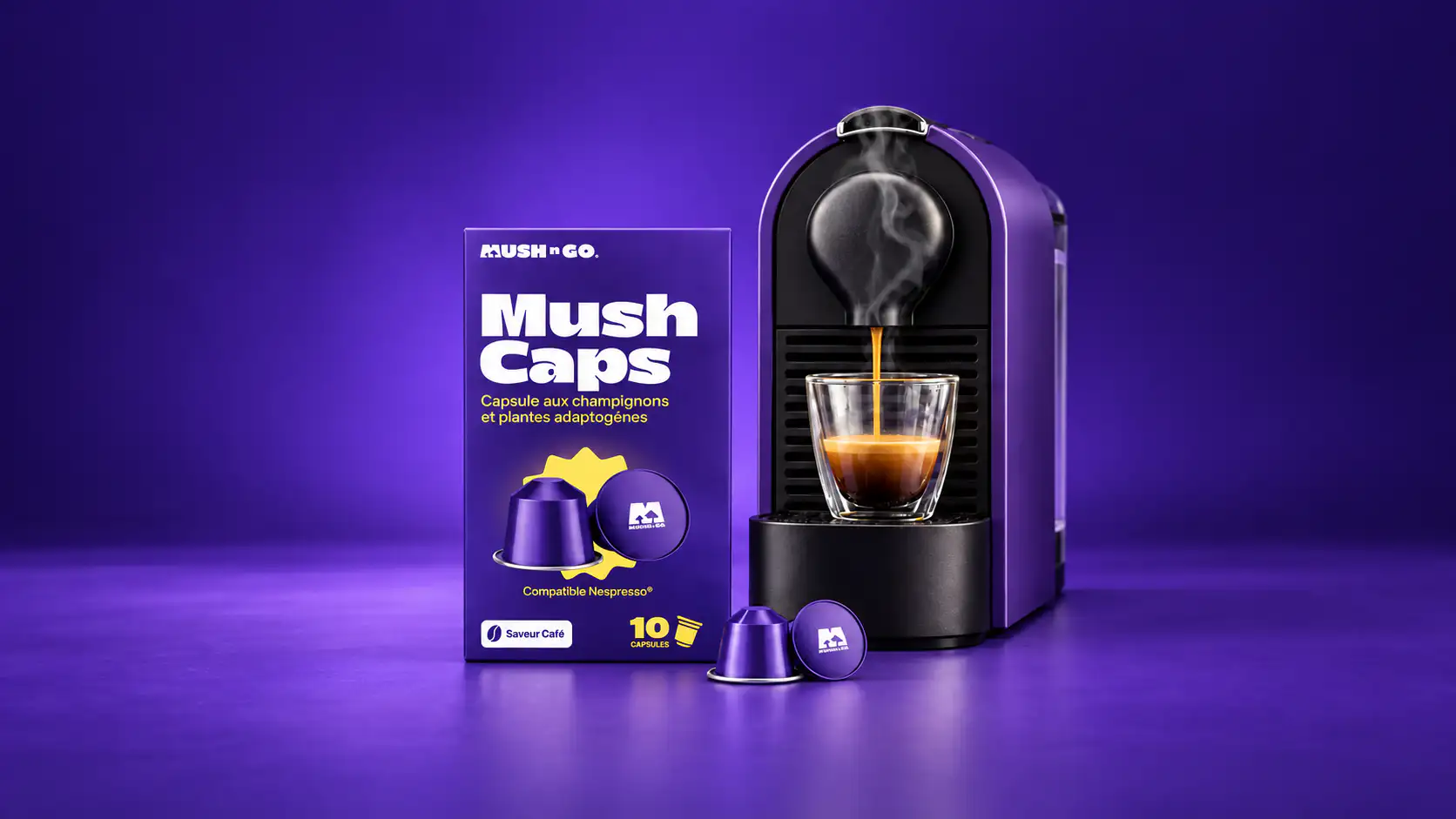
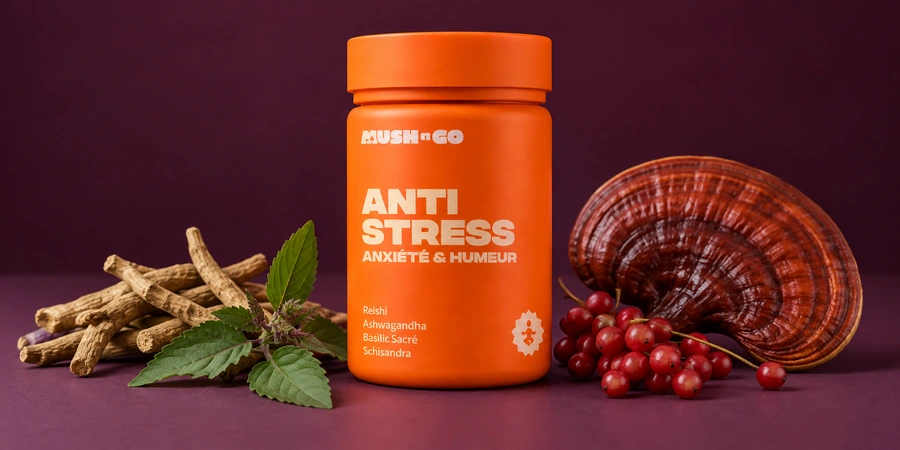
That is the approach of Anti-Stress by Mush N Go, a French formula you will not find in pharmacies (the brand sells direct). What it contains, per capsule, according to the label checked on 10/13/2026:
- ashwagandha: 5,000 mg as dried plant equivalent (50:1 ratio), or about 100 mg of extract and 5 mg of withanolides;
- reishi: 3,000 mg as dried plant equivalent (15:1);
- holy basil (tulsi): 400 mg as equivalent (4:1), schisandra 90 mg, acacia fiber 120 mg;
- vitamin B6: 2 mg, or 143% of the reference intakes.
As you will have noticed: in pure ashwagandha, Anti-Stress is less concentrated than a 600 mg KSM-66, and its 5 mg of withanolides stays below the Polish cap of 10 mg. Its value lies elsewhere: here it is vitamin B6 that carries the only authorized claims. Vitamin B6 contributes to normal psychological function, to the normal functioning of the nervous system, to the reduction of tiredness and fatigue and to the regulation of hormonal activity. Reishi, holy basil and schisandra, for their part, are traditionally used in Asia, with no validated claim in Europe.
The format: 1 capsule per day according to the nutrition table, box of 30, made in Toulouse, vegan and caffeine-free, with a 60-day money-back guarantee. The base price is €42.71 per box (€1.42 per day). As a no-commitment subscription, it drops to €29.90 per month, and to €25.42 with our partner code LMC15 (checked at checkout on 10/13/2026) on mushngo.com. Who does this choice make sense for? Rather for someone looking for a single-capsule routine, with a vitamin whose role is recognized, and who is not aiming for an ashwagandha dose modeled on the trials. Important reminder: it contains ashwagandha, so all of the ANSES precautions apply. To compare with other options, see also our selection of anti-stress herbs.
How do you choose your box of ashwagandha in five checks?
In the aisle or on an online pharmacy, five points are enough:
- ✅ The part of the plant: the root, used traditionally and in most trials.
- Standardized extract: a quantified percentage or amount of withanolides.
- The actual extract dose per day, not the dried plant equivalent highlighted on the front of the pack.
- The warnings: pregnancy, thyroid, medications, and the minimum age shown (some boxes say 15 or 16, ANSES recommends waiting until 18).
- The price per day, calculated on the dose you will actually take.
As a bonus, a clearly identified manufacturer and organic farming. For a selection already sorted by these criteria, see our comparison of the best ashwagandha supplements.
Your questions about ashwagandha at the pharmacy
What is the best ashwagandha at the pharmacy?
There is no universal winner. The most worthwhile one is the one that lists a standardized root extract, an actual extract dose close to 600 mg per day and a reasonable price per day, and that suits your health situation.
Do you need a prescription to buy ashwagandha?
No. It is a dietary supplement, sold over the counter in pharmacies, drugstores, organic stores and online. Asking the pharmacist for advice is still a good idea, especially if you are on medication.
Can you take ashwagandha with antidepressants?
ANSES recommends avoiding it if you are on a sedative treatment or one that depresses the central nervous system, and being cautious with certain medications. If you take an antidepressant, talk to your doctor first.
Can you take ashwagandha every day?
Trials gave it daily, over periods of a few weeks to a few months. Follow the duration stated on the box and check in with a healthcare professional before extending it.
How long does it take for ashwagandha to work?
No serious answer can promise a timeframe. The studies that evaluated it lasted several weeks, 60 days for the 2012 trial, and their authors remain cautious about how robust the results are.
Key takeaways
At the pharmacy, a good ashwagandha can be spotted in thirty seconds: standardized root extract, actual extract dose and price per day. KSM-66 products at 600 mg cost less than 50 cents a day. A complete formula like Anti-Stress meets a different need, thanks to its vitamin B6. In every case, the ANSES opinion applies: when in doubt, ask your pharmacist. 🌿
Dietary supplements should not replace a varied, balanced diet and a healthy lifestyle. This article is for information only and does not constitute medical advice.
Scientific references
- ANSES, Opinion on the risks associated with the consumption of dietary supplements containing ashwagandha (Withania somnifera), request 2021-SA-0077, April 19, 2024: anses.fr
- DGCCRF, List of plants, other than mushrooms, permitted in dietary supplements (January 2019): economie.gouv.fr
- Chandrasekhar K, Kapoor J, Anishetty S. A prospective, randomized double-blind, placebo-controlled study of safety and efficacy of a high-concentration full-spectrum extract of ashwagandha root in reducing stress and anxiety in adults. Indian Journal of Psychological Medicine, 2012: pubmed.ncbi.nlm.nih.gov
- Akhgarjand C et al. Does Ashwagandha supplementation have a beneficial effect on the management of anxiety and stress? A systematic review and meta-analysis of randomized controlled trials. Phytotherapy Research, 2022: pubmed.ncbi.nlm.nih.gov
- Björnsson HK et al. Ashwagandha-induced liver injury: A case series from Iceland and the US Drug-Induced Liver Injury Network. Liver International, 2020: pubmed.ncbi.nlm.nih.gov
- Regulation (EU) No 432/2012 establishing a list of permitted health claims made on foods: eur-lex.europa.eu

LMC content is written by our editorial team from the information published by the brands. Scores out of 10 follow a public grid of 5 criteria*, supplemented by LMC’s editorial assessment.
To support LMC, some links are affiliate links: LMC earns a commission at no extra cost to you, and some of the brands featured are partners. By using the site, you accept our terms of use and our editorial policy.