

What are the symptoms of drinking too much coffee?
Jitters, anxiety, palpitations, sleep problems, stomach aches and headaches are the most common warning signs. They point either to a dose that is too high or to a personal sensitivity to caffeine.
The European Food Safety Authority (EFSA) sums up the short-term negative effects: interrupted sleep, anxiety and changes in behavior. ANSES (the French food safety agency) adds that caffeine raises blood pressure and can lead to tachycardia, which it describes as a classic symptom of caffeine intoxication. Over the long term, EFSA notes that excessive intake has been correlated with cardiovascular problems.
The benchmark to keep in mind: EFSA considers up to 400 mg of caffeine per day safe for a healthy adult, and up to 200 mg in a single dose. A 200 ml cup of drip coffee contains about 90 mg. For the cup-by-cup breakdown, see our guide on how much coffee per day.
| Symptom | What is happening | When to worry |
|---|---|---|
| Jitters, shaky hands, anxiety | Caffeine blocks the relaxing signal of adenosine in the brain | Anxiety attack, feeling of panic |
| Racing heart, palpitations | Rise in blood pressure and heart rate | Chest pain, feeling faint, shortness of breath: call 15 (French emergency number) |
| Trouble falling asleep, broken nights | Caffeine stays active for several hours after the last cup | Insomnia lasting more than a few weeks |
| Heartburn, reflux, rumbling stomach | The effect varies from person to person; weak link with reflux in studies | Frequent pain, vomiting, weight loss |
| Headaches, fatigue | Often a sign of withdrawal, a few hours after the last dose | Unusual or very intense headaches |
This is no fringe phenomenon. According to ANSES, about 30% of French adults exceed the caffeine threshold identified as triggering anxiety, and nearly 7% exceed the threshold above which chronic toxicity is suspected.
Why does coffee make you jittery or anxious?
Because caffeine neutralizes the brain's main natural brake, adenosine. At high doses, the stimulating effect tips over into agitation, and in anxious people it can trigger an attack.
Over the course of the day, adenosine builds up in the brain and activates receptors that promote relaxation and drowsiness. ANSES explains that caffeine works mainly by counteracting this sedative effect. At a low dose, that means alertness. At higher doses, the nervous system goes into overdrive: inner tension, sweaty palms, racing thoughts.
The link with anxiety has been measured. A meta-analysis published in 2022 in General Hospital Psychiatry pooled controlled trials in which people with panic disorder and healthy volunteers were given caffeine or a placebo, at doses of 400 to 750 mg, the equivalent of about five cups. The result: 51% of patients had a panic attack after caffeine (none after placebo), compared with 1.7% of healthy volunteers. Caffeine also increased perceived anxiety in healthy people at these high doses.
Two practical conclusions:
- If you are prone to anxiety or panic attacks, caffeine should be the first thing you cut back on. Talk to your doctor about it.
- If jitters only show up after three or four cups, that is a dose signal, not a disease.

Also read: How much coffee per day without going over the limit. Coffee and cortisol: what the measurements say.
Can coffee make your heart race?
Yes, a high dose of caffeine can speed up your heart, but in most healthy adults, moderate intake does not increase heart rhythm problems. Persistent palpitations, however, should always be checked by a doctor.
ANSES points out that caffeine raises blood pressure and can cause tachycardia, all the more pronounced when the dose is high and the person is not used to it. It notes that alcohol tends to amplify caffeine-induced rhythm disturbances in predisposed people, and that caffeine during physical exertion is a cardiac risk factor for these same people.
The most telling trial was published in 2023 in the New England Journal of Medicine. For 14 days, 100 adults fitted with a continuous electrocardiogram were randomly told each day either to drink coffee or to avoid caffeine. What it showed:
- no significant increase in premature atrial contractions, the primary endpoint (58 per day versus 53);
- more premature ventricular contractions on coffee days (154 versus 102 per day);
- more steps during the day, but 36 minutes less sleep the following night.
In other words, coffee is not the enemy of a healthy heart it is sometimes made out to be, but it can make "skipped beats" more frequent in some people, and its effects on sleep are clear. If you feel palpitations at rest, irregular ones or ones that come with feeling faint, see a doctor. In case of chest pain, shortness of breath or feeling faint, call 15 or 112 (emergency numbers in France and Europe) right away.

Why is a 4 p.m. coffee still working at bedtime?
Because it takes an average of four hours to eliminate half the caffeine, and up to eight hours in some people. An afternoon coffee is therefore still partly active when you turn off the light.
EFSA gives an average half-life of about four hours in healthy adults, with a range of two to eight hours depending on age, weight, pregnancy, medication or liver health. Let's do the math with a mug of drip coffee, about 95 mg:
| Time | Average elimination (4-hour half-life) | Slow elimination (8-hour half-life) |
|---|---|---|
| 4 p.m., the coffee | 95 mg | 95 mg |
| 8 p.m. | About 48 mg | About 67 mg |
| Midnight | About 24 mg | About 48 mg |
The calculation is simplified, but it gives the right picture: in someone who eliminates caffeine slowly, the equivalent of half a coffee is still there at bedtime. And EFSA states that 100 mg close to bedtime can already change the length and structure of sleep in some adults. ANSES confirms caffeine's well-known effects on sleep: delayed sleep onset, shorter and lower-quality sleep.
A trial published in 2013 in the Journal of Clinical Sleep Medicine confirmed this at home. A 400 mg dose taken at bedtime, three hours or six hours before, disrupted sleep in all three cases compared with a placebo. The authors conclude that a large dose of caffeine should be avoided at least six hours before bedtime.
People don't always make the connection: you fall asleep, but your sleep is lighter, and you reach for one more coffee the next day. If you are sleeping badly, try a week with no caffeine after lunch.
Can coffee give you a stomach ache?
In some people, yes, but the link between coffee and reflux is weaker than you often read: large analyses find either no association or a modest one. It comes down to individual tolerance.
A 2014 meta-analysis pooling 15 case-control studies found no significant association between coffee consumption and gastroesophageal reflux. A larger meta-analysis, published in 2026 and covering 40 studies and more than 122,000 people, found reflux slightly more common in coffee drinkers (34.9% versus 30.7%), but its authors consider the clinical relevance of this gap uncertain and do not recommend that everyone give up coffee.
In practice, if your stomach complains:
- try a week without coffee on an empty stomach, drinking it after you eat;
- compare with decaf to find out whether it is the caffeine or the drink itself;
- cut down on large servings, which are often poorly tolerated.
Frequent heartburn, pain that wakes you up at night, vomiting or weight loss are not a coffee issue: see a doctor.
How do you tell too much coffee from caffeine sensitivity?
If symptoms appear after just one or two cups, it is probably a sensitivity; if they only appear after four or five, it is too high a dose. Genetics explains a large part of these differences.
A review published in 2018 in Pharmacological Reviews notes that one enzyme, cytochrome CYP1A2, processes about 95% of the caffeine you ingest, and that its genetic variations make elimination very different from one person to the next. Other variations affect the adenosine receptor targeted by caffeine, which changes sensitivity to its effects on sleep and anxiety. ANSES adds that certain conditions slow down caffeine elimination: liver disease, high blood pressure, psychiatric disorders, ulcers.
A simple way to find out:
- For one week, write down every caffeinated drink, its time and its volume, and the symptoms you feel.
- If jitters or palpitations follow your first cup in the morning, your personal threshold is low.
- If they only come late in the day, after several cups, the cumulative dose is the problem.
- If headaches and fatigue show up on weekends or when you skip a coffee, it is more likely withdrawal.
That last point often comes as a surprise. A landmark 2004 review established that caffeine withdrawal causes headaches, fatigue, drowsiness, irritability and trouble concentrating, 12 to 24 hours after the last dose, sometimes with a habitual intake as low as 100 mg per day. Finally, in a minority of people, consumption becomes hard to control despite the problems it causes: the DSM-5, the American classification of mental disorders, has listed "caffeine use disorder" among the conditions that require further research.

What should you do when you have had too much coffee?
Stop all caffeine for the rest of the day, drink water, move gently and wait: the effects fade as your body eliminates the caffeine, within a few hours. Some signs, however, mean you should call emergency services.
If you have downed cup after cup and you are shaking, your heart is racing or you feel agitated:
- don't have any more coffee, tea, cola or energy drinks;
- drink water and eat something if you have an empty stomach;
- walk a little or breathe slowly to bring the tension down;
- avoid alcohol, which ANSES advises against combining with caffeine.
Call 15 or 112 (emergency numbers in France and Europe) in case of chest pain, feeling faint, difficulty breathing, confusion or seizures. These situations are rare with coffee, but they should never be handled alone. If a child has swallowed a caffeinated product, contact a poison control center.

What can replace your morning coffee when you drink too much?
A hot drink that keeps the ritual with less caffeine: decaf, tea, pure chicory or a low-caffeine chicory-based drink. The goal is to lower your daily total, not to find a miracle fix.
In the morning, it is often the ritual that matters: the hot cup, the roasted aroma, a moment to yourself. Several options let you keep it while cutting back on caffeine.
| Drink | Caffeine per cup | What you need to know |
|---|---|---|
| Drip coffee (237 ml mug) | About 95 mg (USDA) | The benchmark to replace |
| Black tea (220 ml) | About 50 mg (EFSA) | Half the caffeine, different taste |
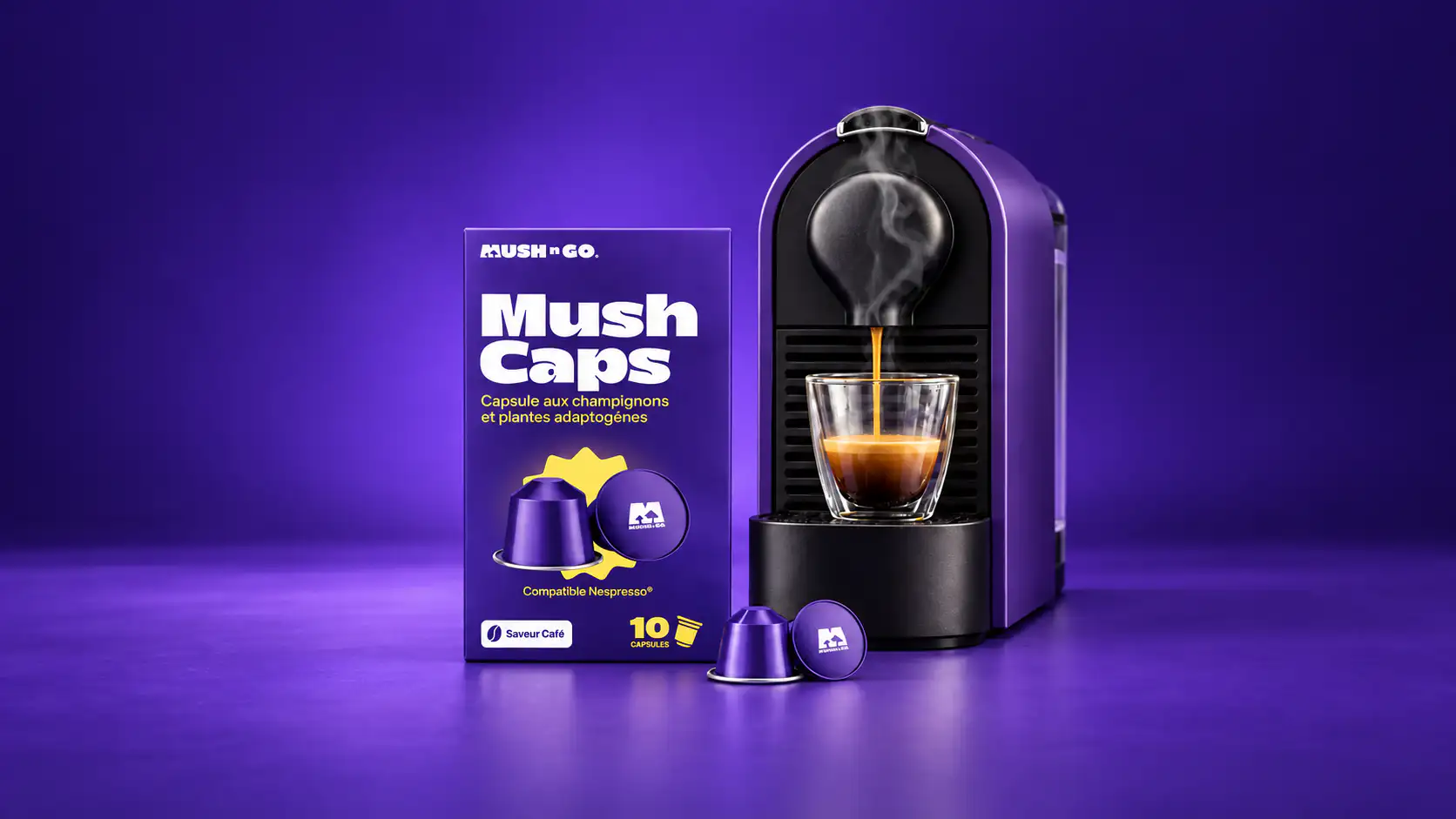
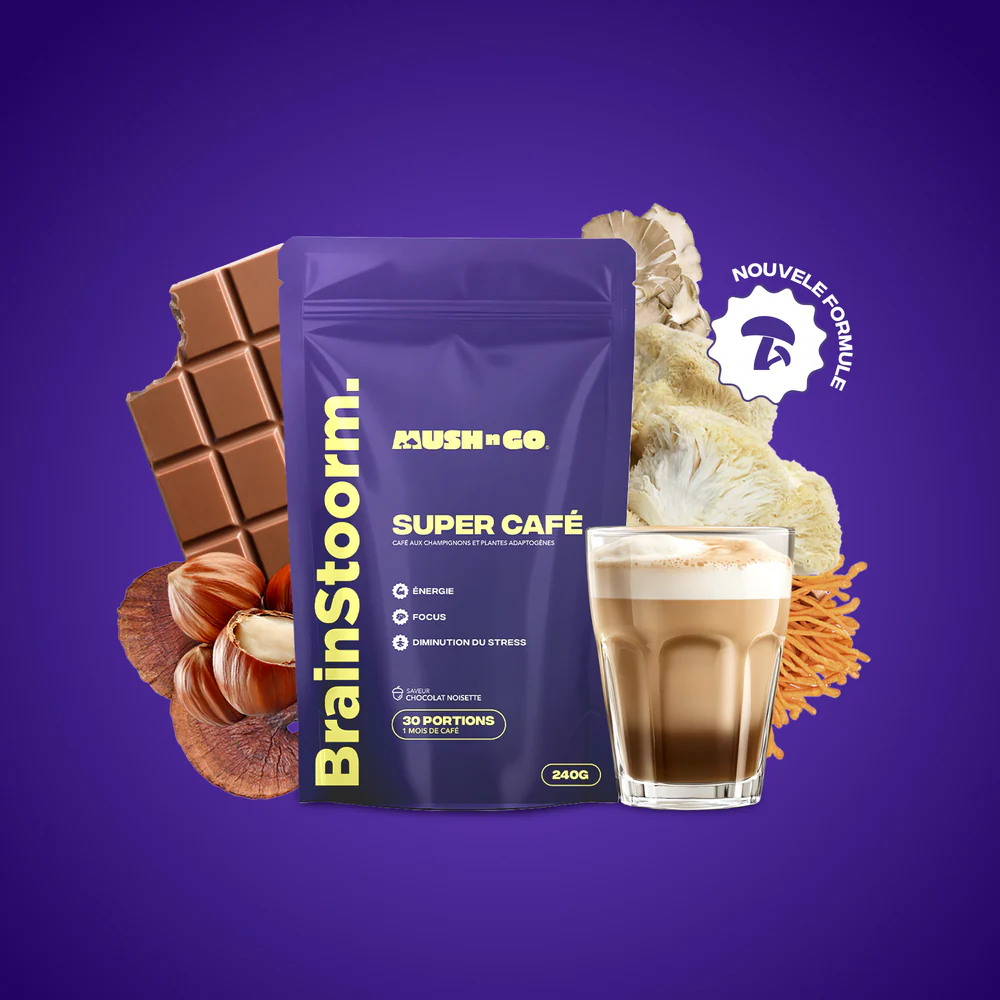
| Brainstoorm Coffee (Mush N Go) | 20 mg (brand's product sheet) | Chicory base with coffee flavor, 1 cup per day maximum |
| Decaf coffee (237 ml) | About 2 mg (USDA) | Same taste, almost no caffeine |
| Pure chicory | No caffeine | Similar roasted taste, no stimulating effect |
Among these options, Brainstoorm Coffee by Mush N Go is aimed at people who want to keep a little stimulation without the load of a coffee. It is not coffee: its base is roasted chicory (3,500 mg per cup) with a coffee flavor, enriched with extracts of lion's mane, cordyceps and chaga (1,000 mg declared for each), maca and a little ashwagandha. Each cup provides 20 mg of caffeine, compared with about 95 mg for a mug of drip coffee. Swapping your morning mug for a cup of Brainstoorm therefore takes about 75 mg off your daily total.
Let's be precise: we cannot promise this drink will make your symptoms go away, and no health claims are authorized for the mushrooms it contains. What can be measured is the drop in caffeine. The brand recommends one cup per day at most, and advises against it for children and pregnant or breastfeeding women; if you are on medication, ask your doctor. Expect to pay €42.71 for 30 servings at the reference price (indicative price checked on November 12, 2026), with a 60-day guarantee, and 10% off with the partner code LMC15 at the Mush N Go store. Our detailed Brainstoorm review and the Brainstoorm Coffee product page cover the rest of the details. ☕
Frequently asked questions about too much coffee
How many cups of coffee a day is too many?
For a healthy adult, EFSA sets the limit at 400 mg of caffeine per day, about four 200 ml cups of drip coffee or five 60 ml espressos. During pregnancy and breastfeeding, the limit is 200 mg. If you get symptoms below that, it is already too much for you.
Can too much coffee make you tired?
Yes, indirectly. Caffeine shortens and lightens sleep, as the New England Journal of Medicine trial showed (36 minutes less sleep on coffee days). Next-day fatigue pushes you to have another coffee, and withdrawal itself also causes fatigue and drowsiness.
How long do the effects of too much coffee last?
A few hours in general. With an average half-life of about four hours according to EFSA, half the caffeine is eliminated in four hours in most adults, but it can take up to eight hours in some.
Does decaf coffee cause the same symptoms?
Not the ones that come from caffeine: the USDA measures about 2 mg per mug of decaf. If your stomach also reacts to decaf, the cause is probably the drink itself rather than the caffeine.
Are mushroom or chicory-based drinks risk-free?
These drinks contain less caffeine, but they come with their own precautions, linked to the added herbs and mushrooms. Read our article on Mush N Go side effects and contraindications before you get started.
Key takeaways
Jitters, palpitations, poor sleep and a sensitive stomach are the most common signs of too much coffee. Compare them with how much you actually drink: above 400 mg per day, it is the dose; below that, it is your sensitivity. Cut back gradually, stop caffeine after lunch, and get medical advice if symptoms persist or worry you. 🌿
Dietary supplements are not a substitute for a varied, balanced diet and a healthy lifestyle. This article is for information only and does not constitute medical advice.
Scientific references
- EFSA, EFSA explains risk assessment: caffeine, 2015: efsa.europa.eu
- ANSES, Caffeine: our advice for avoiding adverse effects, September 30, 2022: anses.fr
- Marcus GM et al. Acute Effects of Coffee Consumption on Health among Ambulatory Adults. New England Journal of Medicine, 2023: pubmed.ncbi.nlm.nih.gov
- Klevebrant L, Frick A. Effects of caffeine on anxiety and panic attacks in patients with panic disorder: A systematic review and meta-analysis. General Hospital Psychiatry, 2022: pubmed.ncbi.nlm.nih.gov
- Drake C, Roehrs T, Shambroom J, Roth T. Caffeine effects on sleep taken 0, 3, or 6 hours before going to bed. Journal of Clinical Sleep Medicine, 2013: pubmed.ncbi.nlm.nih.gov
- Kim J et al. Association between coffee intake and gastroesophageal reflux disease: a meta-analysis. Diseases of the Esophagus, 2014: pubmed.ncbi.nlm.nih.gov
- Muftah M et al. Association of Coffee Intake With Risk of Gastroesophageal Reflux Disease and Complications: A Systematic Review and Meta-Analysis. Clinical and Translational Gastroenterology, 2026: pubmed.ncbi.nlm.nih.gov
- Nehlig A. Interindividual Differences in Caffeine Metabolism and Factors Driving Caffeine Consumption. Pharmacological Reviews, 2018: pubmed.ncbi.nlm.nih.gov
- Juliano LM, Griffiths RR. A critical review of caffeine withdrawal. Psychopharmacology, 2004: pubmed.ncbi.nlm.nih.gov
- Meredith SE, Juliano LM, Hughes JR, Griffiths RR. Caffeine Use Disorder: A Comprehensive Review and Research Agenda. Journal of Caffeine Research, 2013: pubmed.ncbi.nlm.nih.gov
- USDA FoodData Central, entries 171890 (drip coffee) and 171889 (decaffeinated coffee): fdc.nal.usda.gov

LMC content is written by our editorial team from the information published by the brands. Scores out of 10 follow a public grid of 5 criteria*, supplemented by LMC’s editorial assessment.
To support LMC, some links are affiliate links: LMC earns a commission at no extra cost to you, and some of the brands featured are partners. By using the site, you accept our terms of use and our editorial policy.