


Which plant does tea tree essential oil come from, and what does it contain?
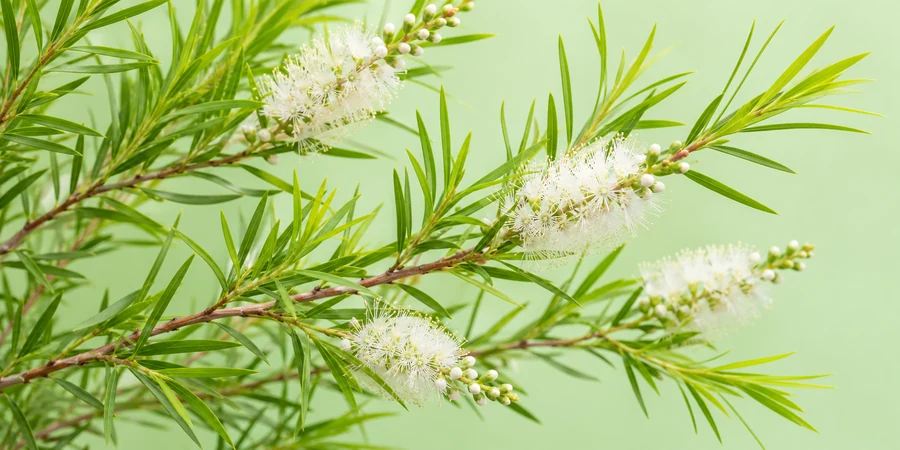
Tea tree is the essential oil obtained from the leaves of Melaleuca alternifolia, an Australian tree in the Myrtaceae family. Its main component is terpinen-4-ol.
Despite its name, this tree has nothing to do with the tea plant, Camellia sinensis: the oil is not made into a herbal tea 🌿. The full botanical name is Melaleuca alternifolia (Maiden & Betche) Cheel, and the oil is most often obtained by steam distillation.
Anses describes three substances worth knowing about: terpinen-4-ol, which dominates the composition, methyleugenol, present in very small amounts, and ascaridole, which is not there originally but forms when the oil is poorly stored. The composition varies with where the plant is grown and the harvest, and the agency stresses that it is hard to know the chemotype of an oil sold in stores.
The plant is listed in Annex I of the French decree of June 24, 2014, which lists the plants that can be used in a dietary supplement (leaf, stem and twig, with eucalyptol and sesquiterpenes to be monitored). That doesn't settle everything: it is the intended use of the product, as a food or a cosmetic for example, that determines which rules apply, Anses points out.
What are the benefits of tea tree, and what do studies really say?
Studies mostly focus on the skin and show modest results, under specific conditions. They do not allow anyone to promise a benefit to people using an over-the-counter bottle.
We describe what researchers have measured, with the size of the trials and their limitations, without turning it into a promise.
In the lab: what researchers have measured
The review by Carson, Hammer and Riley (2006, Clinical Microbiology Reviews) brings together laboratory work in which the oil and its components act on various microorganisms and on certain mechanisms of inflammation. These are in vitro tests, outside a living organism: they say nothing about what happens on human skin.
The authors are cautious: in their view, clinical evidence of effectiveness against bacterial, fungal or viral infections is lacking, and they call for large randomized trials.
Acne: a 2026 meta-analysis to read without too much enthusiasm
Ye and colleagues (2026, Phytotherapy Research) pooled 7 studies and 445 patients with acne. Tea tree oil was associated with lower severity than in the comparison groups (odds ratio of 0.74, 95% confidence interval of 0.63 to 0.88), with side effects that were mostly local and mild.
The authors themselves describe a modest reduction and call for larger trials with standardized formulations. These results therefore do not automatically carry over to an over-the-counter bottle. If you have acne, the advice of a doctor or dermatologist comes before any DIY experiment.
Athlete's foot: a trial of 158 patients, with a caveat
Satchell and colleagues (2002, Australasian Journal of Dermatology) ran a randomized, double-blind, placebo-controlled trial in 158 patients with athlete's foot between the toes. Solutions containing 25% and 50% oil were applied twice a day for 4 weeks. A marked clinical response was seen in 72% and 68% of patients, versus 39% on placebo, and cultures of skin samples were negative in 64% of the 50% group, versus 31%.
There is a twofold caveat. These solutions were highly concentrated and prepared for the trial: they are not directions for consumer use. And four patients (3.8%) developed moderate to severe dermatitis, which improved once they stopped.
What is not proven: colds, sore throats and "does it all"
For respiratory or throat uses, we found no official source that establishes them. Anses instead notes that some consumers misuse these supplements as a medicine against infections, based on properties "claimed in aromatherapy books." So we do not go into them: if a symptom lasts or keeps coming back, that is a job for a doctor or pharmacist.

Also worth reading: stuffy nose at night: causes and evening habits and which essential oils for a sore throat.
How do you use tea tree essential oil on the skin?
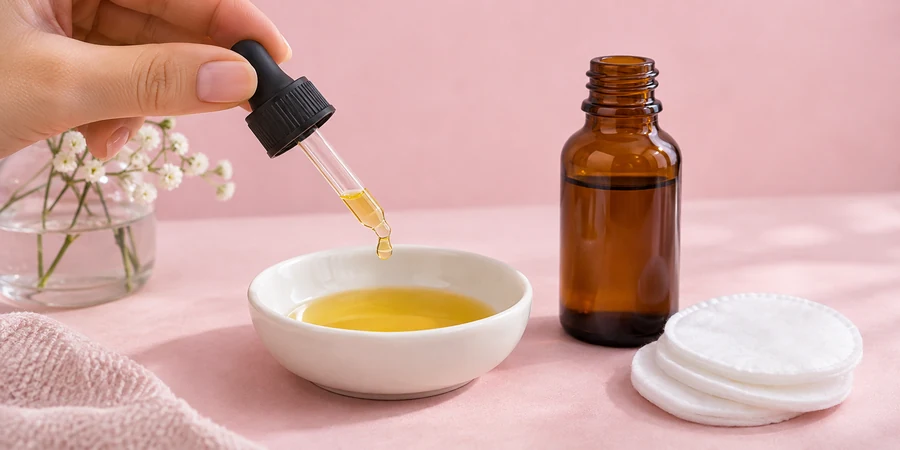
On the skin, tea tree oil is never applied neat or on mucous membranes: it is diluted in a vegetable oil, following the directions on the bottle or a pharmacist's advice, after a patch test.
Pranarôm's organic oil product page presents a dietary supplement and describes directions for oral use, not for the skin. For the skin, the brand therefore gives no instructions on this page: go by the label on the bottle, and ask your pharmacist for advice.
Always diluted, never on mucous membranes
The toxicity review by Hammer and colleagues (2006, Food and Chemical Toxicology) reports that topical use appears relatively safe based on nearly 80 years of anecdotal observations. It does, however, note irritation at high concentrations and allergies in predisposed people, linked to oxidation products. The authors advise applying only diluted oil, avoiding oral use and using a well-stored oil.
Anses adds that an essential oil should never be applied neat on mucous membranes (mouth, nose, eyes) and that you should wash your hands carefully after applying it to the skin. It also notes that some products sold as "essential oil" contain vegetable oil or other ingredients, sometimes over 50%: read the label.
As for dilution, we give no percentage: no official source we read for this article sets one for the general public, and the 25% and 50% used in clinical trials are not usage instructions. A pharmacist will specify it depending on the area, age and skin type, usually in a vegetable oil.
The inner-elbow test and signs of allergy
A patch test in the crook of the elbow is common practice in aromatherapy. We have no official protocol to cite for how long to wait: ask your pharmacist.
The signs described in studies are redness, itching and a burning sensation. If you react, stop, rinse with water and seek medical advice if the reaction is significant or persists.
Tea tree floral water: a different format, different instructions
Floral water, or hydrosol, is the product of distilling the plant, not a diluted essential oil. The product page for Pranarôm's Eau florale de Tea-tree Bio indicates external use (face, body, hair), on a cotton pad or sprayed from about 20 cm (8 inches) away. It adds precautions: not recommended under age 3, avoid the eyes, pressurized container to keep away from heat and out of reach of children.
What are the dangers of tea tree, and what precautions should you take?
The main risk concerns oral use: in 2020, Anses identified carcinogenic, genotoxic and potentially reprotoxic risks for certain compounds. On the skin, the main concerns are irritation and allergy.
Taken orally: the 2020 Anses opinion
⚠️ In its December 2020 opinion, relayed in a news item on December 16, Anses points out that there is no traditional food use of Melaleuca leaves in France. It confirms that oral intake of certain compounds carries carcinogenic, genotoxic and potentially reprotoxic risks.
For tea tree, it cites terpinen-4-ol (testicular toxicity in rats), methyleugenol (very small amounts, but considered genotoxic and carcinogenic to humans) and ascaridole, which appears if the oil is poorly stored. The risk depends on the content levels, the number and size of the drops, and the person's weight. It recommends that manufacturers set a maximum number of drops per day, and advises against consumption by children and by pregnant or breastfeeding women.
The brand's product page includes its own instructions: according to Pranarôm, you should not exceed the recommended dose, use the product for more than 14 days, use it during pregnancy and breastfeeding, or give it to children under 6. We do not repeat any dosage: the risk depends on factors specific to each bottle and each person, and Anses advises talking to a healthcare professional. Regulations also vary from one plant to another: common sage essential oil, for example, is banned in dietary supplements, as explained in our article on sage and menopause.
On the skin: irritation, allergy and poorly stored oil
According to Hammer and colleagues, skin side effects are usually minor, and allergies are mostly linked to oxidized oil that has been exposed to light or air. The athlete's foot trial is a reminder that more pronounced dermatitis is possible: 3.8% of patients. On reactive or damaged skin, ask for advice before any application.
In children: the case of boys before puberty
In 2007, Henley and colleagues (New England Journal of Medicine) described three prepubertal boys whose gynecomastia (development of breast tissue) coincided with the application of products containing lavender and tea tree. It went away after they stopped, and tests on human cells showed estrogenic and antiandrogenic activity for both oils: the authors conclude that the cause is "probable."
These are three cases, with two oils mixed together: no generalization is possible. In any case, Anses advises against essential oils for children, and Pranarôm rules out the oil before age 6 and the floral water before age 3. For a child, ask the pediatrician.
How should you store the bottle to limit oxidation?
Somewhere cool and dark, Anses recommends, which limits the formation of ascaridole. The agency also stresses safety at home: out of reach of children, and never stored with baby care products. In a third of accidents involving children, an essential oil had been given by mistake instead of a medicine, mostly vitamin D.
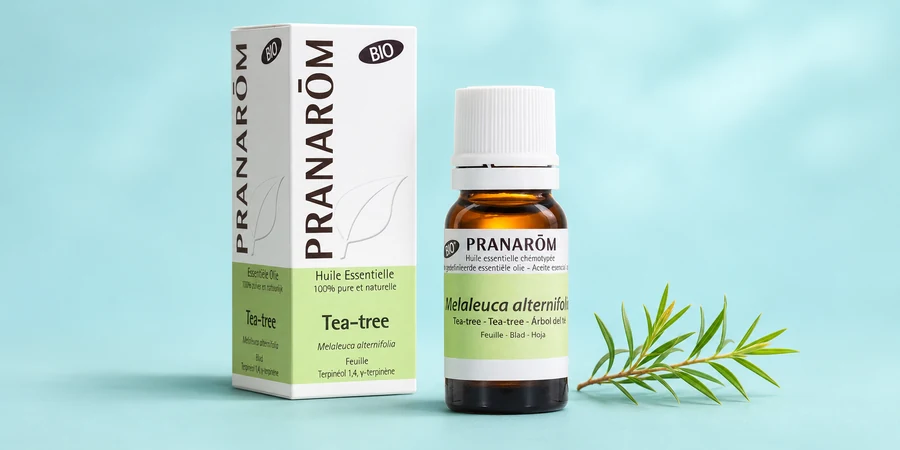
Which tea tree essential oil should you choose: organic, chemotyped, what size?
Check the full Latin name, the plant part used, the stated chemotype and a tinted bottle. A large bottle costs less per milliliter, but stays open longer.
Anses stresses that the chemotype is hard to know for oils sold in stores: so you can favor a product that states it, along with the full Latin name (Melaleuca alternifolia) and the part used. Also check that the oil is clearly presented as pure, with no added vegetable oil.
Pranarôm offers a Huile Essentielle de Tea-tree Bio (organic tea tree essential oil) in 10 ml and a large 30 ml size. According to its official product page, it is 100% organic, pure, whole and chemotyped, with the HECT label. The page presents it as a dietary supplement and makes its own claims (cell protection, the body's defenses, joints): these are the brand's claims, LMC does not repeat them, and no source we read for this article establishes them for tea tree.
| Criterion | Organic essential oil 10 ml |
Organic essential oil 30 ml |
Organic floral water |
|---|---|---|---|
| Indicative price | €7.90 | €17.90 | €12.35 |
| With code LMC (-10%) | €7.11 | €16.11 | €11.12 |
| Price per milliliter (before code) | €0.79 per ml | €0.60 per ml | Size not recorded |
| Status stated on the product page | Dietary supplement | Dietary supplement | External use |
| Age and pregnancy according to the product page | Not under age 6, nor during pregnancy and breastfeeding | Not under age 6, nor during pregnancy and breastfeeding | Not recommended under age 3 |
| Other precautions on the product page | No more than 14 days, away from heat and light, out of reach of young children | No more than 14 days, away from heat and light, out of reach of young children | Avoid the eyes, pressurized container, away from heat, out of reach of children |
Prices are indicative, checked on November 10, 2026, and the price per milliliter is our own calculation. Code LMC gives you 10% off on the Pranarôm website until December 31, 2026 (the "with code" amounts are calculated, so check them in your cart): see the promo code page and our brand page 🧡.
To place an order, you can find organic tea tree at Pranarôm (affiliate link: LMC earns a commission, at no extra cost to you). If you are pregnant, breastfeeding or on medication, or for a child under 6, get advice from a pharmacist or doctor before buying.
Frequently asked questions about tea tree essential oil
Can you swallow tea tree essential oil?
In 2020, Anses identified carcinogenic, genotoxic and potentially reprotoxic risks for certain compounds taken orally, and advises against consumption by children and by pregnant or breastfeeding women. Pranarôm's product page sets its own limits, which we do not turn into advice. Before taking any, ask a pharmacist or doctor for advice.
How many drops of tea tree a day?
We do not give a number. Anses links the risk to the terpinen-4-ol and methyleugenol content, the size of the drops and the person's weight, and asks manufacturers to set a maximum. Only a healthcare professional can tell you whether the brand's limit suits your situation.
Which essential oils are allowed for children?
Anses advises against essential oils for children and pregnant women, notably because of substances that are neurotoxic or toxic to the fetus. For tea tree, Pranarôm rules out the oil before age 6 and the floral water before age 3. A pediatrician or pharmacist can answer case by case.
Does tea tree work on inflammation?
Researchers have studied the oil's action on mechanisms of inflammation, mostly in the lab (review by Carson and colleagues, 2006). None of this translates into a promise for consumers. Red, hot or painful skin calls for medical advice.
What are the possible side effects of tea tree?
On the skin: irritation at high concentrations, allergy linked to oxidized oil and, in the athlete's foot trial, moderate to severe dermatitis in 3.8% of patients. If you react, stop and see a doctor; oral use is covered above.
Can you use tea tree when you are pregnant?
Caution is essential: Anses advises against oral consumption of these oils by pregnant or breastfeeding women, and Pranarôm's product page rules out pregnancy and breastfeeding. For the skin, ask your doctor, midwife or pharmacist for advice.
Key takeaways on tea tree
Tea tree is an oil to handle with care: skin studies with modest results, no promise for consumers, and oral use that Anses warns about.
- Studies involve specific preparations (acne, athlete's foot) and do not carry over to an over-the-counter bottle.
- On the skin: never neat, never on mucous membranes, and ask your pharmacist about dilution and a patch test.
- Taken orally: 2020 Anses opinion, no dosage given here, and advice from a healthcare professional before taking any.
If in doubt, or if you have a lasting symptom, are pregnant, breastfeeding or on ongoing treatment, medical or pharmacist advice remains the first step.
References
- Anses, Dietary supplements containing tea tree, niaouli and cajeput essential oils, news item of December 16, 2020 (December 2020 opinion).
- Anses, Essential oils: risks and precautions, December 17, 2024.
- French decree of June 24, 2014, Annex I, Melaleuca alternifolia: parts used and substances to monitor.
- Carson CF, et al. Melaleuca alternifolia (tea tree) oil: a review of antimicrobial and other medicinal properties. Clin Microbiol Rev, 2006. PMID 16418522.
- Hammer KA, et al. A review of the toxicity of Melaleuca alternifolia (tea tree) oil. Food Chem Toxicol, 2006. PMID 16243420.
- Satchell AC, et al. Treatment of interdigital tinea pedis with 25% and 50% tea tree oil solution. Australas J Dermatol, 2002. PMID 12121393.
- Henley DV, et al. Prepubertal gynecomastia linked to lavender and tea tree oils. N Engl J Med, 2007. PMID 17267908.
- Ye Y, et al. Efficacy and Safety of Melaleuca alternifolia (Tea Tree) Oil for Acne. Phytother Res, 2026. PMID 42098589.
- Pranarôm product pages (organic tea tree 10 ml and 30 ml, floral water), accessed on November 10, 2026.
Dietary supplements are not a substitute for a varied, balanced diet and a healthy lifestyle.

LMC content is written by our editorial team from the information published by the brands. Scores out of 10 follow a public grid of 5 criteria*, supplemented by LMC’s editorial assessment.
To support LMC, some links are affiliate links: LMC earns a commission at no extra cost to you, and some of the brands featured are partners. By using the site, you accept our terms of use and our editorial policy.