

Which essential oils are traditionally used for the throat?
The most frequently cited are peppermint, lemon, oregano and Scots pine, according to brand product pages. None has a proven benefit in the official sources we read: we are talking about traditional uses claimed by manufacturers, never a guaranteed effect.
On Google, the question gets typed a thousand different ways, "essential oil sore throat" or "which essential oil for a sore throat," and the answers all look alike. Official sources, on the other hand, give no ranking: in the two Ameli pages we read for this article, no essential oil appears among the recommendations. The formulas below therefore come from Pranarôm products, as read on their product pages, and the uses described are those the brand claims, on its own responsibility.
Peppermint and lemon: a fresh feeling in the mouth
Peppermint is the oil that gives throat products their fresh feeling. You'll find it in Pranarôm's Aromaforce spray, combined with spearmint, and on the product page for the lozenges, whose refreshing minty taste the brand highlights. Lemon also appears in the spray, in the capsules and on the lozenge product page: the brand describes it as known for its soothing, pleasant effect on the throat, mouth and vocal cords.
That freshness has a downside. The spray's product page advises against using it if you have gastroesophageal reflux, a gastroduodenal ulcer, gastritis, liver or biliary disorders, or a menthol allergy. If any of these applies to you, medical advice comes before choosing a product.
Oregano, Scots pine, savory: the oils of the cold season
Aromaforce products are presented as companions for winter and seasonal changes. The capsules combine oregano essential oil with lemon essential oil, and the brand says oregano is traditionally used for the respiratory tract. The spray adds Scots pine, winter savory, Chinese cinnamon and rosemary to the mint and lemon.
These are concentrated oils, sold as dietary supplements with short usage periods. These claims are the brand's, not promises from LMC, and a "traditional" oil is not, for all that, an oil that needs no precautions.
Tea tree: why oral use is avoided
Tea tree comes up very often in searches about the throat. On oral use, ANSES (the French food safety agency) is clear. In its 2020 assessment, the agency points out that there is no traditional food use of Melaleuca leaves in France, and that oral intake of certain compounds in these oils carries carcinogenic, genotoxic and potentially reprotoxic risks.
It advises against this consumption for children, pregnant women and breastfeeding women, and notes that these supplements are sometimes misused even though they are not medicines. We therefore give no dose of tea tree to swallow. If you are still considering a product that contains it, talk to your pharmacist first.

How do you use an essential oil for the throat without taking risks?
Follow the directions of a pre-dosed product, never put a neat oil on mucous membranes and stop at the stated duration. ANSES advises against essential oils for children and pregnant women.
Oral use: dose and duration matter
ANSES puts it simply: essential oils concentrate a variable mix of substances that can turn out to be toxic to health. It asks you to follow the conditions of use, never to apply a neat oil to mucous membranes and to ask a healthcare professional for advice before any use. In other words, "natural" doesn't mean "no limits."
The durations shown by brands are ceilings, not targets. They are also consistent with Ameli's rule: if a sore throat does not improve after five days of self-medication, see a doctor. As for homemade mixtures (a drop on a sugar cube, in honey), they circulate widely online, but no official source we read endorses them. We do not go into them.
Spray, lozenge, capsule: pre-dosed forms
For tea tree, ANSES stresses that the risk depends on the number of drops swallowed and the size of the drops delivered by the bottle. This applies to any dropper: a drop varies from one bottle to another. A pre-dosed form, where the manufacturer sets the amount of oil per dose, removes that uncertainty.
The durations stated by Pranarôm are short: 7 days for the capsules and the spray, 5 to 7 days for the lozenges (14 days maximum). Details for each product appear below. In any case, do not combine several essential oil products without your pharmacist's advice: ANSES recommends avoiding taking several dietary supplements at the same time.
What to avoid: neat oil on mucous membranes, continuous diffusion
Putting a neat drop in your mouth or at the back of your throat is a no-go: ANSES advises against it for mucous membranes. As for the air, its work on sprays and diffusers notes irritation of the eyes, nose and throat under normal conditions of use, and recommends airing out the room. People with asthma are particularly concerned. So it's best to avoid diffusing continuously in a closed room 🌿
Store bottles out of reach of children, and never with baby care products. In a third of the accidents involving children reported by ANSES, an essential oil had been given by mistake instead of a medicine, mostly vitamin D.


Also worth reading: stuffy nose at night: causes and evening habits and tea tree essential oil: uses and precautions.
Which form should you choose: Pranarôm Aromaforce capsules, spray or lozenges?
All three products are for adults and teenagers only: 18 and over for the capsules and the spray, 12 and over for the lozenges. The choice mostly comes down to your stomach, your age and the form you tolerate.
Pranarôm is a Belgian aromatherapy laboratory, founded in 1991 by pharmacist Dominique Baudoux. Its Aromaforce range brings together its products for the respiratory tract. The full product pages (ingredients, precautions, legal notices) can be read on the brand's official website, https://pranarom.fr/, and should be reread before any purchase. To learn more about the brand, see also our page dedicated to Pranarôm.
Prices checked on the online store on 11/10/2026, given as a guide, with the price after code LMC (-10%) calculated by us.
| Criterion | Capsules Nez-Gorge Bio | Spray gorge apaisant Bio | Pastilles gorge |
|---|---|---|---|
| Indicative price | €10.90 (30 capsules) | €9.50 (15 ml) | €7.80 |
| Price with code LMC (indicative) | €9.81 | €8.55 | €7.02 |
| Essential oils listed on the product page | Oregano, lemon | Peppermint, spearmint, Scots pine, winter savory, Chinese cinnamon, lemon, rosemary | Varies by product: check the ingredients on the packaging |
| Age | 18 and over | 18 and over | 12 and over |
| Brand directions for use | 1 capsule with a meal, 3 times a day, 7 days | Up to 3 sprays, 3 to 8 times a day, 7 days maximum | 1 lozenge to suck, 5 times a day, 5 to 7 days (14 days maximum) |
| Pregnancy and breastfeeding | Do not use (product page) | Do not use (product page) | Do not use (product page) |
| Other precautions on the product page | Read the full precautions section; do not combine with other essential oil capsules | Not recommended with reflux, ulcer, gastritis, liver or biliary disorders, menthol allergy | Contains sweetener: excessive consumption may have a laxative effect |
Capsules Nez-Gorge aux Huiles Essentielles Bio (organic nose and throat capsules)
For three capsules, the product page lists 210 mg of oregano essential oil and 15 mg of lemon, in organic rapeseed oil, in a gelatin capsule. The brand claims they support respiratory tract health and soothe the throat: that is its claim, not ours. They are taken at the start of or during a meal, with a little water.
A box of 30 capsules covers a full 7-day course at three a day, or 21 capsules. For adults only, they are ruled out during pregnancy and breastfeeding, and the precautions section contains other exclusions: reread it in full before ordering.
Spray gorge apaisant aux Huiles Essentielles Bio (organic soothing throat spray)
The spray is sold as a dietary supplement made with organic essential oils. The brand writes that it soothes the throat, and intends it for the winter season, seasonal changes or heavy use of the voice. It is used 3 to 8 times a day, with up to 3 sprays each time, the nozzle held horizontally, pointed toward the throat, mouth wide open.
Precautions on the product page: 7 days maximum, not during pregnancy or breastfeeding, not under 18, not recommended with reflux, ulcer, gastritis, liver or biliary disorders, or a menthol allergy. The brand also recommends that a spray stays personal, to avoid any risk of spreading germs.
Pastilles gorge (throat lozenges)
The brand presents its lozenges as a way to help soothe the pharynx, vocal cords and throat, with a refreshing minty taste. They can be taken from age 12: one lozenge to suck, five times a day, for 5 to 7 days, without exceeding 14 days of use in total. Since the store offers more than one lozenge product, check the ingredients printed on the packaging you receive.
Precautions on the product page: not during pregnancy and breastfeeding, not under 12, contains sweetener, which may have a laxative effect if consumed in excess. If you follow a special diet, ask your pharmacist for advice.
To compare the three product pages side by side, you can check out the Aromaforce range at Pranarôm. This is an affiliate link (LMC earns a commission, at no extra cost to you). Code LMC gives you 10% off until 12/31/2026; according to our Pranarôm promo code page, it cannot be combined with other promotions.
What else can you do besides using an essential oil when your throat stings?
Drink in small sips, suck a lozenge or a candy, don't strain your voice and keep the room between 18 and 20 °C (64 to 68 °F): these are the steps Ameli recommends.
Ameli points out that most sore throats are not serious and go away on their own within a few days. The steps it suggests are simple and require no particular product.
- Suck lozenges or candies: according to Ameli, it is the production of saliva that helps calm the throat.
- Drink plenty of water, in small sips, and favor cool, easy-to-swallow foods.
- Avoid drinks and food that are too hot or irritating, and don't clear your throat.
- Rest your voice: straining it increases the pain.
- Stop smoking, and don't expose a child to tobacco smoke.
- Air out the bedroom often, keep it between 18 and 20 °C (64 to 68 °F), and avoid cold and drafts.
Your pharmacist is also a good first port of call. If the symptoms suggest strep throat, they can perform a rapid diagnostic test (TROD) without a prescription for adults and children aged 10 and over, after checking that there are no eligibility exclusions. They will also tell you which medicines are suitable for self-medication.
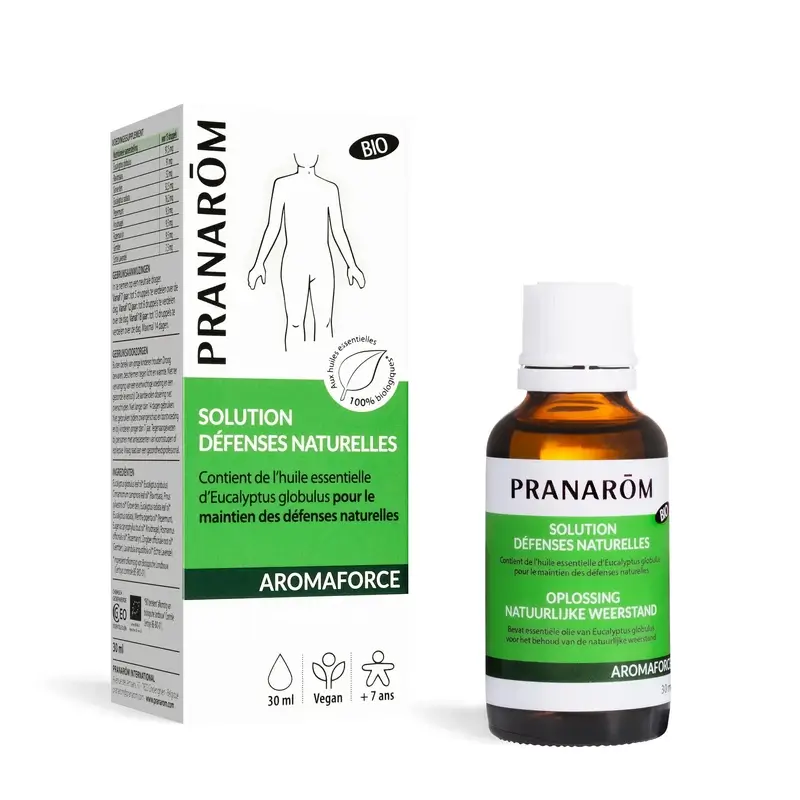
Pranarôm also offers Solution Défenses Naturelles, a supplement in drops from the same range, described on our product page. Its ingredients, which notably include tea tree, are published on the product page, along with its age and duration conditions: read them before considering taking it, and do not take it at the same time as the products above.

When does a sore throat call for medical advice?
If your sore throat does not improve after 5 days (2 days for a child), if it keeps coming back or if your fever goes above 39 °C (102.2 °F), see a doctor. If you have trouble breathing or swallowing: call 15 or 112 (emergency numbers in France).
The criteria below come from Ameli (page updated on September 1, 2026). They apply whatever essential oils or supplements you are taking. An aromatic product should never delay a necessary medical visit ⚠️
- Within the next few days: the sore throat does not improve after five days of self-medication (two days for a child), it comes back frequently, or significant fatigue persists for more than a week.
- The same day: temperature above 39 °C (102.2 °F), vomiting, headaches, a rash, swollen glands, or a weakened immune system (ongoing cancer treatment, for example).
- Call 15 or 112: difficulty breathing or swallowing, signs of dehydration, or a child who refuses to drink, is very pale, drowsy or confused.
On antibiotics, Ameli is categorical: they are useless against viruses, and you should never take them or give them without medical advice. For a child, never choose an essential oil product on your own: ask the pediatrician or family doctor for advice.
Finally, tell your pharmacist or doctor about the supplements you take and any medications that go with them. ANSES insists on this point, because of the risk of interactions.
Your questions about essential oils and sore throats
What is the best essential oil for a sore throat?
No official source we read names a "best" essential oil: Ameli's pages on sore throats don't mention any. To choose, it's better to think in terms of form (capsule, spray, lozenge), authorized age, duration of use and your contraindications, then ask your pharmacist for advice.
Can you swallow tea tree essential oil?
For oral use, ANSES notes carcinogenic, genotoxic and potentially reprotoxic risks from certain compounds, and advises against this consumption for children and for pregnant and breastfeeding women. We therefore give no dose. Ask a healthcare professional for advice before taking any.
Can you put an essential oil directly in your mouth or on your throat?
No. ANSES recommends never applying a neat essential oil to mucous membranes. If you want to use one, choose a pre-dosed product designed for that purpose, and follow its directions.
Ravintsara or tea tree for a sore throat?
The sources we read do not compare these two oils for sore throats, so we cannot pick between them. Tea tree raises the oral-use issue described above; ravintsara, like any essential oil, calls for the same precautions: short duration, not during pregnancy, and your pharmacist's advice.
Can you use an essential oil for a sore throat during pregnancy or for a child?
ANSES advises against essential oils for children and pregnant women. The Pranarôm products presented here are for adults only (capsules and spray) or for those over 12 (lozenges), and are ruled out during pregnancy and breastfeeding. For a child or a pregnant woman, seek medical advice.
After how many days should you see a doctor for a sore throat?
After five days of self-medication with no improvement for adults, and after two days for children, according to Ameli. See a doctor sooner if you have a fever above 39 °C (102.2 °F), swollen glands, a rash or difficulty swallowing, and call 15 or 112 if you have difficulty breathing.
What should you remember before opening the bottle?
An essential oil is neither a medicine nor a risk-free habit: choose it pre-dosed, for adults, over a short period, and it never replaces medical advice.
- Choose a pre-dosed form, read the whole product page, and respect the age, duration and exclusions (pregnancy, breastfeeding, reflux, menthol allergy).
- Never put a neat oil on mucous membranes, and don't swallow tea tree without professional advice.
- See a doctor after 5 days without improvement (2 days for a child), or if you have a fever above 39 °C (102.2 °F), or difficulty swallowing or breathing.
Sources consulted
- Ameli, "Sore throat: what to do and when to see a doctor?", September 1, 2026. See the source
- Ameli, "Consultation and treatment for a sore throat", September 1, 2026. See the source
- ANSES, "Essential oils: risks and precautions", December 17, 2024. See the source
- ANSES, "Dietary supplements containing tea tree, niaouli and cajeput essential oils", December 16, 2020. See the source
- ANSES, "Essential oil sprays and diffusers: Anses calls for vigilance", April 28, 2020. See the source
Pranarôm product pages (Capsules Nez-Gorge, Spray gorge apaisant, Pastilles gorge), accessed on the brand's website on 11/10/2026.
Dietary supplements are not a substitute for a varied, balanced diet and a healthy lifestyle.

LMC content is written by our editorial team from the information published by the brands. Scores out of 10 follow a public grid of 5 criteria*, supplemented by LMC’s editorial assessment.
To support LMC, some links are affiliate links: LMC earns a commission at no extra cost to you, and some of the brands featured are partners. By using the site, you accept our terms of use and our editorial policy.