

Why does your nose get stuffy mostly at night?
Because several factors pile up at bedtime: lying down, the natural alternation between your two nostrils and the air in the bedroom. So a stuffy nose at night is not always caused by a cold.
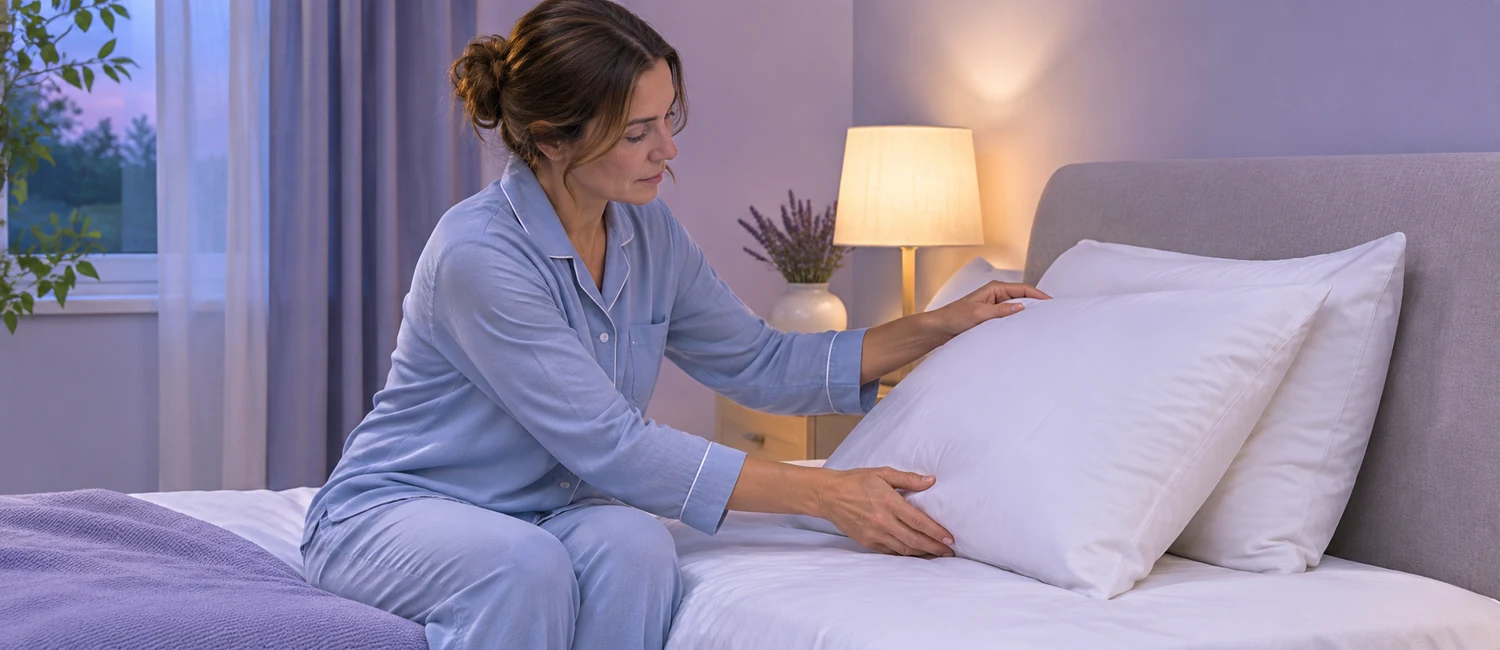
During the day, you barely notice your nose. Then you put your head on the pillow, and one nostril, sometimes both, seems to close up 🌙. Night concentrates the discomfort: you stay still for hours, in a closed room, with nothing but your breathing to focus on.
Lying down and the nasal cycle
Posture matters. A 2023 study (Shi et al., Sleep and Breathing) measured nasal resistance by position in 26 volunteers with no nasal discomfort and 72 patients with sleep apnea. In both groups, it was higher lying on the side than sitting. The increase between sitting and lying down was smaller in the apnea patients: posture changes airflow, in ways that vary from person to person.
Another mechanism is the nasal cycle: the spontaneous alternation between one more open nostril and one more closed. Chen et al. (European Archives of Oto-Rhino-Laryngology, 2024) tracked it during sleep in 30 healthy volunteers: 86.7% showed a classic cycle, with about two side switches per night, mostly during REM sleep. The authors found no clear link with changes in position. In any case, this phenomenon explains why only one nostril sometimes seems blocked when you wake up.
Dry bedroom air and swollen nasal lining
According to sante.fr, when the lining of the nose is irritated, it swells and produces more secretions: the nose runs, then gets blocked. Tobacco smoke, cold, humidity or temporary fatigue are among the factors cited. French national health insurance (Ameli, sinusitis page, February 2026) advises avoiding air conditioners that dry out the air and aiming for about 18 to 20 °C (64 to 68 °F) in the room.
Sante.fr adds that you should air out bedrooms regularly, even in winter, and humidify the air if needed. Cranked-up heating and windows that never open combine exactly what these pages advise against 💧.
Why is your nose stuffy at night without a cold?
The most common explanations are allergic rhinitis, chronic rhinitis or something blocking the airflow. The table below helps you get your bearings, but only a healthcare professional can say for sure.
A nose that closes up every evening, with no fever or colored discharge, doesn't look like an ordinary cold. Official sources describe several distinct situations, summarized below with the step they recommend. This table does not replace an examination: several signs can coexist.
| What you notice | Possible cause mentioned by sources | Helpful step |
|---|---|---|
| Clear discharge, sneezing, itching, no fever | Possible allergy (dust mites, pet hair, pollen, mold), according to Ameli | Talk to a doctor about getting tested; air out the bedroom; don't brush it off if it happens every night |
| Decongestant nasal spray used often, nose increasingly blocked | Chronic rhinitis encouraged by overuse of these sprays, according to sante.fr | Ask a pharmacist or doctor for advice before continuing |
| Loud snoring every night, breathing pauses, daytime sleepiness | Airway obstruction or sleep apnea, according to Ameli | Medical advice without delay: persistent snoring means looking for the cause |
| Only one nostril blocked, with pain or thick discharge on one side only | A situation not to let drag on, according to Ameli (sinusitis page) | See a doctor, the same day if the pain is throbbing or a fever develops |
Dust mite allergy: the stuffy nose of the bed
According to Ameli (July 30, 2026), allergic rhinitis shows up as sneezing, a nose that regularly runs or gets blocked, and itching. The discharge is clear and there is no fever, which points to an allergic rather than viral cause. House dust mites, pet hair, pollen and mold are among the causes; when the allergen is present all year round, the symptoms are not seasonal. If your nose gets blocked mainly in the bedroom and it keeps happening, talk to your doctor.
Chronic rhinitis and sprays used too often
According to sante.fr, chronic rhinitis is most often an allergic rhinitis present all year round. Overuse of local decongestant medicines, the sprays used to unblock the nose, can also lead to chronic rhinitis. It sometimes appears during pregnancy. Ask your pharmacist how long you can use a spray. Ameli specifies that in France, oral decongestants containing pseudoephedrine have been available by prescription only since December 11, 2024.
Snoring and obstruction: when your nose hides something else
According to Ameli (July 1, 2026), nasal obstruction can cause snoring, as can allergic rhinitis, polyps or a deviated septum. Alcohol, tobacco, lying on your back and certain medications taken at bedtime (sleeping pills, tranquilizers, antihistamines) make it worse. Persistent snoring means looking for the cause. In sleep apnea, severe snoring is present in 95% of cases, along with breathing pauses and daytime sleepiness (Ameli, August 2026): medical advice is then a must.


Also worth reading: which essential oils for a sore throat and tea tree essential oil: uses and precautions.
How do you sleep with a stuffy nose without waking up every hour?
Sleep with your head raised, keep the bedroom around 18 to 20 °C (64 to 68 °F), air it out, drink regularly and rinse your nose with saline solution: these are the steps recommended by Ameli and sante.fr.
None of them promises a miracle, but they are simple and easy to combine 😴.
Head raised, bedroom at 18-20 °C and fresh air
Ameli and sante.fr advise sleeping with your head raised to improve airflow: a second pillow or a firm cushion is enough, without bending your neck. Ameli also recommends not covering up too much, because your body heat needs to escape. Air out the bedroom before going to bed, avoid tobacco smoke, and drink regularly during the day (sante.fr cites at least 1.5 to 2 liters a day when you have a cold).
Rinsing your nose before bed
Sante.fr states that saline solution or seawater sprays, sold in pharmacies, can be used to rinse the nose, preferably in single-dose vials. Ameli asks you never to share the nozzle between several people. For a child, it recommends single-use vials.
What do studies show? A 2015 Cochrane review (King et al.) pooled five trials, totaling 544 children and 205 adults, comparing saline rinsing with usual care or other sprays, with no placebo. Most results showed no difference; one larger trial in children did, however, observe a drop in nasal obstruction scores, possibly of minimal size. The authors speak of possible benefits, but of trials that were too small and at high risk of bias. They looked at recent colds, not nighttime discomfort.
Old wives' remedies: onion, bowl of hot water, are they worth it?
Among the official sources we read for this article, none establishes any effect of a cut onion on the bedside table: best not to expect anything from it. For warm, humid air, the 2017 Cochrane review (Singh et al.) analyzed six trials, 387 participants, on steam delivered by a dedicated device (RhinoTherm) in people with colds. It concludes that the evidence shows neither benefit nor harm, with low quality. The trials involved a device, not a bowl of hot water, and boiling water calls for caution, away from children.

What about an essential oil for a stuffy nose at night, and under what conditions?
An essential oil is not a trivial choice: ANSES advises against them for children and pregnant women, and evidence is lacking. If you try one, respect the manufacturer's age limit, duration and precautions, and ask a pharmacist for advice.
Products exist, including the Pranarôm one presented below, but nothing in the official sources we read allows them to be presented as a proven solution. Here is the framework, followed by an example described the way the brand describes it.
What inhalation does, and what it doesn't
According to the abstract of a review on menthol (Eccles, 2003), it activates a cold-sensitive receptor on sensory nerves, which changes the sensation of air passing through the nose. It is a feeling of freshness, not a measurement of what is happening in the nasal passages: we draw no promise from it.
ANSES (2020) noted irritation of the eyes, nose and throat linked to essential oil sprays and diffusers, with some oils rich in phenols or ketones being unsuitable for these devices, and particular vigilance for people with asthma. So you don't diffuse an essential oil all night long, you air out the room, and you keep bottles out of reach of children.
The precautions that come before choosing a product
ANSES (December 2024) points out that essential oils are not recommended for children and pregnant women, that they should never be applied neat to mucous membranes, and that you should ask a healthcare professional for advice before any use. They should never be stored with baby care products: the risk of mixing them up with vitamin D is real.
The leaflet and the manufacturer's product page are the reference (brand website: https://pranarom.fr/). For its Duo Capsules inhalation, Pranarôm specifies: do not swallow, do not use under age 12 or during pregnancy or breastfeeding, contraindicated in case of allergy to an ingredient or a history of seizures or epilepsy, not recommended in case of known respiratory sensitivity.
The Pranarôm Duo Capsules inhalation + Inhalateur
Here is Pranarôm's Duo, presented without making it the solution. According to the brand's product page, its organic essential oil capsules (ravintsara, blue gum eucalyptus, tea tree, palmarosa, peppermint, peppermint eucalyptus, in rapeseed oil) are dissolved in the hot water of the inhaler provided. The brand states that the aromatic molecules carried by the steam clear the nose and help you breathe more freely, and intends it for nasal congestion, rhinitis and nasopharyngitis. This is the brand's wording: LMC does not endorse it, and the product page mentions no effect on sleep 🌿.
Stated directions for use: one capsule in the inhaler, up to three times a day for five days, no more than five minutes of inhalation, from age 12. It is not a product to use all night. Price checked on November 10, 2026: €15.00 instead of €18.80 (indicative), or about €13.50 with code LMC (-10%, valid until December 31, 2026). The product image shows two boxes of 15 capsules and an inhaler. Our Duo product page details the product, and you can also see the Duo at Pranarôm.

When should you see a doctor for a stuffy nose at night?
See a doctor if your nose stays blocked for more than about ten days, if you have a high fever, ear or sinus pain, discharge from only one nostril, breathing pauses or marked sleepiness. For a child, always seek medical advice.
Sante.fr advises seeing a doctor the same day in case of high fever, ear pain, severe headaches or breathing problems, and within the next few days if your nose doesn't clear after about ten days or if blood keeps coming back. ANSM (the French medicines agency) points out that a cold generally clears up on its own in 7 to 10 days without medication.
Ameli adds: symptoms that persist for more than a week with sinus pain, throbbing pain on one side at night, pus-like discharge from only one nostril. A fever above 38.5 °C (101.3 °F) with swelling of the face or an eye, or blurred vision, warrants calling 15 or 112 (emergency numbers in France). Severe snoring, breathing pauses and daytime sleepiness point to sleep apnea: a spray or a capsule is not the answer.
Your questions about a stuffy nose at night
Is it dangerous to sleep with a stuffy nose?
A temporary stuffy nose from a cold is not dangerous in itself, and it generally clears up in 7 to 10 days according to ANSM. It becomes a reason to see a doctor if it lasts, if breathing pauses are observed or if significant daytime sleepiness sets in (Ameli).
Why is only one nostril blocked at night?
It is often the nasal cycle: 86.7% of the volunteers followed by Chen et al. (2024) had one. Pain on one side or thick discharge from only one nostril, on the other hand, should lead you to see a doctor, according to Ameli.
What can you do about a stuffy nose at night during pregnancy?
Sante.fr notes that chronic rhinitis sometimes appears during pregnancy. Simple steps (head raised, fresh air, nasal rinsing) remain the first to try. Essential oils are not recommended for pregnant women (ANSES) and Pranarôm's Duo is ruled out. Ask your doctor or midwife for advice before using any product.
Why does my baby have a stuffy nose at night?
Ameli recommends rinsing a child's nose during a cold with saline solution or seawater in single-dose vials, and contraindicates nasal decongestants before age 15 for nasopharyngitis. Essential oils are not recommended for children (ANSES) and the Duo's product page rules out children under 12. For a baby, medical advice is the way to go, especially with a fever or breathing difficulty.
Is a decongestant spray every evening a good idea?
No, according to sante.fr: overuse of local decongestants can lead to chronic rhinitis. How long to use one should be decided with a pharmacist or doctor.
Are inhalation capsules suitable for everyone?
No. The Duo's product page rules out children under 12, pregnant or breastfeeding women, and people with a history of allergy to an ingredient, seizures or epilepsy, and advises against the product in case of known respiratory sensitivity. Read the leaflet and, if in any doubt, ask a pharmacist.
What should you remember to breathe better tonight?
Start with the simple steps: head raised, bedroom aired out at 18-20 °C (64-68 °F), nasal rinsing. A stuffy nose that lasts calls for medical advice.
- Your nose gets blocked at night because of posture, the nasal cycle and bedroom air, with or without a cold.
- Severe snoring, breathing pauses, fever or a child affected: medical advice is a must.
- Essential oils, including Pranarôm's Duo, have clear contraindications and should not be diffused all night.
Another product in the range, Pranarôm's Aromaboost Sleep product page is presented on LMC, with no promise on our part.
References
- French national health insurance (Ameli), "Acute sinusitis: what to do and when to see a doctor?", February 4, 2026: https://ameli.fr/assure/sante/themes/sinusite/que-faire-quand-consulter
- French national health insurance (Ameli), "Allergic rhinitis and hay fever: symptoms and causes", July 30, 2026: https://www.ameli.fr/assure/sante/themes/rhinite-allergique-et-rhume-des-foins/rhinite-allergique-et-rhume-des-foins-symptomes-et-causes
- French national health insurance (Ameli), "Snoring: understanding snoring", July 1, 2026: https://www.ameli.fr/assure/sante/themes/ronflements/comprendre-ronflement
- French national health insurance (Ameli), "Symptoms, diagnosis and course of sleep apnea", August 7, 2026: https://www.ameli.fr/assure/sante/themes/apnee-du-sommeil/symptomes-diagnostic-evolution
- Santé.fr, "Cold (rhinitis)", August 12, 2026: https://www.sante.fr/rhume-rhinite
- ANSM, "If you have a cold, do not use medicines containing pseudoephedrine", April 8, 2024: https://ansm.sante.fr/informations-de-securite/en-cas-de-rhume-ne-pas-utiliser-de-medicaments-a-base-de-pseudoephedrine-vasoconstricteurs-par-voie-orale
- ANSES, "Essential oils: risks and precautions", December 17, 2024: https://www.anses.fr/fr/article/huiles-essentielles-risques-precautions
- ANSES, "Essential oil sprays and diffusers: Anses calls for vigilance", April 28, 2020: https://www.anses.fr/fr/actualite/sprays-diffuseurs-base-dhuiles-essentielles-lanses-appelle-vigilance
- Shi Y et al., "Influence of postural changes on nasal resistance in patients with obstructive sleep apnea", Sleep Breath, 2023: https://pubmed.ncbi.nlm.nih.gov/35920969/
- Chen J et al., "Real-time observation of nasal cycle during sleep with polysomnography", Eur Arch Otorhinolaryngol, 2024: https://pubmed.ncbi.nlm.nih.gov/39172233/
- King D et al., "Saline nasal irrigation for acute upper respiratory tract infections", Cochrane Database Syst Rev, 2015: https://pubmed.ncbi.nlm.nih.gov/25892369/
- Singh M et al., "Heated, humidified air for the common cold", Cochrane Database Syst Rev, 2017: https://pubmed.ncbi.nlm.nih.gov/28849871/
- Eccles R, "Menthol: effects on nasal sensation of airflow and the drive to breathe", Curr Allergy Asthma Rep, 2003: https://pubmed.ncbi.nlm.nih.gov/12662469/
- Pranarôm product page, Duo Capsules inhalation pour dégager le nez + Inhalateur, accessed on November 10, 2026 (precautions, ingredients, directions for use, price)
Dietary supplements are not a substitute for a varied, balanced diet and a healthy lifestyle.

LMC content is written by our editorial team from the information published by the brands. Scores out of 10 follow a public grid of 5 criteria*, supplemented by LMC’s editorial assessment.
To support LMC, some links are affiliate links: LMC earns a commission at no extra cost to you, and some of the brands featured are partners. By using the site, you accept our terms of use and our editorial policy.