

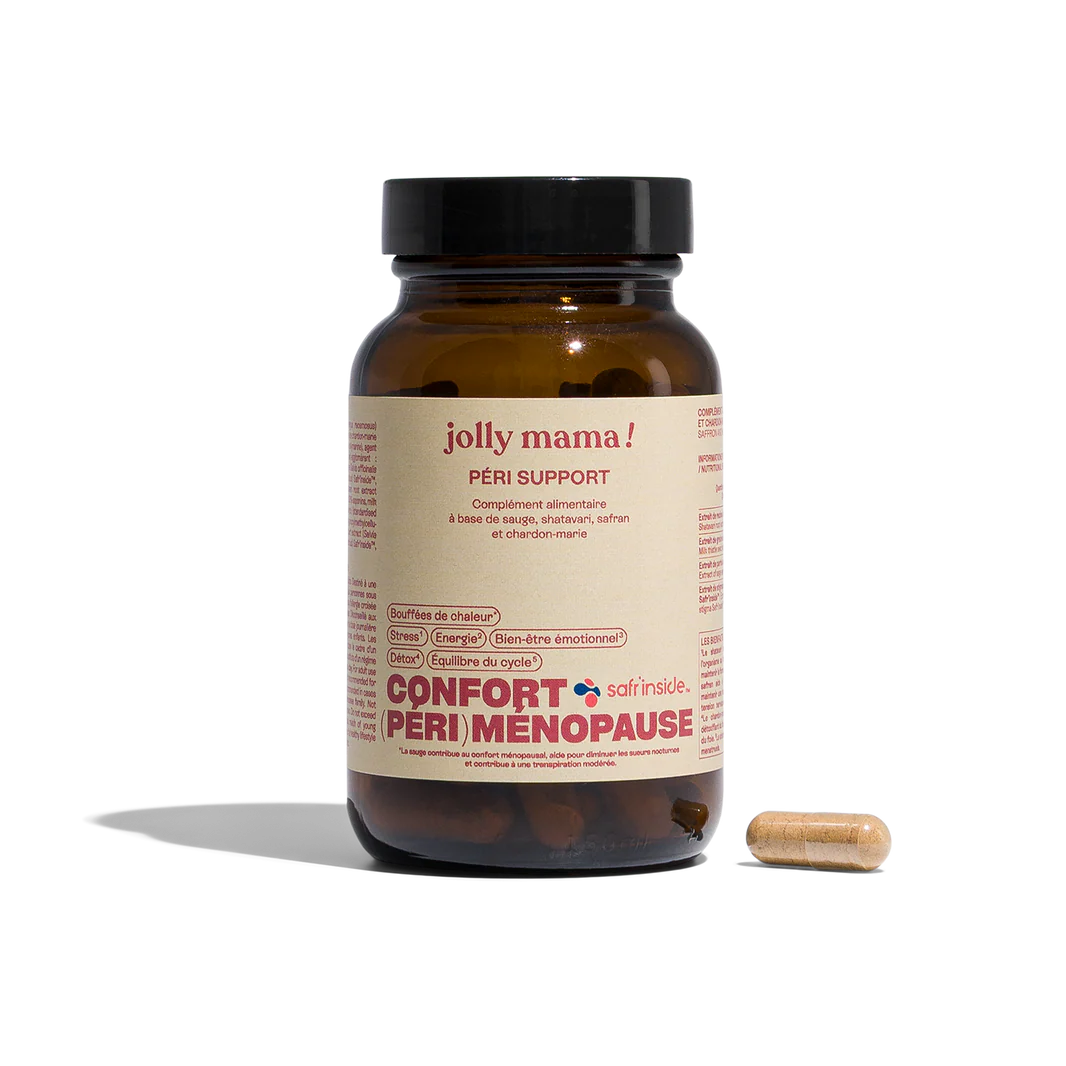
Péri Support, Jolly Mama's herbal supplement, and Ménophytea, the menopause range from Nutreov laboratories sold in pharmacies, come up a lot when you are looking for help with hot flashes without hormone therapy. Yet their approach is very different.
On November 11, 2026, we reread the official product pages of both brands, checked Ménophytea prices at three online pharmacies and read the published studies on each plant. Here is what to check before you buy.
What is the real difference between Péri Support and Ménophytea?
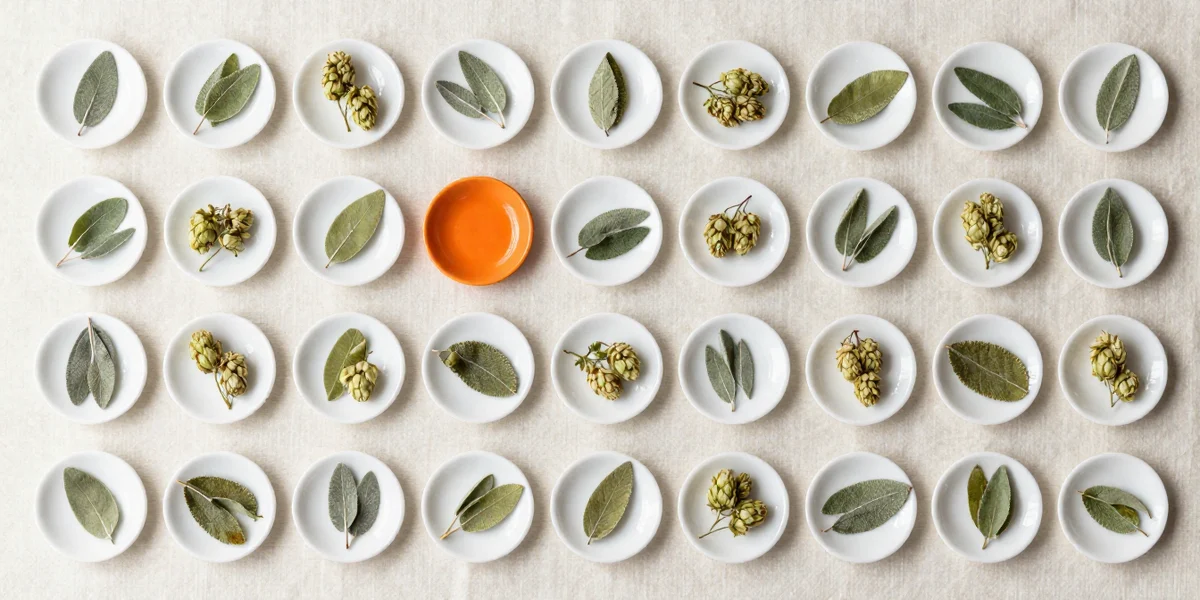
Phytoestrogens. Ménophytea Équilibre Bouffées de chaleur relies on hops, flax and kudzu, which the brand itself presents as sources of phytoestrogens. Péri Support combines sage, shatavari, saffron and milk thistle, with no hormones.
Ménophytea is a range: it also includes a "Sans Hormone" (hormone-free) version, a pollen formula and a cooling stick. The most widely available product in pharmacies for hot flashes is Ménophytea Équilibre Bouffées de chaleur, in day and night capsules. That is the one we are comparing here.
On its product page, Nutreov explains that flaxseed contains lignans, that hops naturally contain phytoestrogens and that the night capsules "contain active ingredients with estrogenic activity." The brand therefore openly takes an approach based on these plant compounds.
Jolly Mama describes Péri Support as "hormone-free, compatible with a history of cancer and thyroid disorders." Its formula contains no soy, red clover, hops or flax, the usual sources of phytoestrogens.
The direct consequence: the precautions are not the same, especially if you have a history of breast cancer.
What exactly is in each supplement?
Péri Support provides four plant extracts in two capsules, with no vitamins. Ménophytea provides three, with chicory inulin and vitamin B6, spread over four capsules a day.
Péri Support (2 capsules a day, with a glass of water) contains:
- 500 mg of shatavari root extract (Asparagus racemosus), standardized to 20% saponins;
- 250 mg of milk thistle seed extract, standardized to 80% silymarin;
- 123 mg of sage aerial part extract (Salvia officinalis);
- 30 mg of Safr'inside™ saffron stigma extract.
The formula is vegan, iodine-free, made in France, with no vitamins or minerals.
Ménophytea Équilibre Bouffées de chaleur is taken in two steps: 2 green capsules in the morning, 2 white capsules in the evening. Ingredients as listed by four online pharmacies:
- Day capsules: 400 mg of chicory inulin, 210 mg of dry flaxseed extract, 100 mg of dry hop cone extract and 0.42 mg of vitamin B6;
- Night capsules: 750 mg of chicory inulin, 50 mg of dry kudzu root extract (Pueraria montana var. lobata) and 0.42 mg of vitamin B6.
Over a day, that adds up to 0.84 mg of vitamin B6, or 60% of the reference value. It is the only active ingredient in either product with an authorized claim related to hormones: vitamin B6 contributes to the regulation of hormonal activity. It also contributes to the reduction of tiredness and fatigue.
Worth noting: the most abundant ingredient in Ménophytea is inulin, a fiber, at 1.15 g a day. And the product pages we read do not state the content of lignans, isoflavones or 8-prenylnaringenin, the active compound in hops.

Phytoestrogens or not: what difference does it make?
Phytoestrogens are plant compounds that resemble estrogens. They explain why some plants are of interest for hot flashes, and also why precautions apply in case of hormone-dependent cancer.
In its reference report published in 2005 with Afssaps, the French food safety agency Anses classifies isoflavones, isoflavans, coumestans, flavanones, chalcones and enterolignans as phytoestrogens. The three plants in Ménophytea fit this logic:
- flax provides lignans, which the body converts into enterolignans;
- hops contain 8-prenylnaringenin, a flavanone that the researchers who studied it describe as a potent phytoestrogen;
- kudzu contains isoflavones in its root.
On the risk, Anses takes a nuanced view: data in women show no increase in breast cancer risk, but animal data call for caution in case of hormone-dependent cancer or a history of this type of cancer. It recommends printing on the label: "Not recommended for women with a personal or family history of breast cancer. Talk to your doctor." That is almost word for word Ménophytea's precaution.
Péri Support contains none of these plants. That does not mean its plants have no hormonal effect: in a recent trial on shatavari, estradiol and FSH increased in the treated group, and how sage works has not been worked out. "Hormone-free" is accurate, but it does not replace medical advice if you have a hormonal history.
What do studies say about the plants in each formula?
None of these plants has an authorized health claim in Europe. Trials exist, but they are small, often funded by manufacturers, and use extracts that differ from those in commercial capsules.
The plants in Péri Support:
- Sage. In the Bommer 2011 trial, 71 menopausal women with at least five hot flashes a day took a fresh sage tablet for 8 weeks. The hot flash score dropped by 50% at 4 weeks and by 64% at 8 weeks. But the trial was open-label, with no placebo group, and its lead author worked for the manufacturer of the preparation. The Wilfried 2021 trial, double-blind and placebo-controlled in 80 women aged 48 to 65, found a 55% drop in the hot flash severity score in 4 weeks. It was funded by the same manufacturer, with a fresh sage extract different from the one in Péri Support.
- Saffron. In the Lopresti 2021 trial, 86 perimenopausal women received a saffron extract (affron®, 14 mg twice a day) or a placebo for 12 weeks. Saffron did better than placebo on mood (anxiety scores -33% and depression scores -32%), but not on hot flashes. The study was funded by the maker of the extract, which is not Safr'inside™.
- Shatavari. In the Gudise 2024 trial, 70 women took a shatavari formulation or a placebo, double-blind. The authors report fewer hot flashes, night sweats and insomnia. In the Mahajan 2025 trial, 80 perimenopausal women took 300 mg of root extract or a placebo for 8 weeks. Hot flashes and stress decreased more on shatavari, and estradiol increased. Both trials are small.
- Milk thistle is not highlighted by the brand for hot flashes.
The plants in Ménophytea:
- Hops. In the Heyerick 2006 trial, 67 menopausal women received a hop extract standardized for 8-prenylnaringenin or a placebo for 12 weeks. The 100 µg dose did better than placebo at 6 weeks, but no longer at 12 weeks. The higher dose was less effective. In the Erkkola 2010 crossover trial, in 36 women, the overall effect was not significant.
- Flax. In the largest trial on this list, Pruthi 2012, 188 women ate a flax bar providing 410 mg of lignans or a placebo bar for 6 weeks. The hot flash score dropped by 4.9 points with flax and by 3.5 points with placebo: the difference was not significant.
- Kudzu. In the Bihlet 2021 study, 50 menopausal women took kudzu root extract for 4 weeks, at different doses. The symptom score dropped in four out of five groups, but the study was open-label, with no placebo, and run by employees of the sponsoring company.
Neither formula has been tested as such, and the extracts used in the trials are not those in the capsules. On the Péri Support side, sage and shatavari have small placebo-controlled trials. On the Ménophytea side, hops give inconsistent results and flax did no better than placebo in a large trial.
Hot flashes and night sweats: which should you choose for your nights?
If night sweats are breaking up your nights, both formulas target this symptom, with different plants. Either way, your evening habits matter as much as the capsule.
Ménophytea plays on timing: one formula in the morning, another in the evening, for "24-hour action" according to the brand, meaning four capsules at two different times. Péri Support is taken all at once, two capsules a day. If you tend to forget the evening dose, this detail matters.
The sage trials are the ones that most directly measure hot flashes; saffron has mainly been studied for mood. These trials lasted 4 to 12 weeks: judge over several weeks, not a few days.
As for habits, a cool bedroom, light bedding, a glass of water within reach and less alcohol and caffeine in the evening are among the usual tips.
We go into these pointers in detail in our article on menopause hot flashes. If your symptoms weigh on your daily life, hormone therapy can also be discussed with your doctor or midwife.
What if you have a history of hormone-dependent cancer?
Nutreov advises against Ménophytea Équilibre Bouffées de chaleur if you have a personal or family history of breast cancer. Jolly Mama states that Péri Support is compatible with a history of cancer. In both cases, talk to your doctor before starting.
For Ménophytea, the instruction follows the Anses recommendation, and the brand's FAQ mentions a contraindication in case of a hormone-dependent history. If this applies to you, including a family history, this formula is not for you.
For Péri Support, the stated compatibility is the manufacturer's position, based on the absence of hormones and of phytoestrogen plants. But hormone-dependent cancer often comes with long-term treatment: only your oncologist or doctor can approve a supplement in your situation. Show them the full ingredient list.
Also check:
- current medications: the brand advises against Péri Support for people taking an antidepressant. Ménophytea should be taken at least 60 minutes apart from your medications;
- thyroid: Jolly Mama states that Péri Support is compatible with thyroid disorders; Anses listed women treated for hypothyroidism among the groups to monitor with phytoestrogens.
Péri Support: for which profile, and with what precautions?
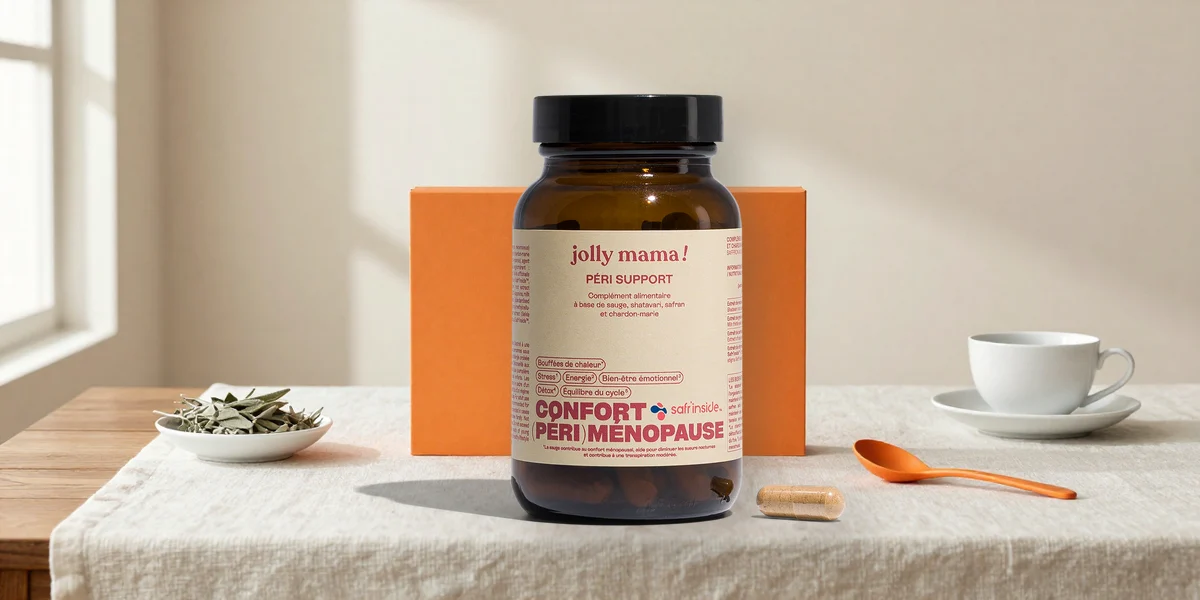
Péri Support is aimed at perimenopausal women, from age 35 according to the brand, who prefer a hormone-free herbal formula, at two capsules a day.
Jolly Mama recommends it for hot flashes, night sweats, cycle imbalance, irritability, stress or fatigue. The product page states that it is also suitable for menopause. The list price is €34 a month, or about €1.13 a day. Code LMC15 gives you 15% off a one-time order.
The brand's precautions, as listed on the product page:
- for adults only, intended for a sexually mature population;
- not recommended for people taking an antidepressant;
- not recommended in case of known cross-allergy, particularly to the Asteraceae family;
- not recommended during pregnancy and breastfeeding;
- do not exceed the recommended daily dose.
If your need is more about fatigue and vitamin intake, the brand also offers Péri Essentials (€30 a month), a multivitamin taken as two capsules a day with 300 mg of Bacognize® bacopa. Here, the claims are authorized: vitamin B6 contributes to the regulation of hormonal activity, vitamin B12 contributes to the reduction of tiredness and fatigue, and vitamin D contributes to the maintenance of normal bones. It is not recommended if you take an anticoagulant, and its biotin can skew some lab tests.
You can order Péri Support with code LMC15. This is an affiliate link: LMC earns a commission if you buy, at no extra cost to you.
Péri Support or Ménophytea: which one should you choose for your profile?
Ménophytea Équilibre costs less and is aimed at women with no history of hormone-dependent cancer who are comfortable with a phytoestrogen-based approach. Péri Support costs more and targets women who want to avoid these plants, with a simpler routine.
| Criterion | Péri SupportJolly Mama | Ménophytea Équilibre Bouffées de chaleurNutreov |
|---|---|---|
| Active ingredients per day | Shatavari 500 mg, milk thistle 250 mg, sage 123 mg, Safr'inside™ saffron 30 mg | Inulin 1,150 mg, flax 210 mg, hops 100 mg, kudzu 50 mg, vitamin B6 0.84 mg |
| Phytoestrogens | Hormone-free; no classic phytoestrogen plant | Yes, according to the brand (flax lignans, hops, kudzu); content not stated |
| Authorized claim | None (plants only) | Vitamin B6: contributes to the regulation of hormonal activity |
| Doses per day | 2 capsules in one dose | 4 capsules: 2 in the morning, 2 in the evening |
| Price per month | €34 (list price, brand website) | €18.99 to €20.69 for a box of 120 capsules (3 online pharmacies, 11/11/2026) |
| Target profile | Perimenopause from age 35 and menopause: hot flashes, night sweats, cycle, mood, stress, fatigue | Menopause: hot flashes, night sweats |
| Brand precautions | Not recommended with an antidepressant or with an Asteraceae allergy; pregnancy and breastfeeding: no | Not recommended with a personal or family history of breast cancer; take apart from medications; pregnancy and breastfeeding: no |
| History of cancer | Stated as compatible by the brand; medical advice essential | Not recommended by the brand |
To decide, ask yourself three questions:
- Do you have a personal or family history of breast cancer, or another hormone-dependent cancer? Rule out Ménophytea Équilibre, and talk to your doctor about Péri Support before taking it.
- Do you take an antidepressant? The brand advises against Péri Support. Ask your doctor or pharmacist for advice.
- Is budget the deciding factor? Expect about €19 to €21 a month for Ménophytea Équilibre, €34 for Péri Support.
If you want to compare more broadly, our comparison of perimenopause supplements reviews other hormone-free formulas, and our menopause comparison covers what comes after. To find out whether this applies to you, read at what age perimenopause starts, then premenopause and dietary supplements for the role of each family of active ingredients.
Frequently asked questions
Does Ménophytea contain hormones?
It does not contain hormones, but plants that the brand presents as sources of phytoestrogens: flax, hops and kudzu. Its FAQ describes it as a solution "based on phyto-hormones." That is why it is not recommended if you have a personal or family history of breast cancer.
Is there a Ménophytea without phytoestrogens?
Yes. Ménophytea Équilibre Bouffées de Chaleur Sans Hormone uses a flaxseed oil free of lignans, with vitamin E, vitamin D3 and a bitter orange extract. It sells for €18.80 for 28 capsules on the brand's website. Because of the bitter orange, it should not be used if you take blood pressure medication.
Can you take Péri Support and Ménophytea at the same time?
It is not advised: both target the same symptoms, and stacking supplements is not recommended. Choose one formula and talk to your doctor or pharmacist if in doubt.
How long before you can judge the effect?
The trials cited lasted 4 to 12 weeks. So judge over several weeks. If symptoms remain bothersome, see a doctor: other options exist, including hormone therapy depending on your medical history.
Does code LMC15 work on Péri Support?
Yes, code LMC15 gives you 15% off a one-time order on the Jolly Mama website.
Scientific references
- Bommer S, Klein P, Suter A. First time proof of sage's tolerability and efficacy in menopausal women with hot flushes. Advances in Therapy, 2011. Open-label trial without placebo, 71 women, lead author employed by the manufacturer. See the source
- Wilfried D, Nina CDG, Silvia B. Effectiveness of Menosan® Salvia officinalis in the treatment of a wide spectrum of menopausal complaints. Heliyon, 2021. Randomized double-blind placebo-controlled trial, 80 women, 4 weeks, funded by the manufacturer. See the source
- Lopresti AL, Smith SJ. The effects of a saffron extract (affron®) on menopausal symptoms in women during perimenopause. Journal of Menopausal Medicine, 2021. 86 women, effect on mood, not on hot flashes. See the source
- Gudise VS, Dasari MP, Kuricheti SSK. Efficacy and safety of Shatavari root extract for the management of menopausal symptoms. Cureus, 2024. Randomized double-blind trial, 70 women. See the source
- Mahajan S, Avad P, Langade J. Efficacy and safety of Shatavari (Asparagus racemosus) root extract for perimenopause. International Journal of Women's Health, 2025. 80 women, 8 weeks, rise in estradiol observed. See the source
- Heyerick A et al. A first prospective, randomized, double-blind, placebo-controlled study on the use of a standardized hop extract to alleviate menopausal discomforts. Maturitas, 2006. 67 women, effect at 6 weeks, not at 12. See the source
- Erkkola R et al. A randomized, double-blind, placebo-controlled, cross-over pilot study on the use of a standardized hop extract to alleviate menopausal discomforts. Phytomedicine, 2010. 36 women, overall effect not significant. See the source
- Pruthi S et al. A phase III, randomized, placebo-controlled, double-blind trial of flaxseed for the treatment of hot flashes (NCCTG N08C7). Menopause, 2012. 188 women, no difference from placebo. See the source
- Bihlet AR et al. The efficacy and safety of multiple dose regimens of Kudzu (Pueraria lobata) root extract on bone and cartilage turnover and menopausal symptoms. Frontiers in Pharmacology, 2021. Open-label study without placebo, 50 women. See the source
- Afssa, Afssaps (Anses). Safety and benefits of dietary phytoestrogens: summary of the report, 2005. Families of phytoestrogens, caution in case of hormone-dependent cancer, recommended labeling. See the source
- Regulation (EU) No 432/2012 establishing a list of permitted health claims (vitamin B6, vitamin B12, vitamin D). See the source
Dietary supplements are not a substitute for a varied, balanced diet and a healthy lifestyle. This article does not replace medical advice. Ingredients and precautions taken from the official product pages on November 11, 2026; prices may change. If your symptoms weigh on your daily life, or if you have a history of hormone-dependent cancer, a thyroid disorder or are on ongoing treatment, talk to your doctor.

LMC content is written by our editorial team from the information published by the brands. Scores out of 10 follow a public grid of 5 criteria*, supplemented by LMC’s editorial assessment.
To support LMC, some links are affiliate links: LMC earns a commission at no extra cost to you, and some of the brands featured are partners. By using the site, you accept our terms of use and our editorial policy.