

Why do hot flashes appear during menopause?
Hot flashes come from a disrupted internal thermostat, triggered by falling estrogen. The body thinks it's too hot and urgently sets off a release of heat.
At menopause, the ovaries gradually stop producing estrogen and progesterone. Yet these hormones help regulate body temperature in the hypothalamus, the area of the brain that acts as a thermostat. Deprived of its usual reference points, this thermostat becomes hypersensitive: a tiny change is enough to make it believe the body is overheating.
The reaction is then immediate and dramatic. Blood vessels in the skin dilate to release heat, which explains the redness of the face and neck, then sweating takes over. Returning to normal is often accompanied by chills, sometimes brief lightheadedness or palpitations. They're also called vasomotor symptoms, and more broadly climacteric symptoms, a term that covers all the symptoms linked to this hormonal transition.
These episodes are short: France's national health insurance (Assurance Maladie) notes that they rarely last more than a few minutes. Their frequency, however, varies enormously. Some women have two or three a week, others several an hour.
Several factors trigger or amplify an episode, and they're worth knowing because they're the first ones you can act on:
- warm surroundings, an overheated room or a bed with too many covers;
- eating a meal, especially a large or spicy one;
- alcohol;
- intense physical exercise;
- emotion, stress or frustration.
Hot flashes rarely come alone. They're often accompanied by fatigue, mood changes or trouble concentrating, which we covered in detail in our article on fatigue after 40 and during menopause.

How long do hot flashes last?
Longer than you might think: the median duration is 7.4 years according to the large American SWAN study, and 4.5 years after the final period.
This is probably the most useful piece of information in this article, and the one least often shared. The SWAN study, published in 2015 in JAMA Internal Medicine, followed 3,302 women for seventeen years. Among the 1,449 participants who reported frequent hot flashes, the total median duration of symptoms reached 7.4 years. After the final period, they still persist for a median of 4.5 years.
Above all, this duration depends heavily on when symptoms begin. Women whose hot flashes start early, in premenopause or early perimenopause, have them for a median of more than 11.8 years. Conversely, those whose symptoms only appear after menopause is established get off with 3.4 years. Perceived stress, anxiety and depressive symptoms are also associated with longer durations.
These numbers aren't here to discourage you, but to set a realistic expectation. A woman who waits for it to "go away on its own in a few months" risks letting years of discomfort settle in without putting anything in place. The Assurance Maladie remains cautious on this point: it states that hot flashes are present for a few months, but sometimes last several years.
An important nuance: not all signs of menopause follow the same timeline. Hot flashes and sweats are temporary and eventually ease off. Other symptoms, such as vulvovaginal dryness and urinary problems, on the contrary set in for the long term and can get worse over time. So the two aren't managed the same way.

Why are hot flashes worse at night?
Because body temperature naturally drops to help you fall asleep, which makes the disrupted thermostat even more reactive. The Assurance Maladie confirms that they occur mostly at night.
In the evening, the body lowers its core temperature to prepare for sleep. In a woman whose thermostat is already unstable, this programmed change is enough to trigger an episode. Add an overheated bedroom, a thick comforter or a late dinner with wine, and the awakenings pile up.
One point deserves emphasis, because it's not well known: night sweats can occur on their own, without an associated hot flash. They're sometimes so heavy that you have to change the sheets. A woman who feels no hot flashes during the day can therefore still have her nights disrupted by this mechanism.
The consequences go well beyond the discomfort of the moment. Night after night of fragmented sleep fuels daytime fatigue, irritability and trouble concentrating. It's often this cycle, more than the episodes themselves, that drives women to look for a solution.

What can you change day to day to limit episodes?
Identifying your own triggers and acting on your environment and habits remains the first step, with no side effects and no cost.
Before any supplementation, a few adjustments often make a measurable difference. They don't eliminate hot flashes, but they reduce the frequency of avoidable episodes, the ones caused by an identifiable external factor.
- Keep a journal for two weeks. Writing down the time of each episode and what came before it reveals precise patterns: the evening glass of wine, the tense meeting, the overheated room. It's the foundation everything else builds on.
- Dress in thin layers. Several light layers you can take off one by one are better than a single warm garment, and breathable natural fabrics limit the clammy feeling that follows an episode.
- Cool down the bedroom. A room at around 18 degrees Celsius, a lighter comforter, cotton or linen bedding, and cool water within reach.
- Rethink dinner. Eat your evening meal earlier, go easy on spicy dishes and limit alcohol, which dilates blood vessels and encourages awakenings.
- Move regularly. Regular, moderate physical activity is associated with better sleep and better stress management. Intense exercise late in the day, however, can trigger an episode.
- Work on your breathing. Slow, deep breathing as the hot flash rises helps you get through the peak more calmly, and acts on the stress that keeps it going.
- Quit smoking. Smoking is one of the factors associated with more pronounced symptoms.
If stress keeps showing up in your journal, our tips on premenopause symptoms are a useful addition to this list.
Which plants are traditionally used for hot flashes?
Sage, black cohosh, lemon balm and hops are the most widely used. None has an authorized health claim in Europe, and the scientific data are far from unanimous.
Let's be clear from the start, because few pages say it: no health claim is authorized for these plants in the European Union. Their files are still "on hold" awaiting evaluation. A manufacturer can therefore include them in a formula and describe their traditional use, but no one can claim that they treat hot flashes. What we can do, however, is look at what the research says, without embellishing.
Common sage is the plant most associated with sweating in traditional European use. It's found in most formulas designed for menopause.
Black cohosh (Actaea racemosa, also called cimicifuga) is the most studied, and the most debated. A Cochrane review published in 2012, which pooled sixteen randomized trials and 2,027 women, found no significant difference from placebo in hot flash frequency or in menopause symptom scores. Later meta-analyses reached more favorable conclusions, and the scientific debate remains open. Saying its effectiveness is proven would be dishonest; saying it's useless would be just as dishonest.
Lemon balm and hops are mainly used for their traditional role in nervousness and falling asleep, often as add-ons in nighttime formulas.
Black cohosh: the precautions labels don't show
This point deserves a closer look, because it's rarely mentioned on sales pages. Black cohosh is indeed authorized in dietary supplements in France: it appears in Annex I of the French decree of June 24, 2014, for the rhizome and root. So there's nothing irregular about finding it in a formula sold in France.
However, the herbal medicine containing the same extract carries explicit warnings that you won't find on supplements:
- cases of liver damage have been reported: you should stop taking it and see a doctor if you experience unusual fatigue, loss of appetite, yellowing of the skin or eyes, dark urine, abdominal pain, nausea or vomiting;
- the treatment period should not exceed six months of continuous use;
- medical advice is essential if you have a history of breast cancer or a hormone-dependent tumor, and before any combination with estrogen therapy;
- Anses (the French food safety agency) considers its use not recommended during pregnancy and breastfeeding.
These precautions don't disqualify the plant, they frame its use. They simply deserve to be known before you buy, and discussed with a pharmacist or doctor if in doubt.
How do you choose a supplement for hot flashes?
First look at when your episodes happen, then at the doses displayed in milligrams, the real length of a course and the cost per day. The format matters less than how readable the formula is.
The French market offers dozens of formulas, and their compositions are often similar. A few criteria help you decide without getting lost:
- When your episodes happen. Hot flashes that are mostly during the day, mostly at night or both don't call for the same formula. Nighttime complexes generally add soothing plants, sometimes melatonin.
- Doses displayed in milligrams. A label announcing a "plant complex" without specifying the amount of each ingredient makes any comparison impossible.
- The real length of a course. A jar doesn't always last a month. Dividing the price by the number of days avoids unpleasant surprises, and larger formats almost always work out cheaper.
- No hormones. Dietary supplements don't contain any, which is what sets them apart from hormone therapy, which requires a prescription.
- The format. Gummies, capsules or tablets: it's mainly a question of adherence. The best format is the one you take every day without thinking about it.
- The brand's transparency on where the product is made, contraindications and customer service.
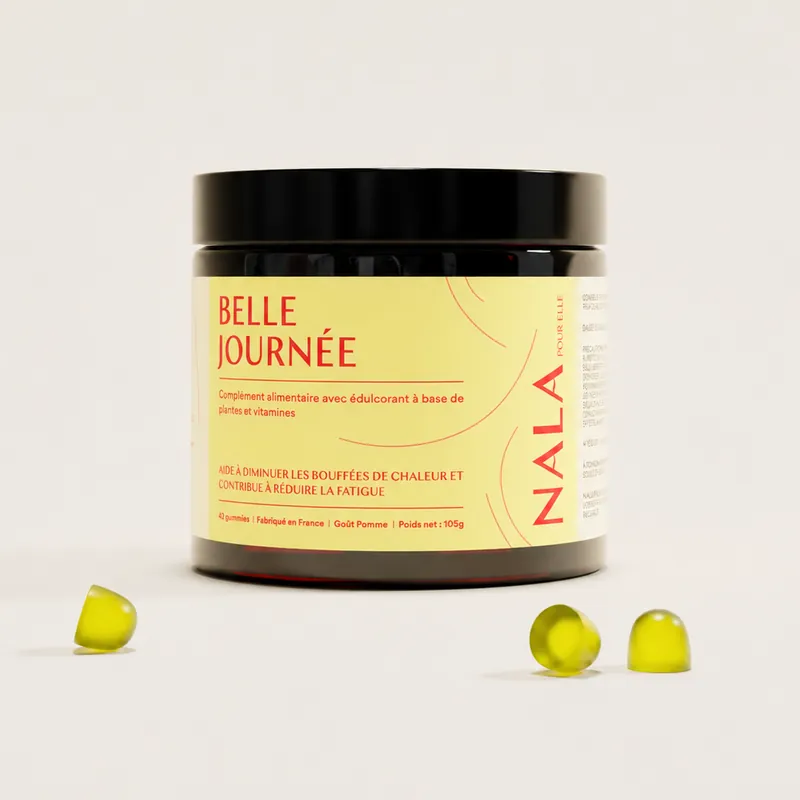
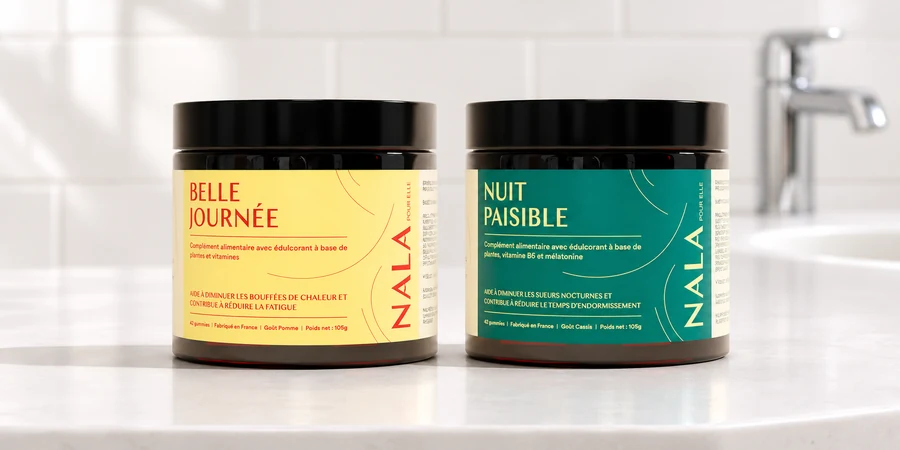
To illustrate, here's how the three formats in the Nala Pour Elle range break down. It's a French brand specializing in premenopause and menopause, which we analyzed in detail:
| Criterion | Analyzed by LMCBelle Journée |
Nuit Paisible |
Pack Bouffées de chaleur |
|---|---|---|---|
| Target profile | Daytime episodes | Nighttime episodes and awakenings | Day and night over a long course |
| Format | 42 apple-flavored gummies | 42 blackcurrant-flavored gummies | Day and night formats combined |
| Duration covered | 3 weeks | 3 weeks | 9 weeks |
| Indicative price | €25.90 | €25.90 | €74.90 |
| With the code LMC10 | €23.31 | €23.31 | €67.41 |
| Cost per day | €1.11 with the code | €1.11 with the code | €1.07 with the code |
| Hormone-free | Yes | Yes | Yes |
| Authorized health claim for the plants | None | None | None |
Prices are indicative and were taken from the brand's website. The code LMC10 gives you 10% off the Nala Pour Elle store.
When should you talk to a doctor?
As soon as hot flashes affect your sleep or daily life, and right away if you have an unusual symptom. Hormone therapy exists and is discussed case by case.
A dietary supplement never replaces medical advice, and menopause isn't something you have to grit your teeth through. Several situations warrant a consultation:
- hot flashes that disrupt your sleep several nights a week, or that interfere with work and social life;
- symptoms that get worse instead of easing over time;
- vaginal bleeding after menopause has set in, which calls for prompt medical advice;
- a personal or family history of breast cancer, a hormone-dependent tumor or cardiovascular disease, before starting any herbal product;
- ongoing treatment, because of possible interactions;
- isolated hot flashes, with no other sign of menopause, or occurring very early or very late: other causes exist and should be ruled out.
Menopausal hormone therapy remains the most effective option for vasomotor symptoms. It comes with contraindications and benefits to be weighed individually: that discussion belongs with your doctor, not with an article.
Frequently asked questions about hot flashes
What illness causes hot flashes?
In the vast majority of cases after 45, hot flashes simply reflect the hormonal transition of menopause, which isn't an illness. Other causes do exist, however: thyroid disorders, side effects of certain medications, low blood sugar, infections, alcohol consumption. That's why isolated hot flashes, with no other sign of menopause, call for medical advice rather than supplementation.
When do hot flashes stop?
There's no set date. The SWAN study puts the total median duration at 7.4 years, including 4.5 years after the final period. Women whose symptoms start early, before their periods stop, generally have them for longer. Their intensity, for its part, usually decreases over time before they disappear completely.
Can stress cause hot flashes?
Stress doesn't create the hormonal disruption, but it acts as a trigger for episodes and as an aggravating factor. The Assurance Maladie lists emotion among contributing factors, and the SWAN study associates high perceived stress and anxiety with a longer total duration of symptoms. So working on your breathing and sleep isn't just comfort advice, it's a real lever.
Which essential oil helps with hot flashes?
No essential oil has an authorized health claim for hot flashes, and clinical data are very limited. Essential oils are also contraindicated in several situations, particularly if you have a history of hormone-dependent disease. Ask a pharmacist for advice before using them, especially orally.
Is it normal to have hot flashes after 70?
It's possible and documented: a minority of women keep having vasomotor symptoms well beyond menopause. Hot flashes that appear for the first time at that age, however, shouldn't automatically be put down to menopause and warrant a medical checkup.
Should you take a supplement continuously or in courses?
Brands generally recommend courses of several weeks to several months, with an assessment of how you feel after six to eight weeks. For formulas containing black cohosh, the regulatory reference for the equivalent medicine sets a limit of six months of continuous use: beyond that, medical advice is essential.
Key takeaways
Hot flashes are neither inevitable nor just a passing nuisance. They last a median of more than seven years, they're concentrated at night, and they respond in part to simple everyday adjustments. The plants traditionally used deserve to be considered with a clear head: no claim is authorized, the data are debated, and some require real precautions for use.
The right approach stays the same: identify your triggers, act first on your environment and habits, then choose a readable formula suited to when your episodes happen, and keep the conversation open with a healthcare professional.
Dietary supplements are not a substitute for a varied, balanced diet and a healthy lifestyle.
References
- Assurance Maladie (Ameli), Menopause: definition, symptoms and diagnosis, updated February 20, 2026.
- Avis JE, Crawford SL, Greendale G, et al. Duration of menopausal vasomotor symptoms over the menopause transition. JAMA Internal Medicine, 2015. PMID 25686030.
- Leach MJ, Moore V. Black cohosh (Cimicifuga spp.) for menopausal symptoms. Cochrane Database of Systematic Reviews, 2012. PMID 22972105.
- French decree of June 24, 2014 establishing the list of plants authorized in dietary supplements, Annex I.
- Anses, opinion on the warnings in EMA herbal medicine monographs as applied to dietary supplements (NUT2019SA0155).
- ANSM (French medicines agency), summary of product characteristics, medicine based on black cohosh extract.

LMC content is written by our editorial team from the information published by the brands. Scores out of 10 follow a public grid of 5 criteria*, supplemented by LMC’s editorial assessment.
To support LMC, some links are affiliate links: LMC earns a commission at no extra cost to you, and some of the brands featured are partners. By using the site, you accept our terms of use and our editorial policy.