




What is perimenopause and at what age does it begin?
Perimenopause, sometimes called the menopausal transition, refers to the hormonal phase that precedes the permanent end of menstruation. According to INSERM, this period corresponds to a progressive instability in ovarian function, with significant fluctuations in sex hormones before their final decline.
The average age of onset is 47 according to ameli.fr data, but this transition can begin as early as 35-40 in some women. Its duration varies widely: it usually spans 4 to 10 years, sometimes longer, before confirmed menopause sets in (no periods for 12 consecutive months).
What makes this period hard to identify is that the symptoms appear gradually and are often wrongly attributed to stress, work overload, or temporary tiredness. Yet they follow a precise biological mechanism: the progressive drop in progesterone first, with estrogen fluctuating irregularly before declining in turn.
The early signs of perimenopause: what your body is trying to tell you
The first sign of perimenopause is almost always the same: your periods change. Not necessarily in a single direction. They can become shorter or longer, further apart or closer together, lighter or, on the contrary, far heavier.
These variations are explained by a relative excess of estrogen against falling progesterone: the ovaries sometimes produce too much estrogen in response to declining follicular function, which causes heavier bleeding. Other cycles, by contrast, may be short and light, depending on the phase of transition.
The other common early signs to watch for:
- Worsened PMS: breast tenderness, bloating, irritability, and headaches in the 10 to 12 days before your period, more intense than before
- Unpredictable cycles: periods that skip, return, disappear for several months, then come back
- Breast tenderness at unusual times outside the premenstrual window
If you check 3 or more of these signs and you're between 38 and 52, you're likely in perimenopause. Talk to your gynecologist about it.

Hot flashes, night sweats, and sleep disturbances in perimenopause
Hot flashes are the best-known symptom of the menopausal transition, and they can appear as early as perimenopause, well before periods stop. They affect roughly 75% of women according to MSD Manuals and INSERM data.
Mechanically, they result from the dysregulation of the autonomic nervous system under the effect of estrogen fluctuations. The hypothalamic thermoregulatory center misreads false overheating alerts, triggering sudden vasodilation. The result: an intense surge of heat, sometimes accompanied by flushing and sweating, lasting from 30 seconds to 5 minutes.
Night sweats are hot flashes that occur at night. They fragment sleep, which generates persistent daytime fatigue independent of how many hours you've slept. According to available data, hot flashes last 7.5 years on average but can persist for more than 10 years in some women.
Perimenopause and fatigue: why you're exhausted for no apparent reason
Perimenopausal fatigue is different from ordinary tiredness. It doesn't ease with rest, and it's often accompanied by brain fog that affects concentration, short-term memory, and verbal fluency. Many women describe it as a loss of cognitive clarity they had never experienced before.
This phenomenon is explained by the role of progesterone in the central nervous system: this hormone has a naturally calming effect and promotes deep sleep. Its progressive decline disrupts sleep cycles, creates anxiety, and contributes to cumulative exhaustion.
Other physical symptoms often accompany this perimenopausal fatigue:
- Heart palpitations with no identified cardiac cause, linked to dysregulation of the autonomic nervous system
- Joint and muscle pain that is diffuse and often more pronounced in the morning
- Vaginal dryness and recurrent urinary tract infections linked to the drop in local estrogen
- Hair loss that is progressive, different from postpartum telogen effluvium

Weight gain in perimenopause: why belly fat increases and how to respond
Weight gain in perimenopause is real, documented, and frustrating, especially because it often happens with no change in diet or lifestyle. The key mechanism is an abdominal fat redistribution: fat migrates from the hips and thighs to the belly under the effect of falling estrogen.
Two biological factors amplify it. First, an emerging insulin resistance linked to hormonal fluctuations, which favors fat storage. Second, a progressive loss of muscle mass that reduces basal metabolism, even at a constant calorie intake.
The most effective levers for limiting this weight gain are:
- Resistance exercise (light strength training, Pilates) to maintain muscle mass and counter the drop in metabolism
- Cutting back on fast-digesting sugars, which amplify insulin resistance
- An adequate protein intake, often insufficient in women aged 40-50
- Managing chronic stress, which raises cortisol and promotes abdominal storage
The difference between perimenopause and menopause: how to know where you stand
Confusion between perimenopause and menopause is common, including among some healthcare professionals. Yet the distinction is simple clinically. You are in perimenopause as long as you still have your periods, even very irregularly. Menopause is confirmed only after 12 consecutive months without a period.
No blood test is needed to make the diagnosis in the vast majority of cases, according to ameli.fr and the HAS. FSH testing is sometimes performed, but it varies so much from one cycle to the next during perimenopause that it isn't a reliable criterion on its own. The diagnosis rests essentially on age, the evolution of cycles, and reported symptoms.
If your periods have been absent for less than 12 months, you are still technically in perimenopause, even if your symptoms are intense.
Which vitamins and supplements for perimenopause?
Once you've identified the symptoms, the next question comes naturally: what should you actually do? On the nutritional side, several micronutrients and plants are well documented for supporting comfort during perimenopause.
The nutritional actives to prioritize:
- Magnesium bisglycinate: supports nervous balance, reduces irritability, and improves the quality of sleep disrupted by the drop in progesterone
- Vitamin D3: often deficient, involved in mood balance and bone health, two major concerns in perimenopause
- Vitamin B6: contributes, per regulatory claims, to the regulation of hormonal activity and to the normal functioning of the nervous system
- Zinc: supports hormonal function and hair health
On the herbal side, certain plants have published clinical data on the specific symptoms of perimenopause:
- Shatavari (Asparagus racemosus): a female adaptogen, studied in several recent clinical trials (2024-2025) on comfort related to vasomotor symptoms and irregular cycles
- Sage (Salvia officinalis): traditionally associated with comfort during menopause, notably regarding hot flashes and sweating
- Saffron Safr'inside™: a patented extract whose effect on mood, irritability, and relaxation is documented in randomized clinical trials

Péri Support and Péri Essentials by Jolly Mama: an answer to perimenopause symptoms
Jolly Mama, a French brand specializing in women's nutrition with more than 200,000 customers, has developed two supplements specifically designed for perimenopause. Their shared positioning: hormone-free and phytoestrogen-free. If you have a history of cancer or are undergoing treatment, ask your doctor's advice before any supplementation.
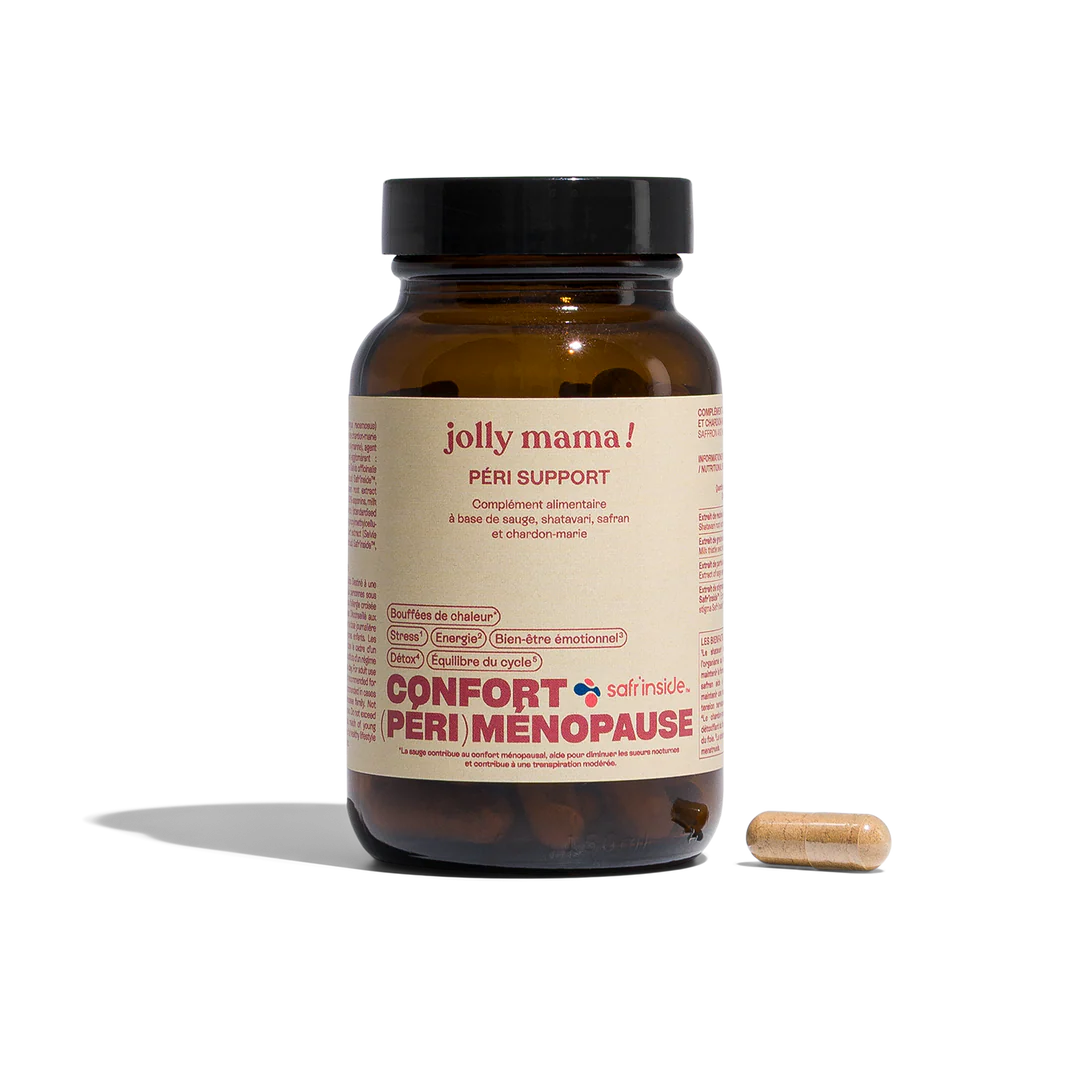
Péri Support is the formula targeting symptoms. It combines 4 complementary actives in 2 capsules per day:
- Shatavari root extract standardized to 20% saponins: 500 mg (cycles, stress, energy)
- Milk thistle standardized to 80% silymarin: 250 mg (liver support)
- Sage Salvia officinalis: 123 mg (hot flashes, night sweats)
- Patented saffron Safr'inside™: 30 mg (mood, relaxation, irritability)
The suppliers of these actives (Safr'inside™ saffron, sage) publish clinical studies suggesting improved comfort, notably on mood and hot flashes. These results concern the actives studied in isolation and are not a promise of individual results. Price: 34€/month for a one-time purchase, 28.90€/month on subscription (-15%).
Péri Essentials is the foundational multivitamin for perimenopause and menopause. In 2 capsules per day: 17 nutrients in their most bioavailable forms, including Quatrefolic® (methylated vitamin B9), K2VITAL® MK-7, Vitacholine™, and Bacognize® (a patented Bacopa extract for cognitive support). Price: 30€/month for a one-time purchase, 25.50€/month on subscription.
Both products are available on the official Jolly Mama site with the code LMC for -15% on your first order. To go further on the formulas available on the market, see our comparison of the best supplements for perimenopause.
FAQ: your questions about perimenopause symptoms
At what age can you be in perimenopause?
Perimenopause begins on average around age 47 but can start as early as 35-40. We speak of early menopause when it occurs naturally before age 40, which requires specific medical follow-up.
How do you tell perimenopause apart from stress or burnout?
The two can coexist and be confused. The distinctive sign is the change in the menstrual cycle: if your periods have changed (frequency, duration, heaviness) with no other identified cause, perimenopause is the most likely explanation from age 40 onward.
Can perimenopause last 10 years?
Yes. Its duration varies widely from one woman to another. Some go through this period in 2-3 years, others over 8 to 10 years before menopause sets in permanently.
Can you still get pregnant during perimenopause?
Yes, as long as you have your periods, pregnancy remains possible. Contraception is still necessary until 12 full months without a period after confirmed menopause.
Are perimenopause supplements effective without hormone therapy?
For mild to moderate symptoms, well-dosed plants and actives like those in Jolly Mama's Péri Support provide clinically studied support. For severe symptoms, a medical opinion on menopausal hormone therapy remains essential.
Scientific references
- INSERM, C'est quoi la préménopause ?, 2023: https://www.inserm.fr
- Ameli.fr, Périménopause : symptômes et contraception, HAS, 2025: https://www.ameli.fr
- Efficacy and Safety of Shatavari Root Extract for the Management of Menopausal Symptoms: A Double-Blind, Multicenter, Randomized Controlled Trial, 2024
- A Standardized Asparagus Racemosus Root Extract Improves Hormonal Balance and Menstrual Health and Reduces Vasomotor Symptoms in Perimenopausal Women, 2025
- The effect of Salvia officinalis extract on symptoms of flushing, night sweat and sleep disorders in postmenopausal women, 2020
- Efficacy of Crocus sativus (saffron) in treatment of major depressive disorder associated with post-menopausal hot flashes, 2018

LMC’s editorial line is built around transparency and reliability. Our content is written to help users make better decisions, based on 7 key criteria* that support trustworthy information, verified promo codes, and useful reviews.
To support LMC, some links are affiliate links. Our recommendations remain independent and based on transparent, verifiable criteria. By using the site, you accept our terms of use and our editorial policy.


.webp)

.avif)