


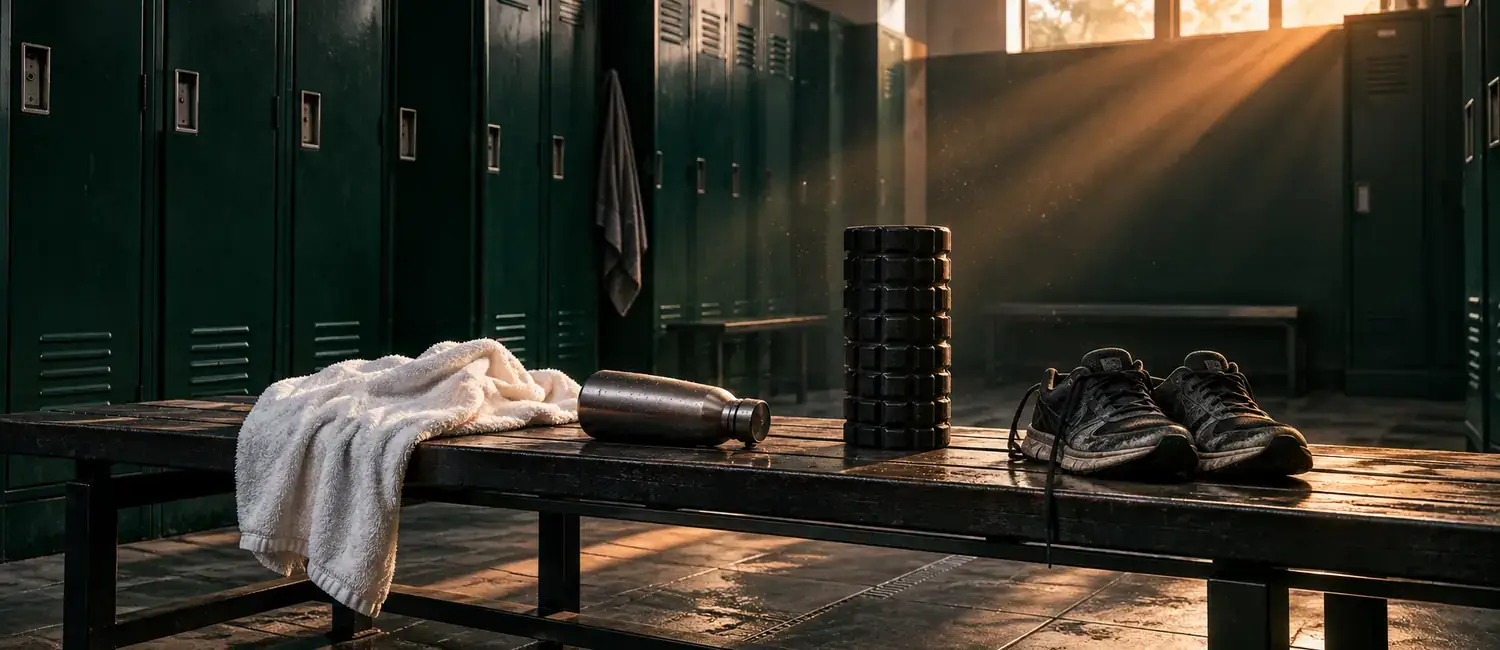
Why do you get sore muscles after a workout?
The scientific name is DOMS, for delayed onset muscle soreness. That delay is exactly what defines it.
The pain does not show up during the session or right after it, but 12 to 24 hours later, usually peaking between 24 and 72 hours. In the vast majority of cases it clears up on its own within 3 to 5 days.
The accepted mechanism involves microscopic damage to muscle fibers and connective tissue, followed by a local inflammatory response. That damage comes mainly from eccentric work, where the muscle lengthens under load: the descent in a squat, the negative phase of a curl, running downhill.
This is why a day of hiking in the mountains often leaves you sorer than a cycling session, even though it feels less intense at the time.
So what about lactic acid? It is the most common explanation, and the most wrong. The lactate produced during exercise is cleared within one to two hours, long before the pain appears. The debate is not entirely closed, a 2022 paper in Metabolites argues for revisiting its role through a neurocentric lens, but the timeline alone is enough to rule out the idea of acid sitting in your muscle for two days.
Does stretching prevent DOMS?
This is the advice people give most often, and the one that holds up worst under scrutiny.
A Cochrane systematic review published in 2011, pooling the available trials on stretching before or after exercise, found a negligible effect on muscle soreness. The reduction is so small that it means nothing in practice for the person doing the stretching.
A pragmatic randomized trial published in the British Journal of Sports Medicine reached the same conclusion under real training conditions.
That does not mean you should stop stretching. It still helps joint mobility and the feeling of stiffness, which is worth something. But selling it as DOMS prevention is a mistake, and it explains the frustration of people who stretch diligently and hurt anyway.
The point that matters more in practice: the best prevention is progression. Adding around 10 % to your load or volume per week, instead of doubling it overnight, avoids most severe soreness. 🏋
There is a second reason to be patient, and it is one of the better established findings in this field. It is called the repeated bout effect: after one session that leaves you sore, the same session repeated a week or two later produces markedly less soreness and less muscle damage. The muscle adapts, and it does so fast. This is why the first week back is brutal and the third is fine, and why chasing soreness as a marker of progress makes no sense once you are training regularly.
Practical consequence for a beginner: the worst thing you can do is wait until the soreness is completely gone before training again, then start over from scratch every time. A light session while still slightly sore keeps the adaptation going and shortens the painful phase over the following weeks.


What actually helps in the first 48 hours?
Only three levers have demonstrated value, and they are less exciting than the gadgets sold for the job.
Move gently. Active recovery, a walk, twenty minutes of low resistance cycling or easy swimming, increases local blood flow and temporarily eases the pain you feel. The effect is real during the activity and in the hours that follow, without speeding up repair itself.
Sleep. This is the most neglected lever and probably the most powerful. Tissue repair happens mainly during deep sleep. A short night after a heavy session mechanically drags the discomfort out.
Eat enough protein. A Bayesian meta-analysis published in 2026 in the Journal of the International Society of Sports Nutrition assessed protein supplements for post-exercise recovery. The effect exists but stays moderate: what counts is your total intake across the day, not the timing of one shake.
Two things do nothing, contrary to what you often read. Drinking three liters of water will not flush soreness away, even though staying properly hydrated remains sensible. And punishing yourself with a second hard session to work the pain out only adds fresh damage on top of the old.

Do cold and heat really do anything?
Both have an effect, just not the one people assume, and cold deserves a warning.
Cold water immersion reduces perceived pain in the hours that follow. Two papers published in 2026, one in PeerJ on the time course of strength recovery, the other in Medicine comparing ice baths with whole body cryotherapy, confirm an effect on sensation and on some short term performance measures.
The caveat matters: by blunting the inflammatory response, routine cold after every session can dampen the muscle adaptations you are training for. In other words, an ice bath makes sense when you have to compete again tomorrow, much less when the goal is to get stronger.
Heat, a hot bath or shower, repairs nothing but relaxes and soothes. It does not carry the same downside for adaptation, which makes it the default choice for a recreational lifter who simply wants to feel better.
Do massage and foam rolling have a measurable effect?
Yes, and they are among the few passive methods that survive systematic review.
A systematic review published in the British Journal of Sports Medicine examined post-exercise massage for muscle soreness. The benefit is real, but modest and short lived, on the order of a few hours of relief.
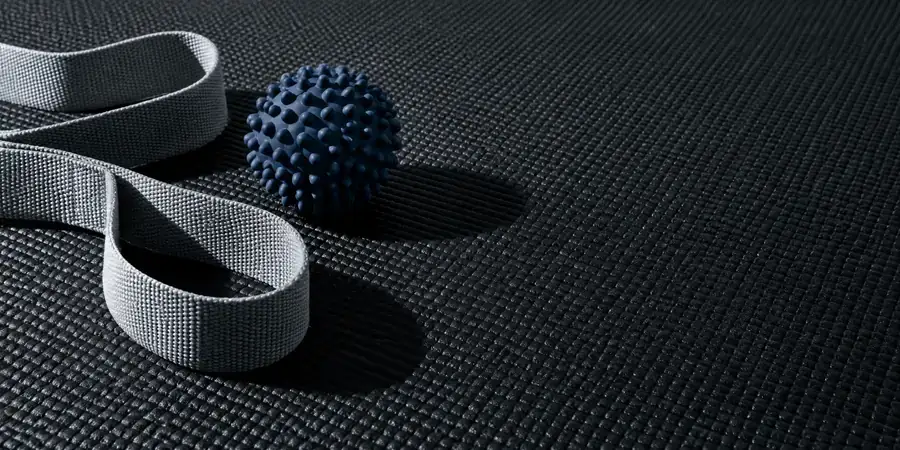
Foam rolling produces comparable results, with the advantage that you can do it alone and for free. Count 60 to 90 seconds per muscle group, without chasing maximum pain, which adds nothing.
Worth remembering: these methods act on how you feel, not on how fast the fibers repair. That is already useful when you have to work or walk normally the next day, but do not expect a shortcut.
What about compression garments? They sit in the same category. Compression tights or sleeves worn in the hours after a session reduce reported soreness and the feeling of heavy legs, with a small effect on some performance markers. The mechanism is debated, and part of the benefit may come from the sensation of support rather than from circulation. If you already own a pair, wearing them the evening after a hard session costs nothing. Buying them specifically to fix DOMS is a poor use of money compared with sleeping properly.
The same goes for massage guns. They do roughly what a foam roller does, faster and more expensively, with no evidence that the vibration adds anything beyond the pressure itself.
Which supplements actually have data on recovery?
The market is crowded, but a few ingredients stand out on the quality of their evidence.
Curcumin, the active compound in turmeric, is the best documented. A systematic review published in 2024 in the Journal of the International Society of Sports Nutrition assessed its effect on exercise induced muscle damage in athletes, and a 2026 study in Nutrients looked at its influence on recovery, oxidative stress and inflammation. The findings point the same way, with an effect on biological markers and on reported pain.
Its weakness is well known: curcumin is poorly absorbed on its own. Formulas that pair it with a fat or with piperine stand a better chance of doing something.
Boswellia (Boswellia serrata) works on different inflammatory pathways. A 2024 systematic review with meta-analysis assessed a standardized extract in osteoarthritis, with favorable effects on pain. That is not the context of a sore lifter, so the transfer should be treated with caution.
Ginger was the subject of a 2026 synthesis in Nutrition Reviews on its influence on exercise induced muscle pain.
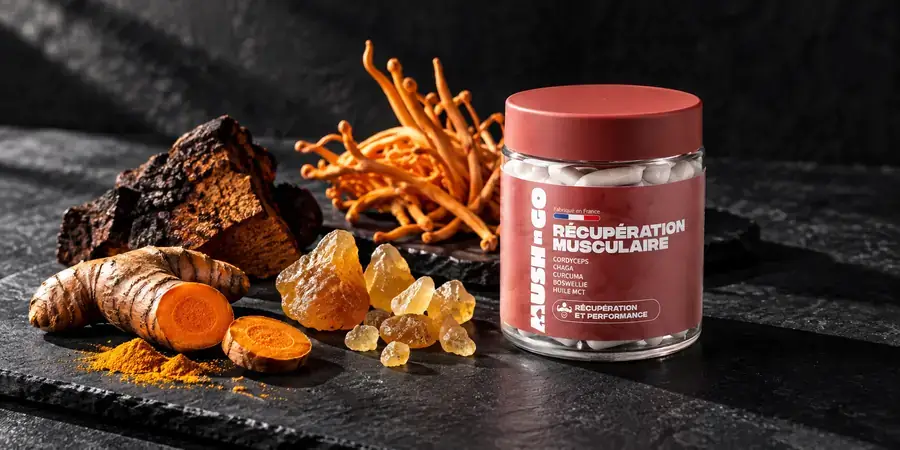
Some formulas aimed at athletes combine precisely these ingredients. The one from Mush N Go pairs turmeric 360 mg and boswellia 180 mg with cordyceps and chaga, plus MCT oil for absorption. The code LMC15 gives 15 % off. We broke down every dose in our analysis of the range, ingredient by ingredient.
Other ingredients come up regularly here. Colostrum has been studied for its effect on exercise related gut permeability, a subject we covered in our guide to colostrum. Ashwagandha has some data on recovery in athletes, detailed in our piece on ashwagandha and sport.
A word on ordinary anti-inflammatories. Taking ibuprofen after every session relieves the pain, but several studies suggest that doing it routinely can interfere with the training adaptations you are after. Keep it for the times when the pain genuinely gets in the way, not as a recovery habit.
| Method | What the studies show | Verdict |
|---|---|---|
| Active recovery (walking, easy cycling) | Temporary relief of perceived pain | ✅Do it |
| Enough sleep | Baseline condition for muscle repair | ✅Do it |
| Protein intake | Moderate effect on recovery, better established on performance | ✅Useful |
| Stretching before or after | Negligible effect on soreness according to the Cochrane review | ❌Useless against DOMS |
| Ice bath | Reduces perceived pain, may blunt long term adaptations | Depends on your goal |
| Massage and foam rolling | Real but modest and short lived effect | ✅Useful |
| Natural anti-inflammatories (curcumin) | Favorable data on muscle damage markers | ✅Worth a look |
| Routine ordinary anti-inflammatories | May interfere with muscle adaptation | ❌Avoid as a habit |
When should you worry about muscle soreness?
Normal soreness is diffuse, symmetrical if the effort was, and it eases a little every day. Some signs mean you should see a doctor without waiting.
- Very intense, localized pain in a single muscle, which came on suddenly during the session: that is not DOMS but probably a strain or a tear.
- Dark urine, the color of tea or cola, along with major muscle pain and swelling. That can signal rhabdomyolysis, which is a medical emergency.
- Pain that lasts beyond 7 days or gets worse instead of better.
- Fever alongside the muscle pain, which points more toward an infection.
If in doubt, especially after an unusually hard return to training, a medical opinion settles the question in a few minutes.
Frequently asked questions about DOMS
How long does DOMS last?
Between 3 and 5 days as a rule, peaking 24 to 72 hours after the session. Past 7 days, it is no longer ordinary soreness.
Can you train with sore muscles?
Yes, as long as you lower the intensity or work other muscle groups. Pushing through a painful muscle raises the injury risk, because coordination is impaired.
Is DOMS a sign of a good workout?
No. It mostly signals an unfamiliar load. A regular lifter progresses perfectly well without soreness, and a beginner can ache after a mediocre session.
How do you avoid DOMS when getting back into training?
By building up gradually, around 10 % more volume per week, and by limiting eccentric work in the first few sessions.
Does the sauna help recovery?
It relaxes and soothes, like a hot bath, but it does not speed up muscle repair. Remember to make up for the fluid loss.
Why am I sorer two days later than the day after?
Because the inflammatory response peaks between 24 and 72 hours, not immediately. The day after a session you are often only stiff. Day two is usually the worst, which is exactly what the delayed in delayed onset muscle soreness refers to.
Does stretching before a workout prevent injury at least?
Static stretching before exercise does not reliably reduce injury risk and can slightly lower force output in the minutes that follow. A dynamic warm-up is the better use of those ten minutes. Keep static stretching for after, or for a separate mobility session.
Scientific references
- Herbert R. D. et al., Cochrane Database of Systematic Reviews, 2011. Stretching to prevent or reduce muscle soreness after exercise. PubMed 21735398
- British Journal of Sports Medicine, 2010. Pragmatic randomized trial of stretching before and after physical activity. PubMed 19525241
- Metabolites, 2022. Should lactate be dismissed from the pathophysiology of DOMS, a neurocentric reading. PubMed 36144262
- British Journal of Sports Medicine, 1998. Does post-exercise massage reduce delayed onset muscle soreness, a systematic review. PubMed 9773168
- PeerJ, 2026. Time course of strength recovery after cold water immersion, systematic review and meta-analysis. PubMed 42473449
- Medicine, 2026. Cold water immersion versus whole body cryotherapy on muscle soreness and jump performance. PubMed 41578562
- Journal of the International Society of Sports Nutrition, 2024. Curcumin and the reduction of exercise induced muscle damage in athletes, systematic review. PubMed 39623590
- Nutrients, 2026. Curcumin supplementation, recovery, oxidative stress, inflammation and muscle damage. PubMed 42356379
- Journal of the International Society of Sports Nutrition, 2026. Effectiveness of protein supplements on performance and recovery, Bayesian meta-analysis. PubMed 41433039
- Explore, 2024. Standardized Boswellia serrata extract in osteoarthritis, systematic review and meta-analysis. PubMed 38365549
- Nutrition Reviews, 2026. Influence of ginger on exercise induced muscle pain. PubMed 42186281
Food supplements are not a substitute for a varied, balanced diet and a healthy lifestyle. If muscle pain is intense, persistent or comes with dark urine, see a health professional promptly.

LMC’s editorial line is built around transparency and reliability. Our content is written to help users make better decisions, based on 7 key criteria* that support trustworthy information, verified promo codes, and useful reviews.
To support LMC, some links are affiliate links. Our recommendations remain independent and based on transparent, verifiable criteria. By using the site, you accept our terms of use and our editorial policy.

.webp)

.avif)