

What is Bonjour Kids, Bonjour Drink's cocoa drink?
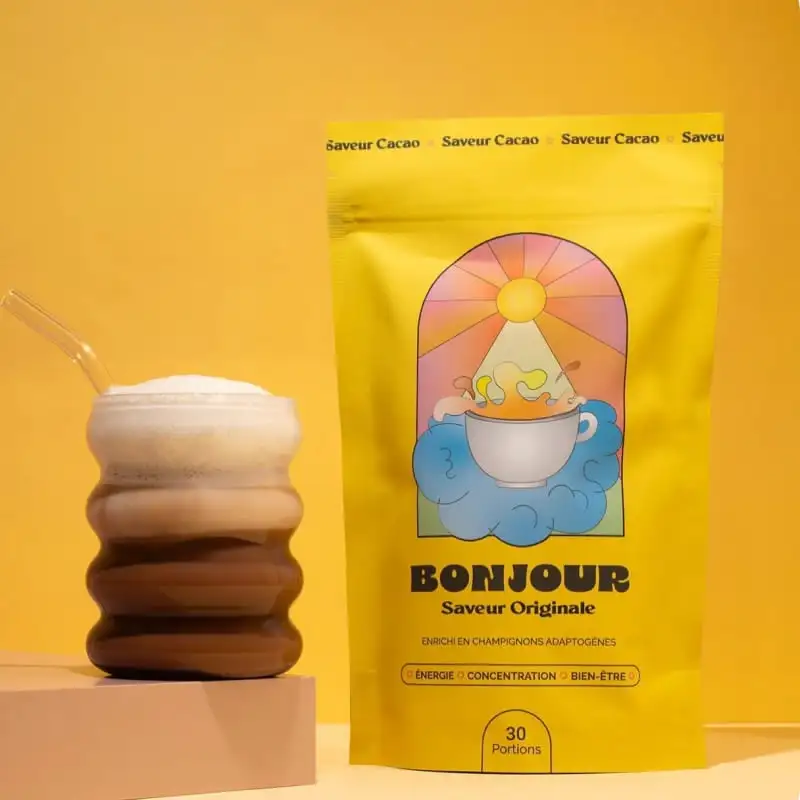
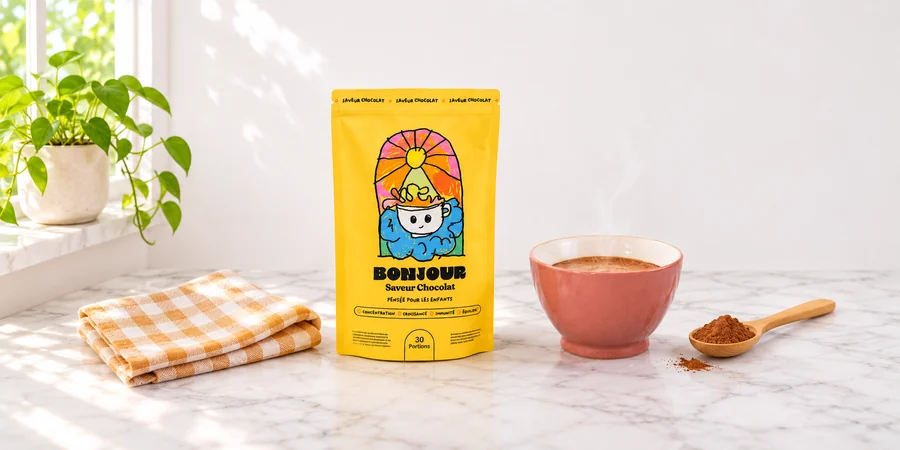
Bonjour Kids is a chocolate powder you stir into a mug of hot or cold milk, formulated for children aged 3 and over, with no added sugars, no caffeine and fortified with eight vitamins and minerals. One pouch makes 30 mugs, and the brand recommends one to two mugs a day, at breakfast or as an after-school snack.
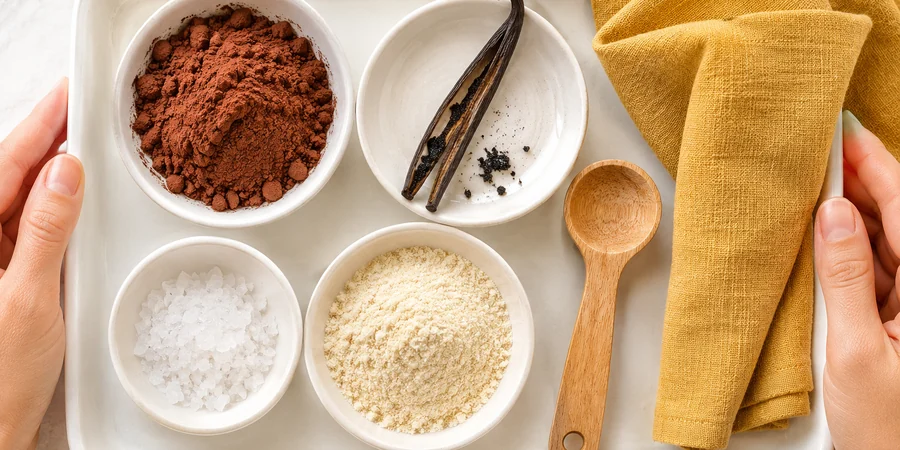
This product has nothing to do with the mushroom drink that made the brand famous. The adult ritual is built on adaptogenic mushrooms, and some flavours contain caffeine: it remains strictly for adults. The children's version drops both. Instead, you get fat-reduced cocoa powder, Bourbon vanilla pod, acacia fibre, a pinch of Camargue salt and steviol glycosides for sweetness, followed by the added vitamins and minerals.
On the pouch, the brand puts forward four themes: focus, growth, immunity and balance. These rest on the added nutrients, not on any property of the drink itself, and that distinction matters when you compare products in this aisle.
The energy profile, meanwhile, is unusual for a chocolate powder: 22 calories per prepared serving, not counting the milk. Most standard powders sit at around 60 to 80 calories for the same dose, and the gap comes almost entirely from sugar, which often makes up three quarters of the product. Here there is none, and that is the first thing that sets it apart on the shelf.
As for manufacturing, the powder is made in France by a laboratory that has specialised in this work for more than twenty years, and every batch goes through Phytocontrol, a COFRAC-accredited laboratory. The cocoa comes from the Dominican Republic, chosen for one specific reason I come back to below: its cadmium content.
What is really in a mug of Bonjour Kids?
One mug provides 100 mg of calcium, 2,5 µg of vitamin D3, 18,8 µg of vitamin K2, 40 mg of vitamin C, 1,25 µg of vitamin B12, 6 mg of vitamin E, 1,25 mg of zinc and 5,5 µg of selenium, all from identified natural sources. That level of transparency is rare: the brand names the origin of each micronutrient rather than settling for a list of additives.
The calcium comes from a seaweed, Lithothamnion, rather than a synthetic carbonate. The vitamin D3 is extracted from lichen, which makes it suitable for a plant-based diet, whereas standard D3 comes from sheep's wool lanolin. The K2 comes from natto, the Japanese fermented soya. Vitamin C comes from acerola, zinc from guava leaf, selenium from a yeast and B12 from fermentation.
| Nutrient | Amount per mug | Share of the adult RI | Source in the formula |
|---|---|---|---|
| Calcium | 100 mg | 12,5 % | Lithothamnion seaweed |
| Vitamin D3 | 2,5 µg | 50 % | Lichen |
| Vitamin K2 | 18,8 µg | 25 % | Fermented natto |
| Vitamin C | 40 mg | 50 % | Acerola |
| Vitamin B12 | 1,25 µg | 50 % | Fermentation |
| Vitamin E | 6 mg | 50 % | Soya |
| Zinc | 1,25 mg | 12,5 % | Guava leaf |
| Selenium | 5,5 µg | 10 % | Yeast |
| Fibre | Not stated | Not applicable | Organic acacia gum |
Two comments on this table. The percentage column needs to be read with care, and the next section explains why. As for the amount of acacia fibre per mug, it is not disclosed, even though the ingredient comes second on the list: a figure would match the transparency the brand shows on vitamins.
The claims these nutrients allow are governed by EU regulation 432/2012, which sets their wording word for word. Calcium is needed for the maintenance of normal bones and for the maintenance of normal teeth. Vitamin D contributes to normal absorption/utilisation of calcium and phosphorus and to the normal function of the immune system. Vitamin C contributes to the reduction of tiredness and fatigue and to normal functioning of the nervous system. Zinc contributes to normal cognitive function. These sentences come straight from the official text, and none of them is about the product itself: they are about the nutrients it contains.
A word on what is not on the list: no caffeine, no adaptogenic mushrooms, no added sugars, no gluten, no lactose, no artificial additives. The formula is vegan. For a parent who reads labels, that is a short list, and that is a good sign.

Also worth reading : is Bonjour Kids dangerous for a child? / which Bonjour Drink version by age.
Why the percentages on the pouch refer to an adult
The percentages shown on food labels are calculated from the reference intakes in Annex XIII of EU regulation 1169/2011, and that annex states in black and white that they are values for adults. One mug therefore covers 50 % of the adult reference for vitamin D, vitamin C, vitamin B12 and vitamin E, 25 % for vitamin K, 12,5 % for calcium and zinc, and 10 % for selenium.
For a child aged 4 or 6, who weighs three to four times less than an adult, the same amount automatically represents a much larger share of their needs. That is exactly why the brand caps intake at two mugs a day rather than three or four, and that cap should be followed to the letter. It is not set by the cocoa, it is set by the vitamins.
This also changes how you fit the product into the day. If your child already takes a multivitamin, a fortified water or fortified breakfast cereals, the intakes add up without anyone doing the maths. In that case, the sensible move is to talk to your paediatrician rather than stacking them, and to pick one or the other.
Two nutrients deserve a closer look. First, vitamin K2: it contributes to normal blood clotting under regulation 432/2012, and that is precisely what makes it incompatible with anticoagulant treatments of the vitamin K antagonist family. It is rare in children, but it does happen, and it calls for medical advice before the product is introduced. Then there is selenium, where the margin between a useful intake and too much is narrower than for other minerals: at 5,5 µg per mug you are nowhere near it, but it is one more reason not to pile up sources at the same time.

What does the research say about this kind of fortified drink?
No clinical study has been published on Bonjour Kids as a product, and that needs saying plainly: what is documented are the nutrients and ingredients it contains, not the drink itself. The same goes for the vast majority of products in this aisle, and no brand should claim otherwise.
On calcium, the benchmark systematic review is a Cochrane review that pooled supplementation trials in children. Its conclusion is nuanced and worth knowing as a parent: supplementation increases bone mineral density, but the effect is modest and does not necessarily last once it stops. In other words, a regular intake makes sense in a diet that falls short, not as an insurance policy for adult life.
On acacia fibre, a controlled trial published in Nutrients in 2021 measured better satiety and a lower blood glucose peak after breakfast in 48 adults, with good digestive tolerance. Two caveats apply: the study involved adults, and the doses tested, 20 and 40 g, are far above what a 6 g serving of chocolate powder provides. So this result cannot be carried over to a child's morning mug.
On breakfast itself, however, the evidence is stronger and directly relevant. A crossover trial in 96 adolescents found better accuracy on complex cognitive tasks on mornings with breakfast than on mornings without. The credit goes to the meal, not to any particular powder, and that may be the most honest argument in favour of this product: if it gets a child who used to skip breakfast to sit down and eat, the benefit is real, and it does not come from a miracle ingredient.
Finally, on cocoa and cadmium, the regulations give a clear benchmark. EU regulation 2023/915 sets the maximum cadmium level for cocoa powder sold to the consumer or used in drinking chocolate at 0,60 mg/kg. The brand states 0,27 mg/kg for its Dominican Republic cocoa, backed by lab results, which is less than half the limit. That is a genuine mark of seriousness, and it is rarely disclosed in this aisle.
How does it taste, and do children take to it?
It tastes like a proper hot chocolate, a little more bitter than Nesquik and much less sweet, with a note of vanilla that rounds it off. That is the direct result of having no sugar, and it is the real question mark over this product.
A child used to standard powders often finds the first mug bland or bitter. The switch goes more smoothly if you serve the drink nice and hot, with whole milk rather than semi-skimmed, and allow a few days to adjust. Another, more gradual option: mix their usual powder with this one for a week, then increase the share of Bonjour Kids.
The texture, on the other hand, is a real strength. The acacia fibre stops lumps from floating on the surface, a classic flaw of unsweetened cocoa, and the powder dissolves without a blender. Each serving is measured with the scoop provided, about 6 g, so a 30-mug pouch lasts between two weeks and a month depending on how often you use it.
How much does a mug cost, and where can you buy Bonjour Kids at the best price?
The 30-mug pouch is listed at 44,00 euros, or 1,47 euro per mug, and drops to 35,20 euros with the code LMC20, or 1,17 euro per mug. On subscription, the brand starts at 0,90 euro a day before discount, and takes off an extra 5 % from two children upwards. These prices are indicative and were checked at the time of writing.
Let's be clear: at 1,17 euro, a mug costs several times as much as a mug of supermarket chocolate powder. What you are really comparing is the whole package (a sugar-free powder fortified with eight naturally sourced micronutrients, made in France and tested batch by batch) against a powder that is 75 % sugar and costs a few cents a cup.
You buy it from the brand's official shop, bonjourdrink.co, which offers a 60-day money-back guarantee and free delivery. That is a long time, and for a product whose taste may not win everyone over straight away, the guarantee has real value: it leaves time for the adjustment period.
The code LMC20 gives 20 % off the whole range, Kids included. To use it, simply enter it in your basket on the official Bonjour Kids page. The full details of ingredients, doses and conditions are also on our Bonjour Kids product sheet.
What are the weak points of Bonjour Kids?
Three limits stand out: just one flavour in the range, cocoa that is not organic, and a price that stays high for daily use. None of them is a deal-breaker, but they are worth weighing up before you order.
- Just one flavour. Chocolate and nothing else. For a product meant to be drunk every morning, boredom is a real risk, and the adult range has six flavours where the children's version has only one.
- The cocoa is not certified organic. The acacia fibre and the vanilla are, the cocoa is not. For a brand that takes so much care over where its raw materials come from, it is an inconsistency you can spot on the label.
- The price. Even with the discount, 1,17 euro per mug works out at around 35 euros a month for a child who has one a day, and double that for two mugs.
On the precautions side, vitamin K2 calls for medical advice if your child is on a vitamin K antagonist anticoagulant, and the cap of two mugs a day is not a marketing line. The product contains soya, which matters if there is an allergy. And like any sweet-tasting drink, even one with no sugars, it replaces neither water nor a meal.
My final verdict on Bonjour Kids
I give Bonjour Kids 8,3 out of 10. It is one of the cleanest children's formulas I have come across in this aisle: no added sugars where competitors put in three quarters, micronutrients whose origin is named one by one, French manufacturing, published batch tests and a cadmium level half the regulatory limit.
What I mark it down for comes down to three things: the non-organic cocoa, the single flavour, and a price that commits you over time. The product holds up perfectly well as a morning ritual for a family trying to move away from sugary powders, much less so as an impulse buy. The 60-day guarantee is the right safety net for making up your mind at home.
To go further: our analysis of Bonjour Drink's Yuka score, the page on contraindications across the Bonjour range, which separates the adult and children's formulas, and our Bonjour Drink brand profile.
Frequently asked questions about Bonjour Kids
From what age can children have Bonjour Kids?
The brand says 3 years. Below that age, the product is not intended for this use, and a toddler's diet is a matter for the usual paediatric follow-up.
How many mugs a day can a child drink?
One to two mugs a day at most. The cap comes from the added vitamins and minerals, whose amounts are calculated on adult references, not from the cocoa.
Does Bonjour Kids contain sugar or caffeine?
Neither. The sweet taste comes from steviol glycosides, the sweetener E960, and the children's formula contains no caffeine and no adaptogenic mushrooms, unlike the adult range.
Is Bonjour Kids suitable for a lactose-intolerant child?
The powder is lactose-free and vegan. It is usually made with milk, though: with a plant-based drink, the taste changes and the calcium the meal provides is not the same.
Can you get Bonjour Kids for less?
The code LMC20 gives 20 % off the whole range, Kids included, and a subscription brings the price per mug down further, with an extra 5 % from two children upwards. Prices are indicative and should be checked on the shop.
Scientific and regulatory references
- Winzenberg T. et al., Calcium supplementation for improving bone mineral density in children, Cochrane Database of Systematic Reviews, 2006. PMID 16625624
- Larson R. et al., Acacia Gum Is Well Tolerated While Increasing Satiety and Lowering Peak Blood Glucose Response, Nutrients, 2021. PMID 33672963
- Cooper S.B. et al., Breakfast consumption and cognitive function in adolescent schoolchildren, Physiology & Behavior, 2011. PMID 21439306
- Regulation (EU) No 1169/2011, Annex XIII, reference intakes for adults. EUR-Lex
- Regulation (EU) No 432/2012 establishing a list of permitted health claims. EUR-Lex
- Regulation (EU) 2023/915 on maximum levels for certain contaminants, point 3.2.15.4 for cadmium in cocoa powder. EUR-Lex
Food supplements should not be used as a substitute for a varied and balanced diet and a healthy lifestyle. This article does not replace advice from a healthcare professional: if you are on medication, have an allergy or follow a special diet, ask your doctor or paediatrician.

LMC content is written by our editorial team from the information published by the brands. Scores out of 10 follow a public grid of 5 criteria*, supplemented by LMC’s editorial assessment.
To support LMC, some links are affiliate links: LMC earns a commission at no extra cost to you, and some of the brands featured are partners. By using the site, you accept our terms of use and our editorial policy.