

What is the best chocolate powder for a child?
For everyday use, Bonjour Kids tops our ranking: it is the only powder in this comparison that is both free from added sugars and enriched with eight vitamins and minerals. Van Houten L'Original comes a close second for families who want pure cocoa and the lowest price, ahead of Nesquik and then Banania, both of which have very high sugar content.
Here is the full ranking, before we look at each product in detail:
- 1. Bonjour Kids: no added sugars, enriched, cocoa from the Dominican Rep. with its cadmium content published. By far the most expensive of the lot.
- 2. Van Houten L'Original: two ingredients, 0,9 g of sugars per 100 g, unbeatable on price. But bitter, and nothing added.
- 3. Nesquik: 75,1 g of sugars per 100 g, i.e. 9,5 g per serving, and 23 % cocoa. The taste every child accepts.
- 4. Banania: sugar as the first ingredient, 69 g per 100 g, and a noticeably more generous recommended serving, which puts 23 g of sugars in each mug.
The nutritional values quoted in this article were taken from retailers' product pages on 15 November 2026. They may change as recipes are reformulated, so the best habit is still to read the packet you have in your hand.
How we separated these four powders
The ranking is based on the sugar actually consumed per serving, the place of cocoa in the recipe, the declared micronutrients and the length of the ingredient list. Price comes last, and it does not work in our number one's favour.
The first criterion deserves an explanation, because it holds a few surprises. Comparing the figures per 100 g of powder is not enough: each brand recommends a different serving, and that is what decides what ends up in the mug. A powder with 69 g of sugars per 100 g and a 33 g serving delivers more sugar than a powder at 75 g served at 13 g. That is exactly the gap you see between the two supermarket brands in this comparison.
The second criterion is the share of cocoa, which you can read straight off the packet. Below 25 %, the powder is first and foremost a sugary product flavoured with cocoa, not a sweetened cocoa, and you can taste the difference just as clearly as you can see it in the nutrition table.
The third is what has been added. Some powders are fortified, others are not, and neither approach is bad in itself: what matters is knowing, so you don't double up with other fortified products on the same day.
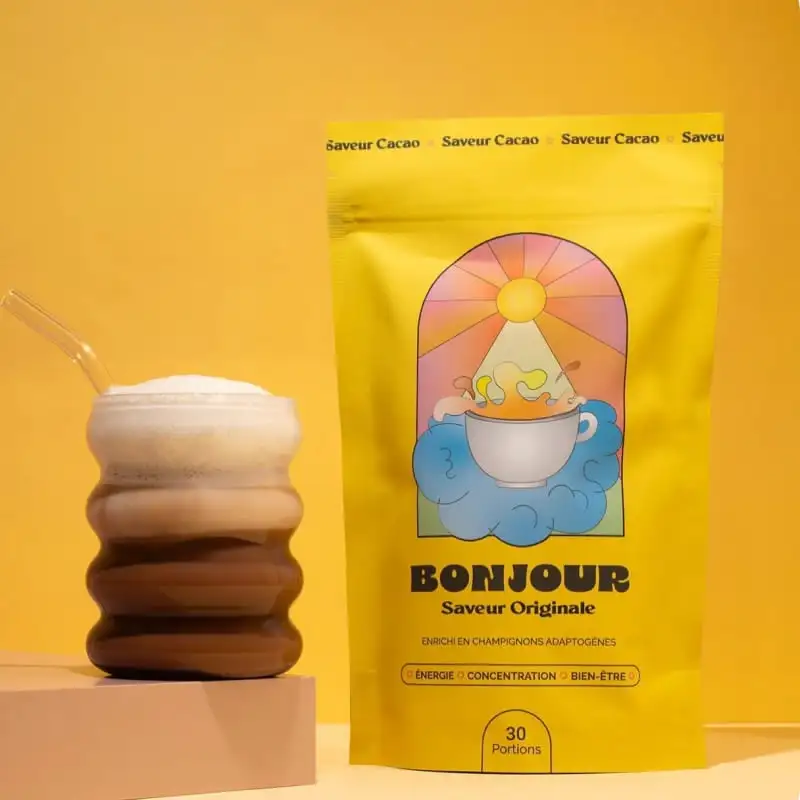

Also worth reading : my full review of Bonjour Kids / the safety questions about this drink.
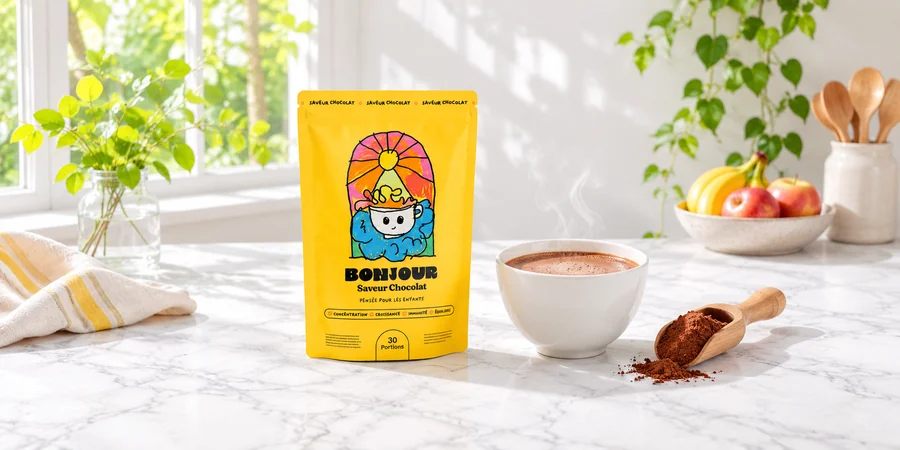
1. Bonjour Kids, the only sugar-free, fortified powder
Bonjour Kids is a cocoa powder formulated for children aged 3 and over, with no added sugars, no caffeine and enriched with eight vitamins and minerals of natural origin. A mug provides 22 calories, excluding milk, compared with 40 to 90 calories for a serving of a standard sweetened powder.
The recipe fits in a few lines: fat-reduced cocoa powder, acacia fibre, Bourbon vanilla pod, Camargue salt, steviol glycosides for sweetness, then the micronutrients. The calcium comes from marine algae, vitamin D3 from lichen, vitamin C from acerola, K2 from natto, zinc from guava leaf. It is the only product in this comparison that names the source of every one of its nutrients.
Another distinctive feature: the brand publishes the cadmium content of its cocoa, 0,27 mg per kilo, against a regulatory ceiling of 0,60 mg per kilo for cocoa powder. None of the other three products discloses this figure, even though it is the real health issue with cocoa-based products.
The drawbacks are real and you need to know them: only one flavour in the range, cocoa that is not organic, and above all a price in a different league from the rest of the shelf, 1,17 € per mug with our code, against a few cents for a supermarket powder. You will find the full details in our Bonjour Kids review, and safety questions are covered separately in our article on the possible risks for a child.
2. Van Houten L'Original, pure cocoa at the best price
With 0,9 g of sugars per 100 g and just two ingredients, Van Houten's unsweetened cocoa is the least processed product in this comparison, and the cheapest per mug. Its ingredient list comes down to fat-reduced cocoa powder and an acidity regulator.
Its figures are remarkable: 20 g of protein per 100 g, 11 g of carbohydrates with almost no sugars, and a recommended serving of around 5 g, which means 0,2 g of sugars in the mug. For a parent whose goal is simply to cut out sugar, it is the most direct and most economical option on the shelf.
The problem lies elsewhere, and with a child it is a big one: pure cocoa is frankly bitter. Without added sugar or sweetener, most children refuse it, and it is very tempting to stir in a spoonful of sugar yourself, which defeats the whole point. It also provides no added vitamins or minerals.
This is the choice I would recommend to a family whose child already accepts less sweet flavours, or for baking. For a breakfast mug, it needs a little help, for example a mashed banana or milk that is already lightly sweetened.
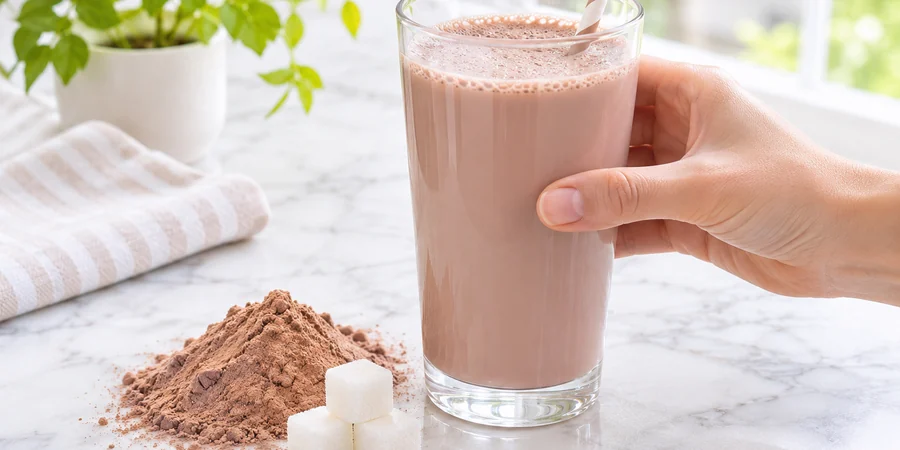
3. Nesquik, the classic every child accepts
Nesquik contains 75,1 g of sugars per 100 g of powder, i.e. 9,5 g per recommended 13 g serving, and 23 % cocoa. In other words, three quarters of the product is sugar, and cocoa comes a long way behind.
The recipe adds an emulsifier, soya lecithin, salt, a natural flavouring, cinnamon, and two vitamins, C and D. The latter is the brand's long-standing nutritional selling point, and it still holds: vitamin D is indeed a nutrient that the French diet covers poorly.
Credit where it is due: this is the powder children drink without negotiating, it dissolves perfectly, it costs a few cents per mug and it is gluten-free. For occasional use, a mug on a Sunday morning, nobody should feel guilty.
For everyday use, however, 9,5 g of sugars per mug is roughly two sugar cubes, every morning, before the rest of breakfast even starts. It is this repetition that raises questions, not the product itself.
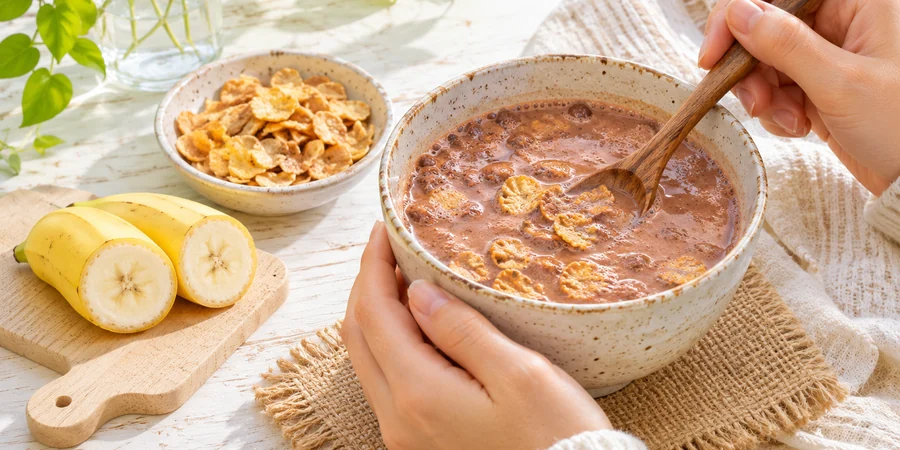
4. Banania, a childhood taste hiding a generous serving
In Banania, sugar is the first ingredient on the list, ahead of the highly defatted cocoa that makes up only 19 % of the recipe, and the powder contains 69 g of sugars per 100 g. Because the recommended serving is more generous, the mug provides 23 g of sugars, the highest in this comparison.
The recipe also includes biscuit cereals made from wheat and barley, which give it its distinctive taste but rule the product out for anyone with a gluten intolerance. Banana, which gives the brand its name, accounts for 0,25 % of the recipe, the same as honey.
It is not a bad product, it is a treat with a taste that many adults associate with their childhood. The cereals make it more filling than a simple cocoa powder. But at 23 g of sugars per mug, the equivalent of four to five sugar cubes, it clearly belongs in the occasional category.
| Criterion | Tested by LMCBonjour Kids |
Van Houten unsweetened |
Nesquik |
Banania |
|---|---|---|---|---|
| Sugars per 100 g | ✅No added sugars | ✅0,9 g | ❌75,1 g | ❌69 g |
| Sugars per serving | ✅0 g | ✅0,2 g | ❌9,5 g | ❌23 g |
| Share of cocoa | Main ingredient | 100 % | 23 % | 19 % |
| Added micronutrients | ✅8 vitamins and minerals | ❌None | Vitamins C and D | Not declared |
| Ingredient list | Short, no artificial additives | ✅2 ingredients | Emulsifier, flavouring, cinnamon | Cereals, flavouring, honey |
| Gluten | ✅Gluten-free | ✅Gluten-free | ✅Gluten-free | ❌Wheat and barley |
| Cost per mug | ❌1,17 € with LMC20 | ✅A few cents | ✅A few cents | ✅A few cents |
How to cut the sugar in the mug without putting your child off
Switching powders overnight is the surest way to get the mug refused. A taste for sweetness is learned, and it can be unlearned too, but over a few weeks rather than all at once.
The method that works best is gradual mixing. Keep the usual powder and replace a quarter of the serving with unsweetened cocoa for a week, then half, then three quarters. The taste buds follow along without the child noticing any break, and many families stop halfway, which already halves the morning sugar.
The second lever, often more effective than changing brands: the serving size. The quantities recommended on packets are generous, and nobody measures them. Going from a heaped spoon to a level spoon cuts the sugar by a third without touching the product. With a powder served at 33 g, that is ten grams less sugar in the mug.
A third option is the milk itself. Whole milk carries the taste of cocoa better than semi-skimmed, and a piping hot drink tastes sweeter than a lukewarm one with exactly the same composition. These are details, but they help a palate used to sugar accept a recipe that contains less of it.
Finally, timing matters as much as the product. A mug at teatime, with a piece of fruit or a slice of bread, is easier to negotiate than a change imposed first thing in the morning, when the child is in a hurry and in no mood to try something new. We go through this choice between breakfast and teatime in our article on which drink suits which age.
Why Bonjour Kids tops our ranking
Because it is the only one that solves both problems at once: the sugar and getting the child to accept it. Van Houten solves the first but often fails on the second, while Nesquik and Banania do the opposite.
That is the whole point of the sweetener in this formula: it gives a sweet chocolatey taste without sugar, where pure cocoa stays bitter. This choice is not neutral and is worth knowing about, as steviol glycosides are the additive E960, which is also why we still keep Van Houten on the podium.
On top of that come three things that no competitor in this comparison offers: micronutrients whose source is named one by one, French manufacturing with batch testing by a COFRAC-accredited laboratory, and a published cadmium content that is less than half the regulatory ceiling.
That leaves the price, and it is the acknowledged weak point: at 1,17 € per mug with the code LMC20, Bonjour Kids costs ten to twenty times as much as a supermarket powder. It is a question of family budget, not a foregone conclusion. If you want to try it, the brand offers a 60-day guarantee on its online shop, bonjourdrink.co, and the code gives 20 % off the children's range. Prices are indicative as of the publication date.
One last word on what this ranking does not say: none of these powders is essential. A mug of milk with a piece of fruit makes a very good breakfast. The point of this article is to choose as well as possible when you want hot chocolate, not to claim that you need it.
Frequently asked questions about chocolate powders for children
Which chocolate powder contains the least sugar?
Van Houten L'Original, with 0,9 g of sugars per 100 g, and Bonjour Kids, which contains no added sugar at all. The standard powders on the shelf range from 69 to 75 g per 100 g.
Is unsweetened cocoa suitable for a child?
Nutritionally, yes, it is actually the simplest product. The difficulty is the taste: pure cocoa is bitter and many children refuse it without something to sweeten it.
From what age can you give a child chocolate powder?
It depends on the product and on what the manufacturer states. Bonjour Kids is aimed at children aged 3 and over. For standard powders, the useful benchmark is the amount of sugar rather than the age.
Is chocolate powder fortified with vitamins useful?
It can be, in a diet lacking certain nutrients, but the intakes add up with other fortified products and any supplements. If your child is already taking supplements, talk to your paediatrician.
What about organic chocolate powder from the supermarket?
The organic label covers the farming method, not the amount of sugar. An organic powder can easily contain 70 g of sugars per 100 g: you still need to read the nutrition table.
Sources and method
- Nutritional values and ingredient lists taken on 15 November 2026 from retailers' product pages (Nesquik, Banania, Van Houten L'Original) and from the brand's website for Bonjour Kids.
- Regulation (EU) No 1169/2011 on the provision of food information to consumers, nutrition declaration and Annex XIII. EUR-Lex
- Regulation (EU) 2023/915 on maximum levels for contaminants, point 3.2.15.4 for cadmium in cocoa powder. EUR-Lex
- Regulation (EC) No 1925/2006 on the addition of vitamins and minerals to food. EUR-Lex
Food supplements are not a substitute for a varied and balanced diet and a healthy lifestyle. This comparison is an opinion based on public data and does not replace the advice of a healthcare professional. Prices are indicative and correct as of the publication date.

LMC content is written by our editorial team from the information published by the brands. Scores out of 10 follow a public grid of 5 criteria*, supplemented by LMC’s editorial assessment.
To support LMC, some links are affiliate links: LMC earns a commission at no extra cost to you, and some of the brands featured are partners. By using the site, you accept our terms of use and our editorial policy.