
What level of evidence for each ingredient? The sorting table in men
Zinc is the only ingredient whose link with testosterone has been assessed and then authorized by the European authorities. The herbs then split between a few encouraging but small trials and null results.
A positive study is neither proof nor a promise. The last column gives the ingredient's status in Annex I of the French decree of June 24, 2014, which product pages almost never mention.
| Ingredient | Level of evidence | What was measured in men | Sample size and duration | Limitation | Status in France (decree of June 24, 2014) |
|---|---|---|---|---|---|
| Zinc | The strongest: claim assessed by EFSA and authorized | Blood testosterone dropping after zinc restriction, rising after supplementation in zinc-deficient older men (Prasad, 1996) | 4 young men (20 weeks of restriction) and 9 older men (3 to 6 months of zinc) | Very small samples, effect seen in a deficiency setting | Nutrient, not in Annex I. The only authorized claim on testosterone (EU Regulation 432/2012) |
| Ashwagandha | Several trials and a meta-analysis, heterogeneous extracts | Salivary testosterone +14.7% versus placebo, with no difference in fatigue or sexual well-being (Lopresti, 2019). Average increase in men in a meta-analysis (Fornalik, 2026) | 57 recruited, 43 analyzed (men aged 40 to 70), 8 weeks. Meta-analysis: 23 trials, 1,706 participants | Salivary rather than blood measurement, extracts not comparable with one another | Not in Annex I, sold under mutual recognition. ANSES warning opinion (2024) |
| Fenugreek | Meta-analyses: small effect, very low certainty | Total and free testosterone up versus placebo (Rao, 2016). Small effect on total testosterone in meta-analyses (Isenmann, 2023; Yang, 2026) | 120 men aged 43 to 70, 12 weeks. Meta-analyses of 7 and 13 studies | Certainty of evidence rated very low (Yang, 2026), different patented extracts | Annex I: seed. Mandatory warning advising against use by pregnant women |
| Tongkat ali (Eurycoma longifolia) | Favorable meta-analysis, safety not established | Total testosterone up in the pooled trials (Leisegang, 2022) | 9 studies reviewed, 5 randomized trials pooled | Small trials. EFSA concluded in 2021 that the safety of the root extract is not established under any conditions of use | Not in Annex I. Not authorized as a novel food in the EU |
| Shilajit | One randomized double-blind trial | Total testosterone, free testosterone and DHEAS up versus placebo, LH and FSH stable (Pandit, 2016) | Men aged 45 to 55, 250 mg twice a day, 90 days | A single trial, on a standardized purified shilajit | Mineral and organic resin, not a plant: not in Annex I. Purity (heavy metals) is what separates products |
| Omega-3 | Contradictory trials | No effect on total testosterone (Giltay, 2012). Increase in overweight men (Abbott, 2020) | 1,850 men, 41 months. 22 men, 12 weeks | Very different populations and doses, the increase comes from a secondary analysis | Nutrient, not in Annex I. No claim on testosterone |
| Maca | Effect on self-reported desire, none on hormones | Self-reported sexual desire up from 8 weeks, testosterone and estradiol unchanged (Gonzales, 2002 and 2003) | Men aged 21 to 56, 1.5 or 3 g per day, 12 weeks | Shin review (2010): 4 trials, limited evidence | Annex I: tuber. The absence of alkaloids must be demonstrated by test reports |
| Tribulus terrestris | Negative on testosterone | Testosterone, androstenedione and LH: no difference versus placebo (Neychev, 2005) | 21 men aged 20 to 36, 4 weeks | Qureshi review (2014): ineffective on testosterone in humans | Annex I: leaf, young shoot, fruit. "Plant parts must be cooked" |
Among the herbs sold for natural testosterone, the ranking does not follow popularity: tribulus terrestris, the star of online forums, comes last, and both ashwagandha and tongkat ali are missing from the French list. If you are already torn between two candidates, that face-off has its own article: shilajit or ashwagandha, which one to choose and should you combine them.
Why is tribulus terrestris disappointing for testosterone?
In the benchmark controlled trial, tribulus terrestris changed neither testosterone nor LH, and a systematic review considers it ineffective on this point in humans. Its reputation comes from animal studies and combination formulas.
The trial by Neychev and Mitev (2005) split 21 men aged 20 to 36 between two doses of extract and a placebo for four weeks. Testosterone, androstenedione and LH, measured six times, showed no difference between the groups.
The Qureshi review (2014), covering eleven studies, only sees an increase in men when tribulus is mixed with other ingredients, and considers the marketing arguments unsupported. The Kamenov trial (2017) measured, in 180 men with erectile dysfunction, an erectile function score 2.7 points higher than placebo, but with Tribestan, a Bulgarian herbal medicine, and with no published results on testosterone.
What the 2014 decree says about tribulus
Tribulus terrestris appears in Annex I for the leaf, the young shoot and the fruit, and the restrictions column specifies: "Plant parts must be cooked". It is one of the very few restrictions in the annex that concern cooking. Yet most labels state "tribulus extract" without specifying the plant part or the process: ask the manufacturer for them.

What do maca trials in men really measure?
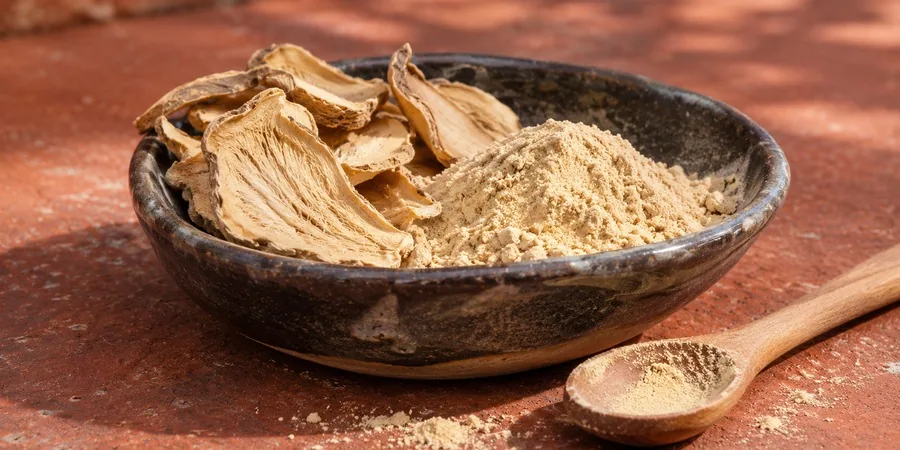
In healthy men, maca has been associated with higher self-reported sexual desire after eight weeks, with no change at all in testosterone.
In the Gonzales trial (2002), men aged 21 to 56 received 1.5 g or 3 g of gelatinized maca per day, or a placebo, for 12 weeks in a double-blind design. Self-reported desire improved from the eighth week, independently of mood and anxiety. The hormonal part of the study (2003) found no change in LH, FSH, prolactin, testosterone or estradiol.
If maca has an effect, it does not work through testosterone. The Shin review (2010), covering four trials, concludes that the evidence is limited. For desire itself, our article on getting your libido back as a man reviews the other levers.
On the regulatory side, only the tuber is authorized, and Annex I requires that "the absence of alkaloids [be] demonstrated by test reports".
What do trials show on ashwagandha and testosterone?
An Australian trial and a 2026 meta-analysis describe an average increase in testosterone in men taking ashwagandha, with very heterogeneous extracts. The plant is not listed in Annex I, and ANSES published a warning in 2024.
In the Lopresti crossover trial (2019), 57 overweight men aged 40 to 70 were recruited (43 completed both phases) and received eight weeks of extract (21 mg of withanolide glycosides per day) and then placebo, or the reverse. Salivary testosterone rose 14.7% more than on placebo, but fatigue, vigor and sexual well-being did not differ. The Fornalik meta-analysis (2026), covering 23 trials and 1,706 participants (all hormones, men and women), finds an average increase in men of about 57 ng/dL, or 2 nmol/L, while stressing the heterogeneity of the studies.
Not in Annex I, and an ANSES opinion you should know about
Ashwagandha (Withania somnifera) is sold in France under mutual recognition, because Belgium and Italy authorize it. In its opinion of April 19, 2024, ANSES (the French food safety agency) lists eight nutrivigilance reports since 2009, considers the extracts too poorly characterized to set a safe dose, and advises against the plant during pregnancy and breastfeeding, under 18, in case of thyroid disorders or hyperandrogenism, liver or heart disorders, and with sedative medication.
How good is the shilajit trial, and how do you choose a pure product?
A randomized double-blind trial measured an increase in total and free testosterone with purified shilajit. It is a single trial, and the purity of the resin matters as much as the dose.
The Pandit study (2016) compared 250 mg of purified shilajit twice a day with a placebo for 90 days in healthy volunteers aged 45 to 55. Total testosterone, free testosterone and DHEAS increased compared with placebo, while LH and FSH remained stable. The proposed mechanism is detailed in our article on shilajit and testosterone.
This result does not create a claim: those displayed by brands are awaiting evaluation, used on the manufacturer's own responsibility. Shilajit is not a plant but a resin formed by the slow decomposition of plant matter, rich in fulvic acid (Carrasco-Gallardo, 2012). It therefore has no place in Annex I, and purity is what separates products, since a mountain resin can contain heavy metals.
Primal, a shilajit tested batch by batch
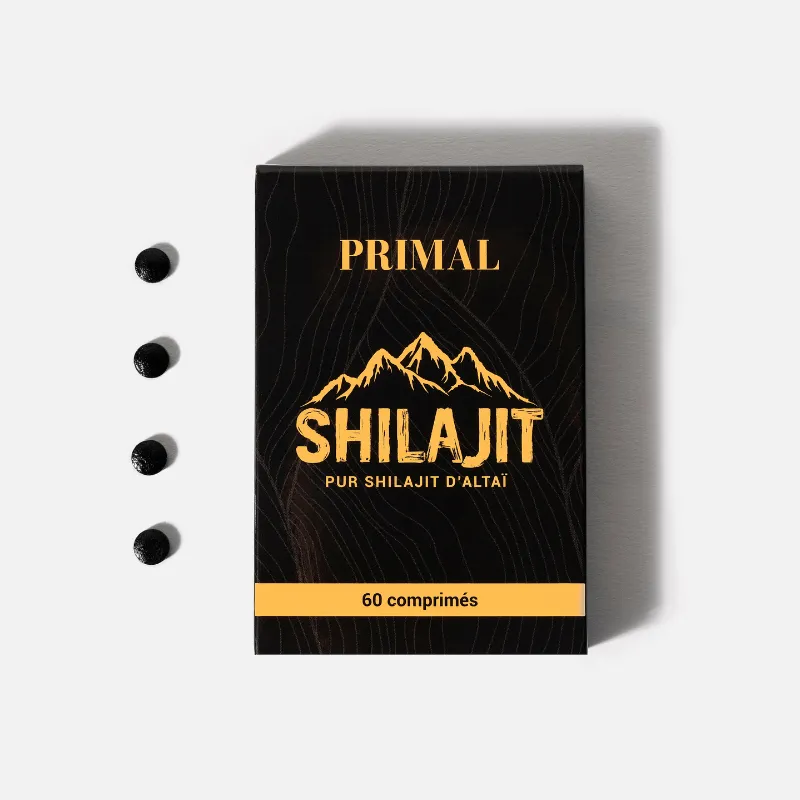
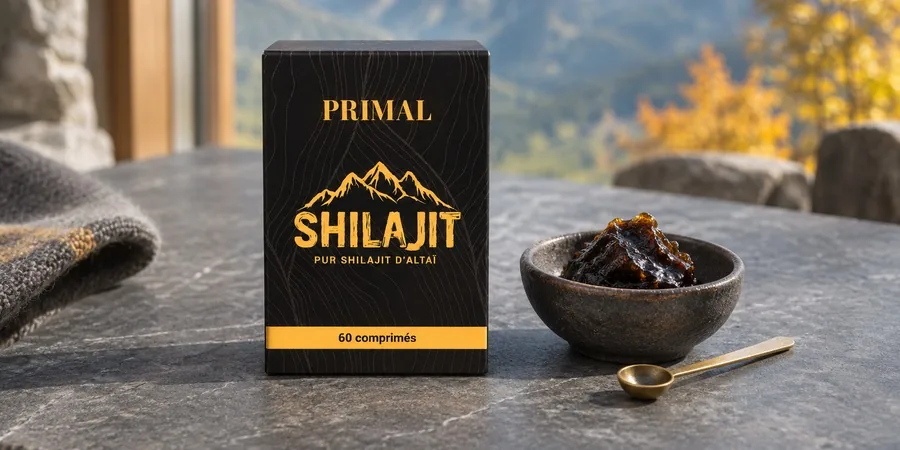
At Primal Supplements, a French brand (primalsupplements.fr), the resin comes from the Altai according to the brand, in 200 mg tablets taken two a day. The brand says it has every batch tested by an independent French laboratory: lead, mercury, arsenic, cadmium, microbiology and fulvic acid, which it states at a minimum of 79%. According to the brand, the test report is available on request.
What this does not tell you: no trial has been published on the Primal product itself, and Pandit used 500 mg per day of a purified, patented extract funded by Natreon, while Primal provides 400 mg per day in a different form. The brand advises against its tablets, or recommends medical advice, during pregnancy and breastfeeding, for minors, and in case of hemochromatosis or severe chronic disease (liver, kidneys, heart), and flags possible interactions with immunosuppressants, blood pressure medications, anticoagulants and corticosteroids. Expect to pay €42.50 for a 30-day box, or €85 for three boxes (indicative prices checked on November 12, 2026): see Primal shilajit tablets, with the code LMC10.
Which other ingredients on the testosterone shelf deserve a look?
Fenugreek has the most meta-analyses but very low certainty, and tongkat ali is not authorized in the European Union. Ginger, pine pollen, saw palmetto, pumpkin seeds and pomegranate have no solid trial in men on testosterone.
Fenugreek and testosterone
In the Rao trial (2016), 120 men aged 43 to 70 took 600 mg per day of a patented seed extract or a placebo for 12 weeks, and their total and free testosterone increased compared with placebo. The Isenmann meta-analysis (2023, 7 studies) finds a small effect on total testosterone in athletes; the Yang meta-analysis (2026, 13 studies) rates the certainty as very low and concludes that the data do not support the commercial promises. Annex I authorizes the seed, with a mandatory warning advising against use by pregnant women.
Tongkat ali (Eurycoma longifolia) and testosterone
The Leisegang meta-analysis (2022) finds an increase in total testosterone across five randomized trials. But in 2021, EFSA examined a root extract proposed at 200 mg per day as a novel food: it shows a potential for DNA damage, and its safety is not established under any conditions of use. Missing from Annex I and without European authorization, it has no place in a supplement legally sold in France.
Ginger, pine pollen and pomegranate
Ginger rhizome is authorized without restriction, with methyleugenol to keep an eye on. The Banihani review (2019) on ginger and sperm quality relies mainly on experimental work that still needs to be confirmed in men. Three pines appear in Annex I for their needles, buds, bark, cones or young shoots: pollen is not an authorized part. Androgens were detected in it in 1971 (Saden-Krehula), but we found no trial in men. Pomegranate is authorized (fruit, leaf, flower, seed), but the studies we found on pomegranate juice and male testosterone were done in rats.
Saw palmetto, pumpkin seed oil and omega-3
The fruit of Serenoa repens is authorized provided the label states "Ask your doctor and/or pharmacist for advice"; pumpkin seed is authorized without restriction. These two plants are studied for urinary comfort related to prostate size, not for testosterone: the 2023 Cochrane review (27 studies) finds little or no difference from placebo for saw palmetto, and the Hong trial (2009) did not measure testosterone. For omega-3, the Alpha Omega trial (Giltay, 2012) finds no effect in 1,850 men followed for 41 months, while a secondary analysis by Abbott (2020) notes an increase in 22 overweight men.
Why is zinc the only one allowed to talk about testosterone?
EU Regulation 432/2012 authorizes the claim "Zinc contributes to the maintenance of normal testosterone levels in the blood". It only applies to a product that is at least a source of zinc.
Assessed by EFSA in 2010, this wording comes with a strict condition of use: "The claim may be used only for food which is at least a source of zinc" within the meaning of Regulation 1924/2006. Also note the word "maintenance": the claim does not say that zinc increases testosterone.
In four young men deprived of zinc for 20 weeks (Prasad, 1996), testosterone fell from 39.9 to 10.6 nmol/L; in nine older men with moderate deficiency, three to six months of zinc brought it back up from 8.3 to 16.0 nmol/L. The effect concerns deficiency; nothing indicates that extra zinc does any better. A formula that combines zinc and herbs can display the claim on the basis of the zinc, never on the basis of the herbs: our comparison of natural testosterone boosters compares them by cost per month.
What precautions should you take before using an herb for male vitality?
Get your testosterone tested before supplementing, and ask for medical advice if you are on medication, have a thyroid, liver or heart disorder, or a history of hormone-dependent cancer.
- Pregnancy and breastfeeding: a partner who might dip into the box should steer clear. Fenugreek carries a mandatory warning, ANSES advises against ashwagandha and Primal against its shilajit during these periods.
- History of hormone-dependent disease (prostate, breast): nothing that targets the hormonal axis without medical advice.
- Ongoing treatment (thyroid, sedative, immunosuppressant): show the ingredient list to your doctor or pharmacist.
Lasting fatigue often has causes other than low testosterone, and only a morning blood test can settle the question: reference values and the care pathway are in our article on testosterone in men, and lifestyle levers in our guide on declining testosterone in men.
⚠️ Products shipped from outside the European Union that promise a quantified "boost" are the most likely to contain unauthorized ingredients, such as tongkat ali.
Which ingredient should you choose for your profile?
This is our opinion: first check your zinc intake, the only ingredient authorized to talk about testosterone. For an herb, choose a single-ingredient product tested batch by batch, whose plant is listed in Annex I when it is a plant, over a formula with a long ingredient list.
- A single ingredient studied after 40: shilajit (the trial is on a patented extract, not on commercial resins) or fenugreek. For shilajit, insist on batch-by-batch testing, like Primal's.
- Desire more than hormones: maca, with its test report on alkaloids.
- If stress is what brings you here: ashwagandha is traditionally associated with it in Ayurveda, with no authorized claim; in the Lopresti trial, fatigue did not differ from placebo. If you choose it, take a standardized extract and first reread the ANSES exclusions.
- Tribulus terrestris: check the plant part and the cooking, without expecting anything on testosterone. Tongkat ali, for its part, should be ruled out.
Libido first? See our ranking of supplements to boost libido.
Frequently asked questions about male vitality ingredients
Is tribulus terrestris authorized in France?
Yes. It appears in Annex I of the decree of June 24, 2014 for the leaf, the young shoot and the fruit, provided these parts are cooked. No health claim is authorized for it.
Does maca increase testosterone?
No, in the trial that measured it: with 1.5 or 3 g per day for 12 weeks, testosterone, estradiol, LH and FSH did not change compared with placebo (Gonzales, 2003). Only self-reported desire improved.
Does fenugreek increase testosterone?
The Yang meta-analysis (2026, 13 studies) finds a small effect on total testosterone, with very low certainty of evidence. Fenugreek is not recommended for pregnant women, a mandatory warning in France.
Can you buy tongkat ali in France?
Not in a compliant supplement: it is missing from Annex I, and EFSA concluded in 2021 that the safety of its root extract was not established under any conditions of use.
Which ingredient has the most evidence in men?
Testosterone itself is a prescription drug, and no supplement contains it: our comparison of natural testosterone boosters sorts out the difference between the two shelves.
Scientific and regulatory references
- Decree of June 24, 2014, list of plants authorized in dietary supplements, Annex I: Légifrance
- Regulation (EU) No 432/2012, authorized health claims: EUR-Lex
- ANSES, opinion of April 19, 2024 on Withania somnifera (request 2021-SA-0077): ANSES
- EFSA, Eurycoma longifolia root extract as a novel food, 2021: EFSA Journal
- Neychev and Mitev, J Ethnopharmacol, 2005: PubMed 15994038
- Qureshi et al., J Diet Suppl, 2014: PubMed 24559105
- Kamenov et al., Maturitas, 2017: PubMed 28364864
- Gonzales et al., Andrologia, 2002: PubMed 12472620
- Gonzales et al., J Endocrinol, 2003: PubMed 12525260
- Shin et al., BMC Complement Altern Med, 2010: PubMed 20691074
- Lopresti et al., Am J Mens Health, 2019: PubMed 30854916
- Fornalik et al., Planta Med, 2026: PubMed 41740946
- Pandit et al., Andrologia, 2016: PubMed 26395129
- Carrasco-Gallardo et al., Int J Alzheimers Dis, 2012: PubMed 22482077
- Rao et al., Aging Male, 2016: PubMed 26791805
- Isenmann et al., Int J Sports Med, 2023: PubMed 37253363
- Yang et al., Front Nutr, 2026: PubMed 42688439
- Leisegang et al., Medicina (Kaunas), 2022: PubMed 36013514
- Banihani, Andrologia, 2019: PubMed 31012134
- Saden-Krehula et al., Experientia, 1971: PubMed 5549221
- Franco et al., Cochrane Database Syst Rev, 2023: PubMed 37345871
- Hong et al., Nutr Res Pract, 2009: PubMed 20098586
- Giltay et al., Int J Androl, 2012: PubMed 22394170
- Abbott et al., Prostaglandins Leukot Essent Fatty Acids, 2020: PubMed 33221700
- Prasad et al., Nutrition, 1996: PubMed 8875519
Dietary supplements are not a substitute for a varied, balanced diet and a healthy lifestyle.

LMC content is written by our editorial team from the information published by the brands. Scores out of 10 follow a public grid of 5 criteria*, supplemented by LMC’s editorial assessment.
To support LMC, some links are affiliate links: LMC earns a commission at no extra cost to you, and some of the brands featured are partners. By using the site, you accept our terms of use and our editorial policy.