
Do you really have to choose between shilajit and ashwagandha?
Asking the question this way assumes the two compete for the same role. They don't, and that is the first thing to understand before you open your wallet.
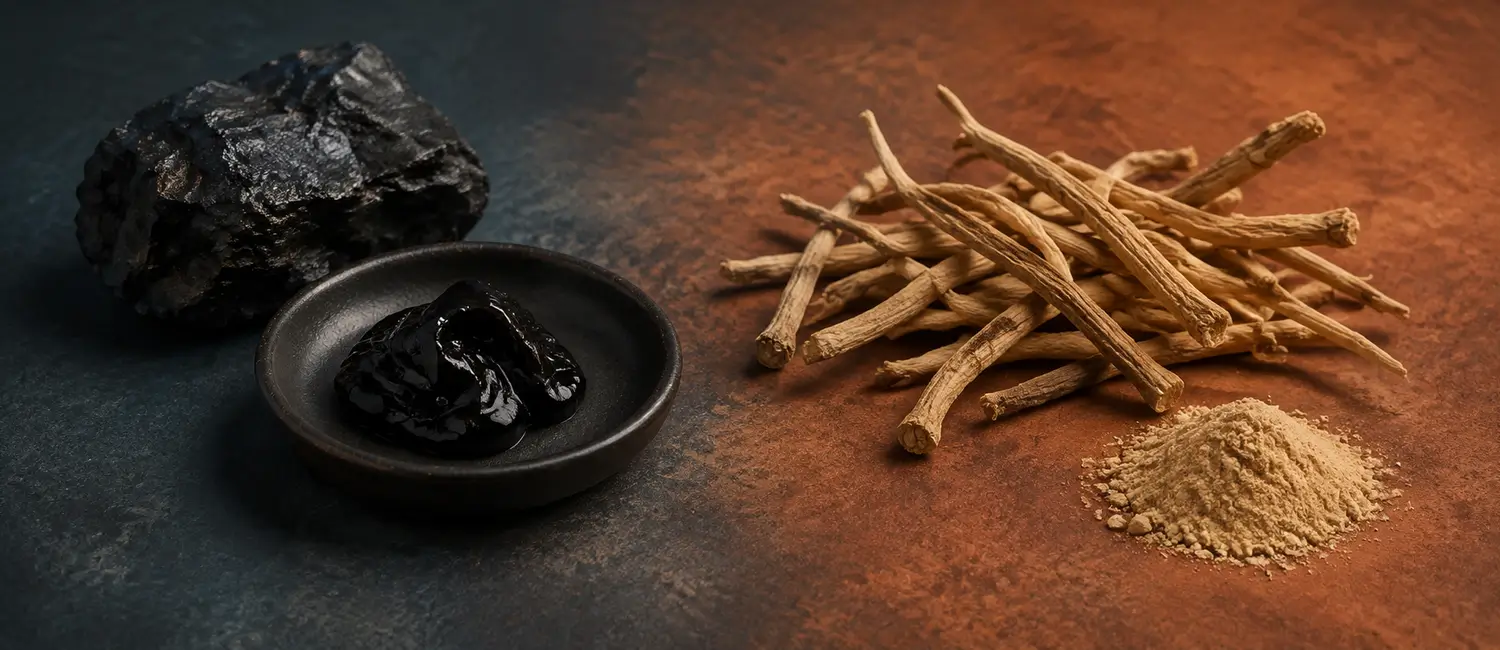
Shilajit is a resin that seeps from high-altitude rocks. It is traditionally used as a general tonic, and the most cited studies on it focus on male hormones and its antioxidant activity.
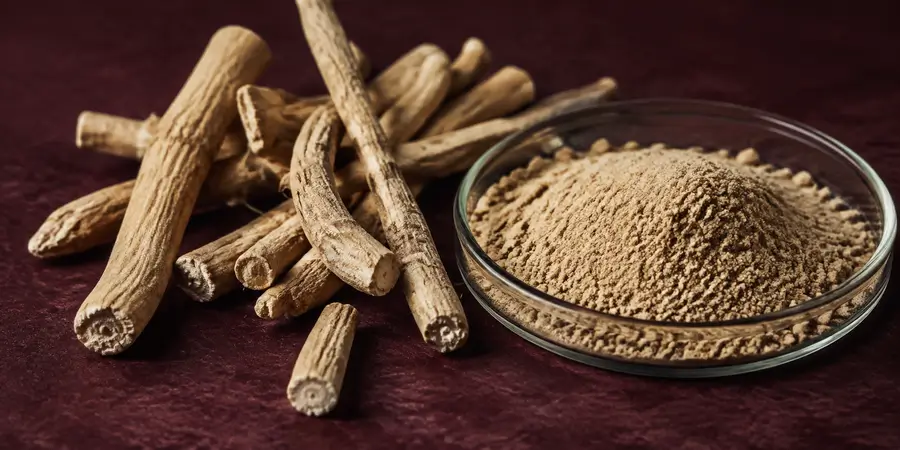
Ashwagandha, on the other hand, is a root. Classified as an adaptogen, it has been studied for longer, mainly for perceived stress, cortisol levels, and sleep quality.
In other words, one leans toward vitality and hormonal balance, the other toward managing mental load and nervous recovery. Depending on your situation, one of the two will be more relevant, both may be, or neither.
Three scenarios emerge in practice. If your main problem is chronic stress with broken nights, ashwagandha better matches what has been measured. If you are looking for baseline support for energy and male vitality, shilajit is closer to your need. And if both dimensions add up, which is common after 35, the question of combining them is a legitimate one.

Shilajit vs ashwagandha: the comparison at a glance
Before going into detail, here is what really separates these two ingredients. The table does not name a winner, because there isn't one in absolute terms.
| Criterion | Shilajit | Ashwagandha |
|---|---|---|
| Nature | Mineral-organic resin | Plant root |
| Scientific name | Asphaltum punjabianum | Withania somnifera |
| Origin | High-altitude rocks, Himalayas and Altai | Crops in India and North Africa |
| Active compounds | Fulvic acids, dibenzo-alpha-pyrones, trace elements | Withanolides |
| Traditional use | General tonic in Ayurveda | Adaptogen, stress management |
| Most studied area | Male hormones, antioxidant activity | Cortisol, perceived stress, sleep |
| Common standardization | Fulvic acid content | Percentage of withanolides |
| Authorized health claim in Europe | None | None |
One row deserves your attention: neither of them has an authorized health claim in Europe. That does not mean they are ineffective, but that the scientific dossiers have not been submitted to or validated by EFSA. Any brand that promises you a specific result with one of these ingredients is operating outside the regulatory framework.

What does shilajit really offer? Origin, purification, and role in a routine
Shilajit forms over centuries, through the slow decomposition of plant matter trapped in rock, under pressure and the action of microorganisms. It is harvested mainly in the Himalayas and the Altai, between 1,000 and 5,000 meters above sea level.
To find out which shilajit brands publish their lab analyses (fulvic acid, heavy metals) and at what price, check out our comparison of the best pure shilajit brands.
Its active fraction is made up of fulvic acids and humic acids, dibenzo-alpha-pyrones, and a mineral component of trace elements. Work by Carrasco-Gallardo published in 2012 identifies fulvic acid as the main active compound in this natural complex.
The mechanism put forward to explain its benefits lies in the very nature of fulvic acid. This molecule behaves like a carrier: it binds to minerals and helps them cross cell membranes. Add to that a documented antioxidant activity, which may limit the oxidative stress that weighs on mitochondrial function, and therefore on cellular energy production. These leads are biochemically coherent, but they remain working hypotheses rather than effects demonstrated in humans.
For men, the reference trial is the one by Pandit and his team, published in Andrologia in 2016. In men aged 45 to 55, at 250 mg twice a day for 90 days, the study measured a 20.45% increase in total testosterone and a 19.14% increase in free testosterone compared with placebo.
This result should be read with its limits in mind: a single trial, a small sample, a specific age group. It is an interesting signal, not a guarantee that applies to everyone.
One practical point matters as much as the biochemistry: raw resin cannot be consumed as is. It has to be purified to remove contaminants, and this process varies enormously from one manufacturer to another. That is where the difference between a serious product and an anonymous resin lies, a topic we cover in detail in our guide on the quality criteria for shilajit for men.
What do we know about ashwagandha? Standardization, uses, and points of caution
Ashwagandha, also called Indian ginseng even though it has no botanical link to ginseng, is the root of Withania somnifera. It is one of the best-documented plants in the Ayurvedic pharmacopeia.
Its quality is judged on one specific criterion: the percentage of withanolides, its active compounds. Serious extracts display a standardization, often between 2.5 and 5%. A non-standardized root powder is far more hit-or-miss, since nothing guarantees the actual content.
The form you choose matters too. Concentrated extracts, made from the root and standardized for withanolides, are the ones used in clinical trials. Plain root powders require much larger amounts to approach the same intake, and leaf-based extracts do not have the same profile as root-based ones. On a label, look for three pieces of information: the part of the plant used, the weight of extract per daily dose, and the standardization percentage. If any of the three is missing, you cannot seriously compare two products.
The most cited trial is Chandrasekhar's, published in 2012. In 64 adults under chronic stress, at 300 mg twice a day for 60 days, researchers measured a 27.9% drop in serum cortisol versus 7.9% in the placebo group, along with improved perceived stress scores.
These data explain why ashwagandha has become the go-to for stress and sleep. They say nothing, however, about a direct effect on male hormones, an area where the evidence remains much thinner.
You also need to know its downside. Ashwagandha is not harmless, and several European health authorities have expressed reservations about it, which we come back to below.
Can you combine shilajit and ashwagandha? For which profiles and with what logic
Combining these two ingredients is nothing exotic. Ayurveda traditionally pairs shilajit with other plants, and this combination is frequently found in formulas on the market.
The logic is easy to understand. Shilajit targets baseline vitality, ashwagandha targets nervous load. For a man dealing with both persistent fatigue and prolonged stress, acting on only one of the two inevitably leaves the other aside.
That said, let's be clear on one point: nothing shows that a combination is systematically better than a single ingredient. The available studies look at each ingredient in isolation, not at their combination. A well-designed complex makes sense on paper, but any synergy is for now a reasonable hypothesis, not established proof.
Three profiles nonetheless get a practical benefit from the combination:
- Those with a mixed issue, vitality and stress at the same time, who would otherwise have to buy two products.
- Those who drop their courses for lack of consistency: a single dose is easier to keep up over time than two bottles to manage.
- Those who want a clear dosage rather than putting together their own stack of ingredients.
The complex still has to be well designed, and not all of them are. Four signals should alert you when comparing two formulas:
- A so-called proprietary blend, which gives a total weight without detailing the share of each ingredient.
- An endless list featuring fifteen ingredients at doses too low to matter.
- Spectacular equivalences such as 20,000 mg, calculated from an extraction ratio and unrelated to the actual content of the capsule.
- A total lack of analysis on the finished product, even though plants and resins are particularly exposed to contaminants.
Conversely, if your need is perfectly well defined, a properly dosed single-ingredient product remains the most rational choice. And if you are unsure how to structure your routine, we devoted a whole article to the question of the all-in-one men's formula.
Which dosages should you use, and when should you seek professional advice?
The protocols studied provide useful benchmarks. For purified shilajit, the literature most often ranges from 250 to 600 mg per day. For ashwagandha, trials commonly use 300 to 600 mg of standardized extract daily.
One question comes up often: when should you take ashwagandha? Its effect on cortisol generally makes it more relevant in the evening, while shilajit fits more naturally in the morning. In a single complex, this ideal split is not always possible, and it is a deliberate compromise worth knowing about.
As for duration, allow at least 8 to 12 weeks before judging anything, since the trials run for 60 to 90 days. Courses with breaks in between better match traditional use than continuous intake all year round.
Now for the precautions, and they are real ⚠️:
- Ashwagandha is the subject of a cautionary recommendation from ANSES, the French food safety agency, which advises against it in case of thyroid, liver, or heart conditions, and during treatments acting on the central nervous system.
- Neither is suitable for minors or for pregnant or breastfeeding women.
- Formulas that combine several plants also combine their respective contraindications, which calls for a careful reading of the label.
The most commonly reported side effects remain mild and digestive. Ashwagandha can cause stomachaches, nausea, or mild drowsiness, especially at the start of a course or on an empty stomach. Shilajit is more often associated with stomach discomfort when the dose is taken all at once. In both cases, splitting the doses and taking them with a meal solves most of these issues.
If you are on any treatment at all, talk to your doctor or pharmacist before starting. And if fatigue has lasted for months, a blood test will tell you more than a supplement.
Why SHYLEX takes a combined approach
Among the French brands that have opted for a combination rather than a single ingredient, SHYLEX is the one we rated highest, with 8.7/10 in our comparison.
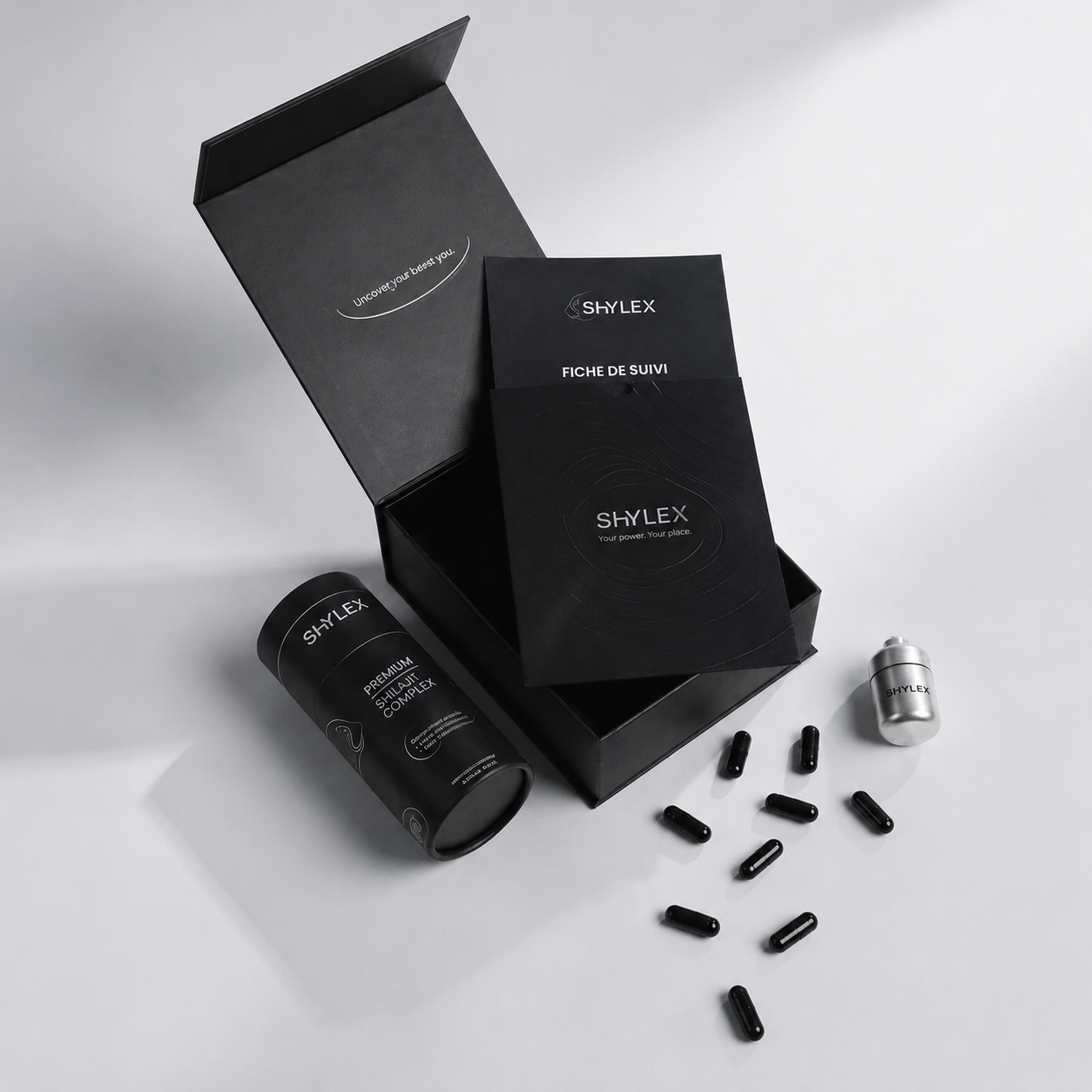
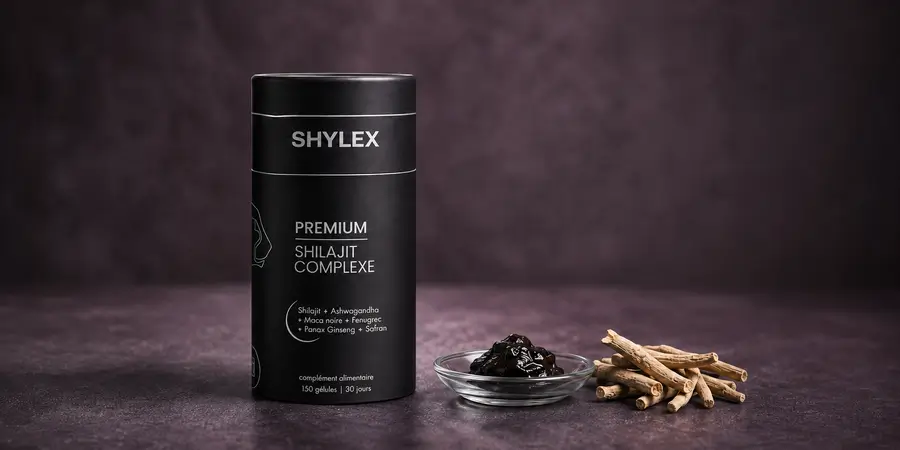
Its Premium Shilajit Complexe brings together purified shilajit and ashwagandha, plus seven other ingredients: black maca, Panax ginseng, fenugreek, saffron, piperine, zinc, and vitamin B6. The daily dose provides 600 mg of shilajit and 500 mg of ashwagandha, two values within the range of the protocols studied rather than token amounts.
Two honest clarifications about this formula. The only officially authorized claims in it come from the micronutrients: zinc contributes to the maintenance of normal testosterone levels in the blood, and vitamin B6 to the reduction of fatigue. Neither shilajit nor ashwagandha has a claim of its own, and suggesting otherwise would be misleading you.
The brand has its products manufactured under GMP and HACCP standards, and publishes heavy metal and microbiology analyses performed on the finished product by an independent French laboratory. The pack of 150 capsules covers 30 days at 5 capsules per day.
👉 See the formula and its dosages (code SHYLEX10 for 10% off)
Frequently asked questions
Why shouldn't you take ashwagandha?
Because it is not suitable for everyone. ANSES recommends caution and advises against it in particular in case of thyroid, liver, or heart disorders, and during psychotropic treatment. Minors and pregnant or breastfeeding women should avoid it.
Does shilajit really work?
Clinical trials exist, notably on male hormones, with measurable results. But they are few and conducted on small samples. No claim is authorized in Europe, which reflects the current state of the evidence.
Does ashwagandha really work?
For stress and cortisol, it is one of the best-documented plant ingredients, with several consistent randomized trials. For the other promises attributed to it, the evidence is much weaker.
Can you take them every day?
For the length of a course, yes, that is in fact how the protocols were run. Continuously all year round is neither the traditional use nor what has been evaluated. Favor courses of 1 to 3 months with breaks.
Which adaptogen should you choose if you are still unsure?
Start from your main need rather than from the ingredient's popularity. Stress and sleep point toward ashwagandha, baseline vitality toward shilajit. Rhodiola and ginseng address yet other needs.
Further reading
- Shilajit for men: benefits, dosage, and quality criteria
- How to choose an all-in-one men's supplement without stacking bottles?
Scientific references
- Pandit S, Biswas S, Jana U, et al. "Clinical evaluation of purified Shilajit on testosterone levels in healthy volunteers". Andrologia, 2016;48(5):570-575. PubMed 26395129
- Chandrasekhar K, Kapoor J, Anishetty S. "A Prospective, Randomized Double-Blind, Placebo-Controlled Study of Safety and Efficacy of a High-Concentration Full-Spectrum Extract of Ashwagandha Root in Reducing Stress and Anxiety in Adults". Indian Journal of Psychological Medicine, 2012;34(3):255-262. PubMed 23439798
- Carrasco-Gallardo C, Guzman L, Maccioni RB. "Shilajit: A Natural Phytocomplex with Potential Procognitive Activity". International Journal of Alzheimer's Disease, 2012. PubMed 22482077
- Anses, opinion on the risks associated with the consumption of Withania somnifera, request 2021-SA-0077. Anses
- Regulation (EU) No 432/2012 establishing a list of permitted health claims. EUR-Lex
Dietary supplements are not a substitute for a varied, balanced diet or a healthy lifestyle.

LMC content is written by our editorial team from the information published by the brands. Scores out of 10 follow a public grid of 5 criteria*, supplemented by LMC’s editorial assessment.
To support LMC, some links are affiliate links: LMC earns a commission at no extra cost to you, and some of the brands featured are partners. By using the site, you accept our terms of use and our editorial policy.