



Why do we end up collecting so many bottles?

The scenario is almost always the same. You start with one ingredient, often magnesium or vitamin D. A few months later, an article or a video praises an adaptogen, so you add it. Then comes zinc, then a B-complex, then the shilajit everyone is talking about.
After a year, the shelf holds five or six boxes, some opened and never finished. Your monthly budget has doubled without you noticing, and above all, nobody knows anymore what is doing what.
This build-up creates three concrete problems.
The first is consistency. A course of supplements delivers its effects over eight to twelve weeks. The more bottles you have to open every morning, the more likely you are to forget one, and the more your courses turn into sporadic intake with no continuity.
The second is duplication. Many commercial formulas already contain zinc, magnesium, or B vitamins. Combining three fortified products can easily push you over the reference intakes for some nutrients, while never reaching a useful dose of others.
One example makes the duplication problem very concrete. Zinc is found in most men's formulas, in multivitamins, in some skin or hair products, and in so-called vitality supplements. Three products that each provide 10 mg bring you to 30 mg per day, well above the safety limit set in Europe for long-term intake. Nobody decided it, nobody noticed it, and yet it is the mechanical result of stacking products.
The third is the real cost, rarely calculated. Four to six products bought separately often cost twice as much as a single complex with comparable content.
What should "all-in-one" really mean?
The phrase has become a marketing argument, and it deserves a demanding definition.
An all-in-one supplement worthy of the name does not try to cover all of the body's needs. No formula can, and a brand that claims otherwise is telling you a story. What it should do is bring together in a single dose the ingredients you would otherwise buy separately for a given goal.
The difference is huge. In the first case, you are being sold an impossible promise. In the second, you are being offered a simpler routine built around a clear goal, here male vitality.
Three conditions separate a real complex from an opportunistic blend:
- The ingredients serve a common goal, instead of covering unrelated needs.
- Each one is present at a dose comparable to the studies that concern it, not in trace amounts.
- The composition is listed ingredient by ingredient, with no overall blend that hides the proportions.
If any of the three is missing, you do not have a complex. You have a list of ingredients.

Why isn't the number of ingredients enough?
This is the most common trap in the aisle. Between a formula with 9 ingredients and another that boasts 24, your instinct pushes you toward the second. That is almost always a mistake.
A capsule has a finite volume. The more ingredients you cram in, the less room each one gets. A 24-ingredient formula mechanically spreads out quantities so small that none of them carries any weight on its own. This is called fairy dusting, and it is common.
Let's take a concrete example. Clinical trials on ashwagandha commonly use 300 to 600 mg of standardized extract per day. A formula that contains 50 mg can legally display it on its label, in big letters, while staying six to twelve times below what was tested.
Three questions let you decide quickly between two products:
- Relevance: does each ingredient serve the stated goal, or are some there just to pad the list?
- Dosage: does the amount per daily dose come close to what has been studied for that ingredient?
- Complementarity: do the ingredients reinforce each other, or do they merely coexist?
On that last point, an example says more than a speech. Piperine, extracted from black pepper, has no targeted effect of its own in this type of formula. It is included because it improves the absorption of other compounds. That is real complementarity, not filler.
Which criteria should you use to choose? The seven points to check
Here is the checklist we apply when we evaluate a men's formula, in the order it is most useful to go through it.
- The goal. Does the formula target an identified need, or does it promise a vague, general benefit?
- The ingredients. Are they documented for this goal, or chosen because they are trendy right now?
- The dosages. Listed per daily dose and not per capsule, which changes everything when the serving is five capsules.
- Standardization. For plant extracts, the content of active compounds must be specified.
- Transparency. No proprietary blend, no equivalence inflated by an extraction ratio.
- Testing. Analyses performed on the finished product, not just on the supplier's raw material.
- Ease of use. Format, number of doses, and taste determine whether you will stick with it for three months.
Two of these points deserve clarification, because they are the source of the most frequent misunderstandings.
On dosages first: the "per capsule" label is misleading as soon as the serving includes several. A formula that lists 120 mg of extract per capsule with a serving of five capsules actually provides 600 mg per day. Another that shows 500 mg per capsule but is taken one at a time provides less. Always bring everything back to the daily dose before comparing, it is the only comparable figure.
On testing next: the raw material analysis supplied by the ingredient manufacturer says nothing about the product you swallow. In between come blending, encapsulation, and packaging. Only an analysis of the finished product, tied to a batch number, truly commits the brand.
This last criterion is the most underestimated, and yet the most decisive. The best product on the market is useless if it ends up at the back of a drawer after three weeks.
Separate bottles or a complex: what difference does it really make?
Let's compare the two approaches on the criteria that matter day to day, rather than on price alone.
| Criterion | LMC pickMulti-ingredient complex | Separate bottles |
|---|---|---|
| Number of products to manage | ✅Just one | ❌4 to 6 depending on goals |
| Daily doses | ✅A single routine | ❌Multiple, at different times |
| Dosage clarity | Depends on the brand's transparency | ✅Complete, each label stands on its own |
| Adjusting one ingredient | ❌Impossible without changing the whole formula | ✅Possible, ingredient by ingredient |
| Consistency between ingredients | ✅Designed upfront by the formulator | ❌Up to you to build |
| Finished product testing | ✅Only one batch to check | ❌As many analyses as brands |
| Approximate monthly cost | ✅35 to 55 euros | ❌75 to 120 euros |
| Consistency over 3 months | ✅Much easier | ❌Hard to keep up |
The amounts shown are ballpark figures observed on the French market, for products of comparable quality. They vary by brand and format.
Two lessons stand out from this comparison. Separate bottles keep a real advantage in terms of flexibility: you adjust one ingredient without touching the others, and you stop the one that does not suit you. That is valuable if you know exactly what you are looking for.
The complex, on the other hand, wins on everything related to sticking with it over time, and that is often what makes the difference between a course you follow through and one you abandon.
What this table does not say, however, needs to be spelled out. A poorly designed complex is still less worthwhile than three well-chosen bottles. The comparison above applies to products of equivalent quality, properly dosed on both sides. If you weigh a fairy-dusted complex against properly dosed single-ingredient products, the latter win hands down, despite the hassle of managing them. Format never replaces formulation quality, it only makes it more or less easy to follow day to day.
Who an all-in-one formula suits, and who it does not
Let's be frank: this format is not for everyone.
It suits the man who is just starting out and does not know where to begin, the one who has already collected several bottles and wants to get back to a sustainable routine, the one who travels or moves around a lot, and the one looking for baseline support for everyday energy rather than a single, highly targeted ingredient.
It is much less suited to four profiles. The man with a specific need identified by a blood test, an iron or vitamin D deficiency for example, who needs a therapeutic dose of a single nutrient. The man on medication, since each added plant multiplies the possible interactions to watch. The man who reacts badly to a specific ingredient, since he will have to give up the whole formula. And the man who already takes other fortified supplements, at the risk of stacking the same nutrients without realizing it.
In all cases, if you are on medication, your doctor's or pharmacist's advice is worth more than your own estimate.

Which warning signs should make you walk away?
Four brand behaviors should make you close the page 🚩.
The outsized promise. A formula claiming to provide everything a man's body needs goes beyond what can be demonstrated. No combination of ingredients replaces a decent diet, sleep, and physical activity.
Internal inconsistency. Some formulas combine stimulating ingredients and others reputed to be calming in the same dose. On paper, the list looks impressive. In practice, you no longer know what you are aiming for, and the ideal times to take it become contradictory.
The hidden cost. The displayed price sometimes corresponds to a subscription with a commitment, with a much higher price outside the subscription. Always check the real price of the first order and the cancellation terms.
No traceability. No batch number, no analysis you can consult, no date for the latest update of the composition. Yet for products that contain plants and resins of natural origin, these are the documents that matter most.
A structured men's formula rather than a collection of bottles
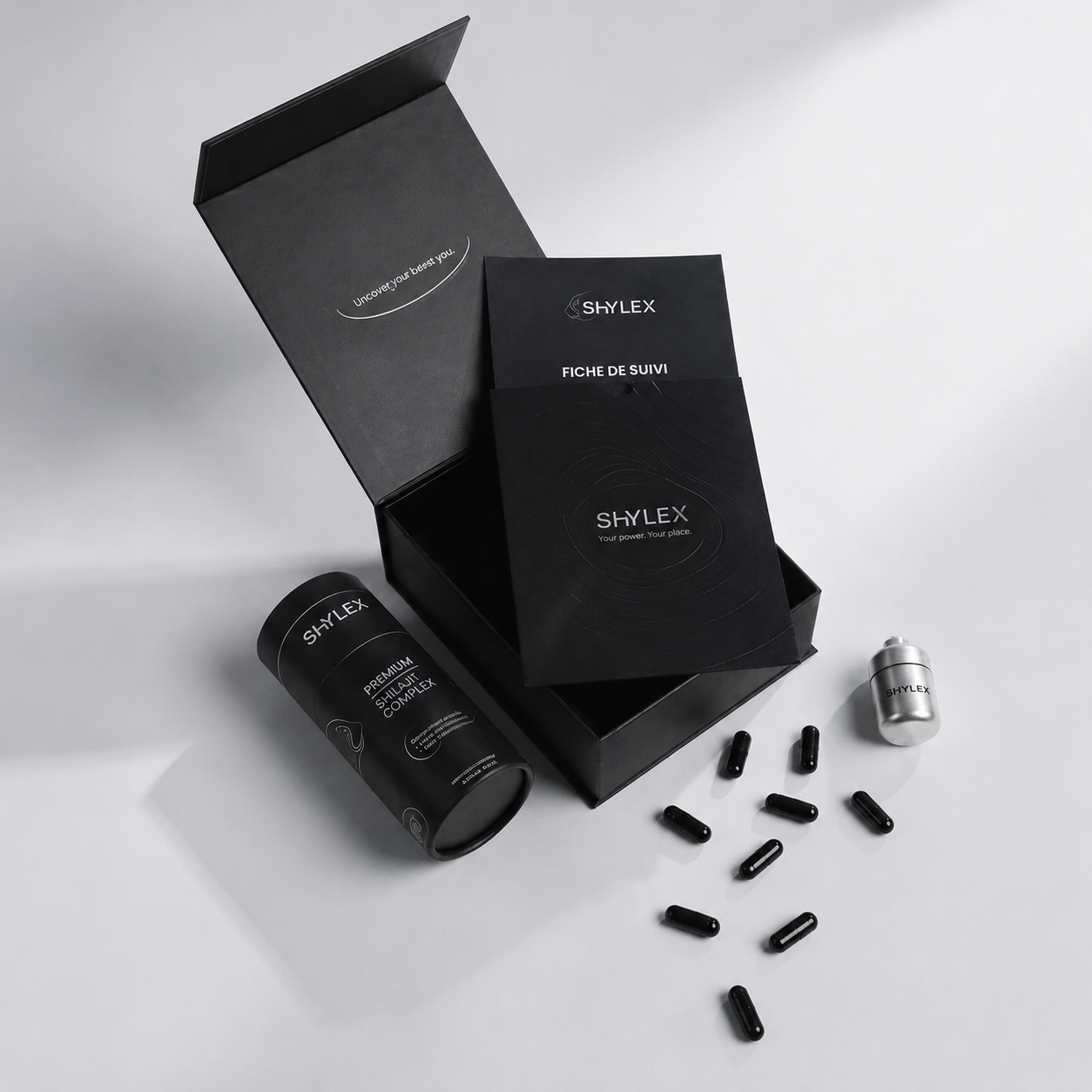
To illustrate the criteria above in concrete terms, let's take the example of SHYLEX's Premium Shilajit Complexe, the highest-rated formula in our men's comparison with 8.7/10.
Its appeal lies precisely in the logic of bundling. It brings together in a single dose ingredients you would otherwise buy separately: purified shilajit, ashwagandha, black maca, Panax ginseng, fenugreek, saffron, piperine, zinc, and vitamin B6. A man who wanted to put this set together himself would walk away with five or six different boxes.
Dosages are listed ingredient by ingredient and based on the daily dose, with 600 mg of shilajit and 500 mg of ashwagandha, two values within the range of the studied protocols rather than symbolic amounts. Zinc reaches 100% of the reference values, which allows it to carry the authorized claim on maintaining normal testosterone levels. Vitamin B6 provides the recognized contribution to reducing fatigue. These two statements are the only officially authorized ones in a formula of this type, since the plants have none.
On the testing side, the brand has its products manufactured under GMP and HACCP standards and publishes heavy metal and microbiology analyses performed on the finished product by an independent French laboratory. The pack of 150 vegan capsules covers exactly 30 days, at 5 capsules per day split between morning and evening, and comes with a guide, a tracking sheet, and a pill organizer to help you keep up the routine.
👉 Compare the 9-ingredient formula (code SHYLEX10 for 10% off)

Frequently asked questions
What is the best dietary supplement for men?
There is no universal answer, and be wary of anyone who claims otherwise. The right product depends on your age, diet, activity level, and any deficiencies you may have. A blood test is a far better guide than a ranking.
Can you take several dietary supplements at the same time?
Yes, as long as you check for duplicates. The risk is not so much interactions between plants as the build-up of nutrients already present in several formulas, such as zinc or B vitamins. Add up your intakes before adding a product.
How long should you stick with a routine?
The protocols studied run for 60 to 90 days. So allow three months before judging, then take a break rather than continuing nonstop all year.
Should you switch formulas after 40?
Needs change, but not enough to justify a product for each age bracket. What mainly changes is the priority given to energy, recovery, and sleep, three areas a vitality-oriented formula already covers.
Does a complex replace a balanced diet?
No, and that is actually the first criterion for judging how serious a brand is. A supplement is an add-on, never a substitute.
Further reading
- Shilajit for men: benefits, dosage, and quality criteria
- Shilajit or ashwagandha: should you choose or combine them?
References
- Regulation (EU) No 432/2012 establishing a list of permitted health claims made on foods. EUR-Lex
- Anses (French Agency for Food, Environmental and Occupational Health and Safety), opinion on the risks associated with the consumption of Withania somnifera, request 2021-SA-0077. Anses
- Pandit S, Biswas S, Jana U, et al. "Clinical evaluation of purified Shilajit on testosterone levels in healthy volunteers". Andrologia, 2016;48(5):570-575. PubMed 26395129
- Chandrasekhar K, Kapoor J, Anishetty S. "A Prospective, Randomized Double-Blind, Placebo-Controlled Study of Safety and Efficacy of a High-Concentration Full-Spectrum Extract of Ashwagandha Root in Reducing Stress and Anxiety in Adults". Indian Journal of Psychological Medicine, 2012;34(3):255-262. PubMed 23439798
Dietary supplements are not a substitute for a varied, balanced diet or a healthy lifestyle.

LMC content is written by our editorial team from the information published by the brands. Scores out of 10 follow a public grid of 5 criteria*, supplemented by LMC’s editorial assessment.
To support LMC, some links are affiliate links: LMC earns a commission at no extra cost to you, and some of the brands featured are partners. By using the site, you accept our terms of use and our editorial policy.