
Why are men interested in shilajit? The short answer
Three reasons come up again and again among men who take the plunge.
The first is everyday energy. After thirty, late-afternoon fatigue sets in, recovery after exercise takes longer, and many men look for support that does not rely on caffeine.
The second is hormonal balance. Testosterone levels naturally decrease by about 1% per year from age 30 to 35, and shilajit has been the subject of a clinical trial in exactly this area.
The third is more practical: this ancestral resin concentrates minerals and organic compounds you will not find elsewhere, which makes it a unique ingredient in a routine.
Still, the word shilajit covers products of very uneven quality. That is where most of the story lies.
What do we really know about shilajit, and what is just marketing?
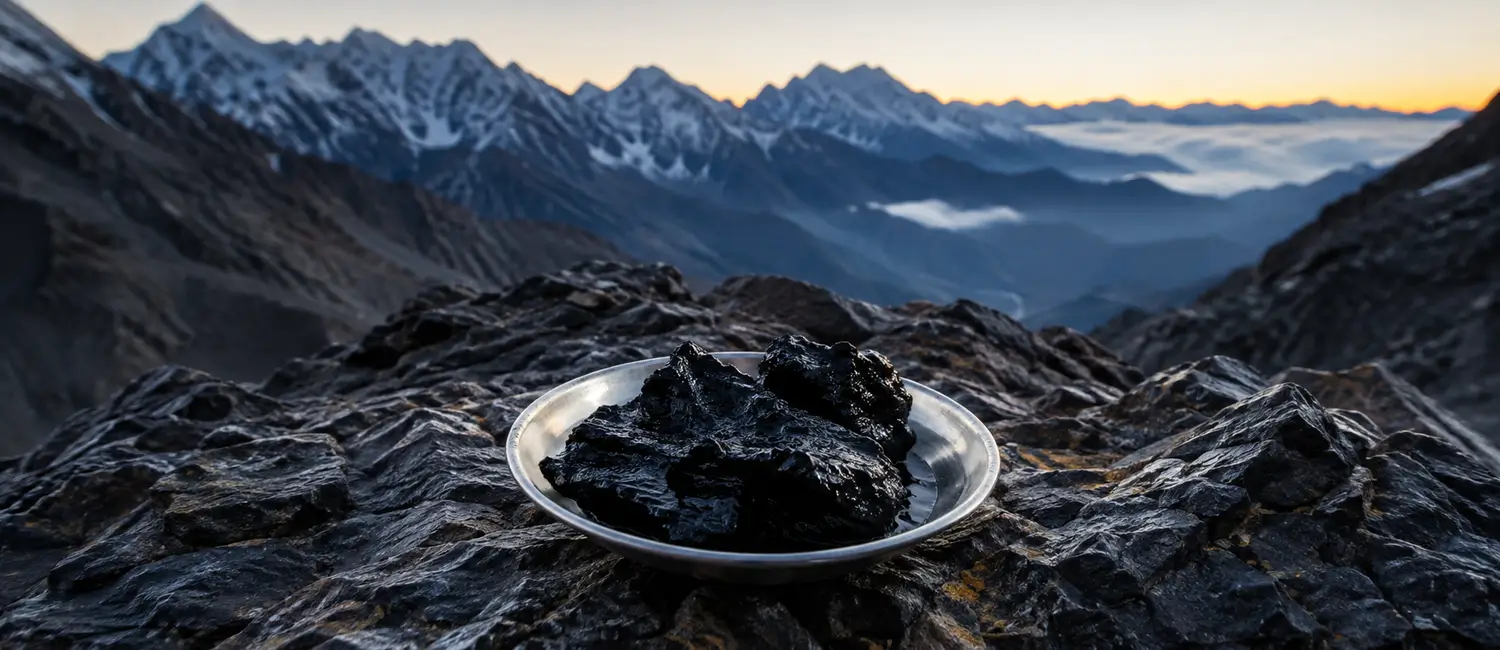
Shilajit, sometimes spelled "shilajeet", is a resinous substance that seeps from high-altitude rocks, mainly in the Himalayas and the Altai, between 1,000 and 5,000 meters. It forms over centuries through the slow decomposition of plant matter under pressure and the action of microorganisms.
Its composition is well documented. It contains fulvic acids and humic acids, dibenzo-alpha-pyrones, amino acids, and a mineral fraction rich in trace elements. Work by Carrasco-Gallardo and his team, published in 2012, describes fulvic acid as the main active compound in the complex.
On the other hand, several common claims rest on nothing solid. Shilajit is not a "mineral" in the geological sense, its trace element content varies enormously from one source to another, and the idea that it contains "85 minerals" useful to the body is more of a sales pitch than nutrition.
Another point worth knowing: the fulvic acid percentage shown on labels, often 50%, is not standardized the same way from one manufacturer to the next. It is a useful indicator, but on its own it is no guarantee of quality.

What benefits does shilajit offer men? What the data show
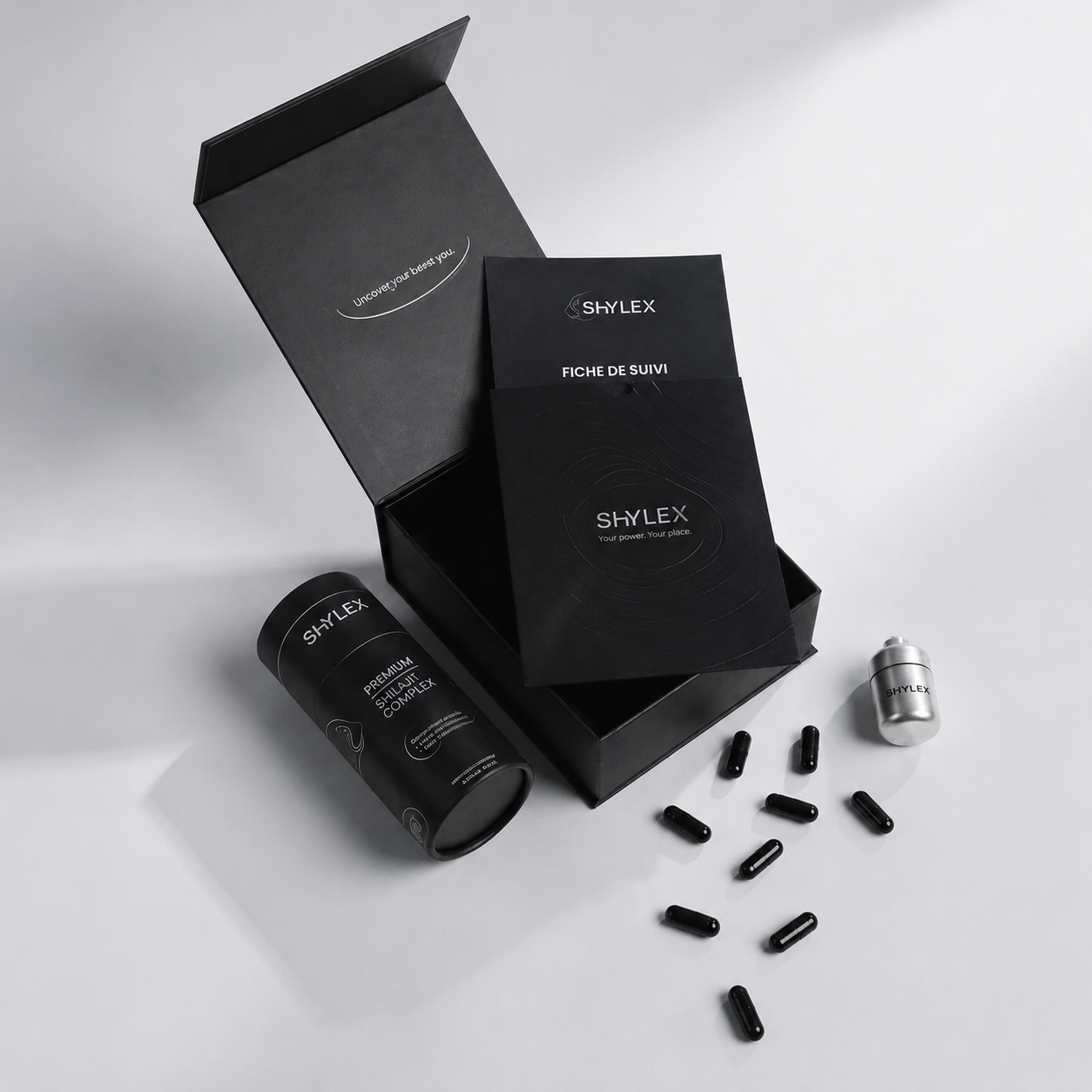
The most cited trial on men is the one by Pandit and colleagues, published in Andrologia in 2016. A randomized, double-blind, placebo-controlled study in men aged 45 to 55, at 250 mg twice a day for 90 days.
To find out which shilajit brands publish their lab analyses (fulvic acid, heavy metals) and at what price, check out our comparison of the best pure shilajit brands.
The measured results: a 20.45% increase in total testosterone, 19.14% in free testosterone, and 31.35% in DHEA compared with placebo, with LH and FSH levels maintained.
These figures call for three honest caveats. The sample is modest, the population is limited to a specific age group, and it is a single trial that has not been replicated on a large scale. An encouraging result is not an individual guarantee.
From a regulatory standpoint, things are even clearer: no health claim is authorized in Europe for shilajit. So it can be described as an ingredient traditionally used in Ayurvedic medicine, studied for its antioxidant properties, but no promised effect can be attributed to it.
What role do zinc and vitamin B6 play in a men's formula?
This is where the nuance becomes important, and many brands skip over it.
The only officially recognized benefits in this type of formula come from micronutrients, not from the plant or the resin. European Regulation 432/2012 authorizes two claims directly relevant to men:
- Zinc contributes to the maintenance of normal testosterone levels in the blood, and to normal fertility and reproduction.
- Vitamin B6 contributes to the reduction of tiredness and fatigue.
These statements only apply if the nutrient reaches a sufficient dose, generally at least 15% of the nutrient reference values. A product that contains a token trace of zinc does not qualify for the claim, even if it displays it.
So remember this: when a formula combines shilajit and zinc, the documented effect on testosterone comes from the zinc. Shilajit brings something else, and it is a common shortcut to credit it with the merits of its neighbor in the formula.
What shilajit dosage should men use?
The answer depends on three levels that need to be distinguished, and that labels often mix up.
The raw material is the crude resin. The extract is concentrated, with a ratio such as 10:1 or 30:1 that multiplies the displayed equivalence. The actual daily dose is the only one that counts, and it is that of the finished product.
In the literature, protocols most often range from 250 to 600 mg per day of purified shilajit. The Pandit trial used 500 mg daily split into two doses.
A few practical pointers 💡:
- Split your intake into two moments of the day rather than taking it all at once.
- Take shilajit with or right after a meal to limit digestive discomfort.
- Allow at least 8 to 12 weeks before judging how you feel, since studies run for 90 days.
- Take breaks between courses rather than using it continuously all year.
Be wary of labels claiming 36,000 mg. That is an equivalent calculated from the extraction ratio, not the amount actually present in the capsule.
Should you choose resin or capsules for daily use?
Both formats have their merits, and the choice mostly comes down to consistency.
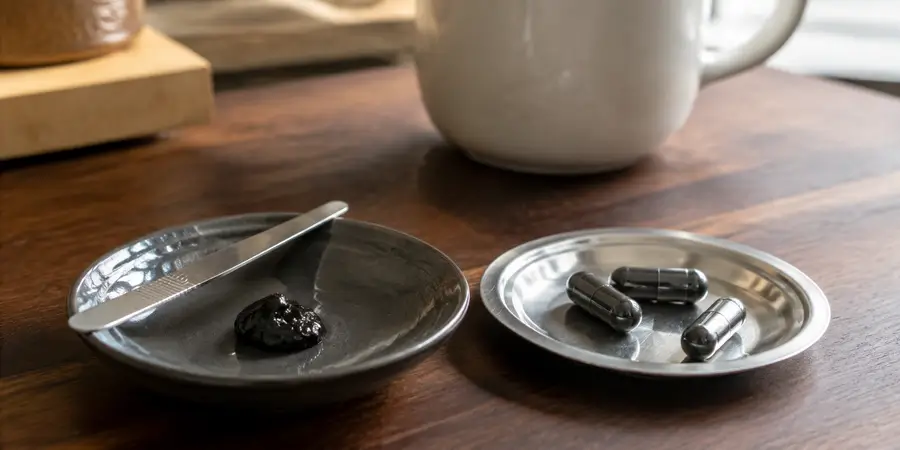
Resin remains the form closest to the traditional product. You measure it with a spatula, dissolve it in a hot liquid, and its strong earthy taste puts off some users. Dosing is also less precise.
Capsules offer a fixed dose, no taste, and are easy to carry. The trade-off is volume: reaching a meaningful daily dose sometimes takes several capsules.
The deciding factor is mundane but real: a course does nothing if you abandon it after ten days. If the taste of resin stops you, capsules will objectively work better for you. We covered the comparison in detail in our article on choosing between resin and capsules.
How do you recognize quality shilajit? The seven criteria to check
The market filled up very quickly, and counterfeiting is a real issue. Here is the checklist we apply.
- Declared geographic origin, with a specific altitude and region, not a vague "Himalayas".
- Documented purification, which removes contaminants from the raw resin.
- Extraction method, preferably with water rather than solvents.
- Heavy metal testing, for lead, arsenic, cadmium, and mercury, on identified batches.
- Microbiological testing, often overlooked even though this is a product of natural origin.
- Transparent dosages, ingredient by ingredient, with no opaque proprietary blend.
- Manufacturing in a certified facility, under GMP or HACCP standards.
A product that checks all seven boxes will inevitably cost more than an anonymous resin sold on a marketplace. That is the price of traceability, and for this particular category, it is not a luxury.
Why do finished product analyses matter as much as the raw material?
Many brands present their raw material supplier's certificate of analysis. That is better than nothing, but it does not tell you what is in the capsule you swallow.
Between the raw material and the finished product come transport, storage, blending with other ingredients, encapsulation, and packaging. Each of these steps can introduce contamination or degrade the initial quality.
An analysis performed on the finished product, batch by batch, is therefore the only document that truly commits the brand. It is also the rarest, because it is expensive and leaves the brand exposed.
When a brand publishes these reports and makes them available, it is a strong signal. When it stays vague and highlights a single percentage, it is the opposite signal.
How SHYLEX applies these criteria in a complete men's formula
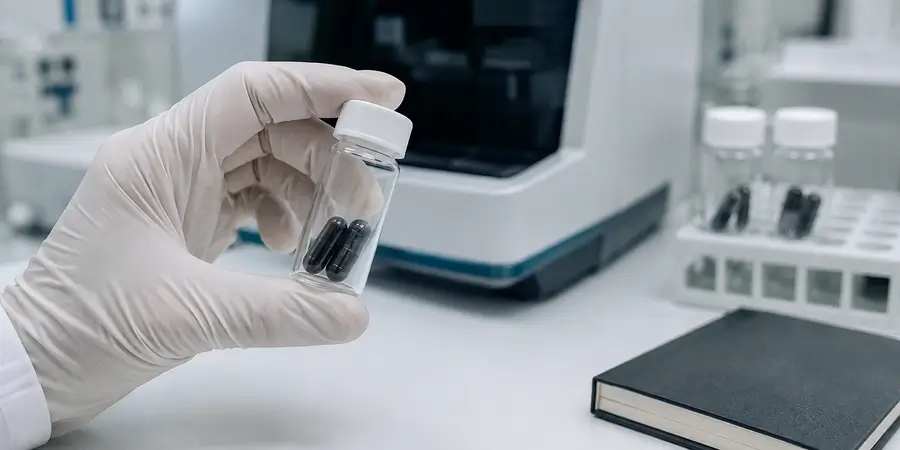
Among the French brands we have evaluated, SHYLEX is the one that meets the greatest number of the criteria above. Its Premium Shilajit Complexe scores 8.7/10 in our comparison.
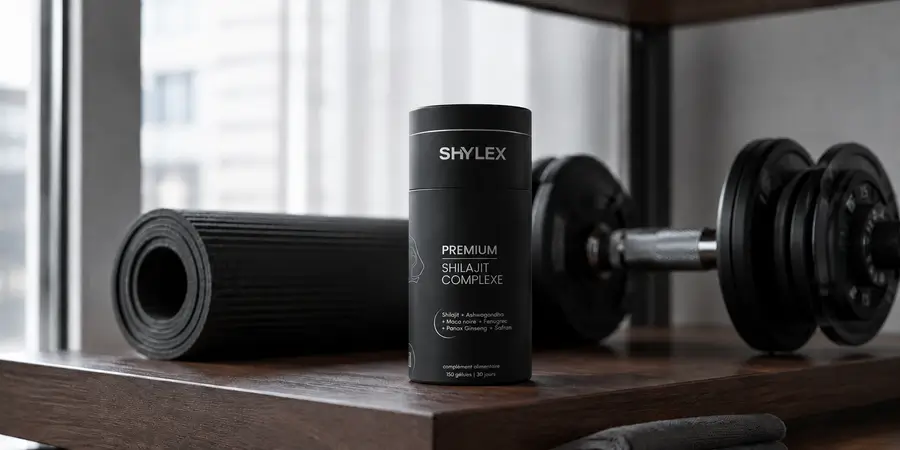
The approach is deliberate: rather than standalone shilajit, the brand builds a 9-ingredient complex designed for a men's routine.
| Ingredient | Daily dose |
|---|---|
| Purified shilajit | 600 mg |
| Ashwagandha | 500 mg |
| Black maca | 500 mg |
| Panax ginseng | 300 mg |
| Fenugreek | 300 mg |
| Saffron | 30 mg |
| Zinc | 10 mg |
| Vitamin B6 | 1.4 mg |
| Piperine | 5 mg |
The 600 mg of shilajit falls within the range of the protocols studied. The 10 mg of zinc covers 100% of the reference values, which allows the formula to carry the claim on maintaining normal testosterone levels. Vitamin B6 provides the recognized contribution to reducing fatigue. Piperine, for its part, is added to promote absorption of the other compounds.
On the testing side, the brand has its products manufactured under GMP and HACCP standards, and publishes heavy metal and microbiology analyses performed on the finished product by an independent French laboratory. The pack of 150 vegan capsules lasts 30 days at 5 capsules per day, 2 to 3 in the morning and 2 in the evening, and comes with a guide, an action plan, a tracking sheet, and a pill organizer.
👉 See the composition and lab analyses (code SHYLEX10 for 10% off)
What precautions should you take before starting a course?
A multi-ingredient complex requires more caution than a single ingredient, since each plant comes with its own contraindications.
- Ashwagandha is the subject of a cautionary opinion from ANSES, the French food safety agency. It is not recommended for people with thyroid, liver, or heart conditions, or for those on treatments acting on the central nervous system.
- Saffron may interact with antidepressants.
- Fenugreek is not recommended if you take anticoagulants.
- Ginseng calls for caution in case of uncontrolled high blood pressure.
These products are not suitable for minors or for pregnant or breastfeeding women. If you are on any treatment at all, talk to your doctor or pharmacist before starting.
Finally, if fatigue has lasted for several months, a blood test will tell you more than a guess. A supplement does not replace a diagnosis.
Frequently asked questions
How long before you feel anything?
The protocols studied last 90 days. Allow at least 8 weeks before drawing a conclusion, and be wary of promises of results within a few days.
Can you take shilajit all year round?
That is not the recommended use. Courses of 1 to 3 months with breaks in between better match the traditional approach and the available data.
Is shilajit also suitable for women?
Yes, even though the available clinical data mainly concern men. Formulas aimed at male vitality, however, contain ingredients that are not suited to every profile.
Is a high fulvic acid content enough to judge a product?
No. It is one indicator among others, not standardized across manufacturers, and it says nothing about contaminants or the quality of the finished product.
Further reading
- Shilajit or ashwagandha: should you choose or combine them?
- How to choose an all-in-one men's supplement without stacking bottles?
Scientific references
- Pandit S, Biswas S, Jana U, et al. "Clinical evaluation of purified Shilajit on testosterone levels in healthy volunteers". Andrologia, 2016;48(5):570-575. PubMed 26395129
- Carrasco-Gallardo C, Guzman L, Maccioni RB. "Shilajit: A Natural Phytocomplex with Potential Procognitive Activity". International Journal of Alzheimer's Disease, 2012. PubMed 22482077
- Regulation (EU) No 432/2012 establishing a list of permitted health claims. EUR-Lex
- Anses, opinion on the risks associated with the consumption of Withania somnifera, request 2021-SA-0077. Anses
Dietary supplements are not a substitute for a varied, balanced diet or a healthy lifestyle.

LMC content is written by our editorial team from the information published by the brands. Scores out of 10 follow a public grid of 5 criteria*, supplemented by LMC’s editorial assessment.
To support LMC, some links are affiliate links: LMC earns a commission at no extra cost to you, and some of the brands featured are partners. By using the site, you accept our terms of use and our editorial policy.