
Does folic acid help you get pregnant? The honest answer

Let's be blunt: no. No data supports the claim that vitamin B9 increases your chances of conceiving, and no European health claim allows it. Yet if you search for "folic acid to get pregnant," you'll find pages that imply it.
What folate actually does is both more modest and more important. The only disease risk reduction claim authorized in Europe, quoted word for word from EU Regulation 1135/2014, reads:
"Supplemental folic acid intake increases maternal folate status. Low maternal folate status is a risk factor in the development of neural tube defects in the developing fetus."
In other words, folate doesn't help you get pregnant; it lays the groundwork so that the pregnancy gets off to a good start. The neural tube closes very early, around the third or fourth week after conception, often before you've even missed a period.
That's why timing is everything: if you wait for a positive test, you're too late on this specific point. Two other authorized claims round out the picture, with folate contributing to maternal tissue growth during pregnancy and to normal blood formation.
Why doctors still prescribe it as soon as you want a baby
Precisely because of that window. France's Haute Autorité de Santé (HAS) addresses folate supplementation from the preconception visit onward. The beneficial effect is obtained with a daily intake of 400 µg, starting at least one month before conception and continuing up to three months after. A systematic review published in JAMA in 2023 for the US Preventive Services Task Force confirms how solid this recommendation is.
What's the difference between folic acid and active folate before conception?
On labels, three terms appear side by side: folic acid, folate, and 5-MTHF or Quatrefolic. This isn't marketing jargon; the difference is real.
- Folic acid is the synthetic form. Your body has to convert it in several steps before it can use it.
- Active folate, in the form of 5-methyltetrahydrofolate, is already in the form your cells can use directly.
- Part of the population carries a variant of the MTHFR gene that slows this conversion, usually without knowing it.
As for the dose, the benchmark doesn't change: 400 µg per day. That's the amount the European claim is built on, and it's also the amount recommended for women trying to conceive in the general population. 5 mg doses exist, but they're prescribed for specific situations, never taken on your own initiative.
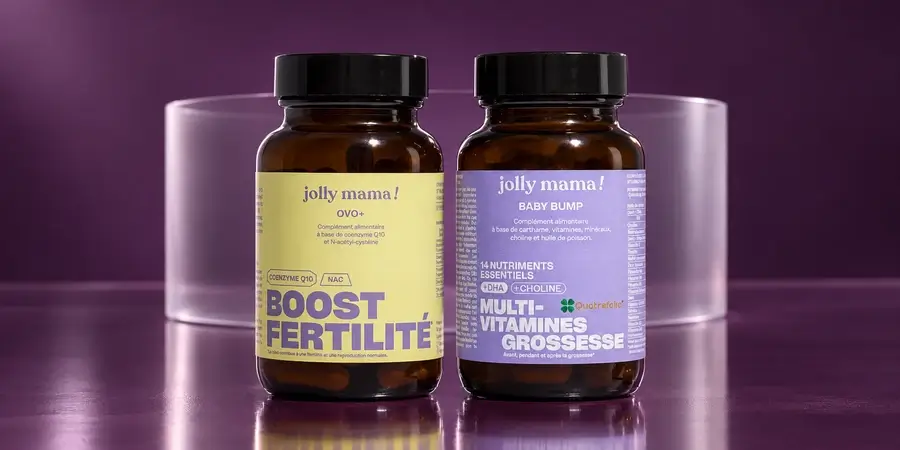
This is the criterion that really separates the formulas on the market. Jolly Mama's Baby Bump, for example, provides 400 µg of folate as Quatrefolic, the reference dose in its directly absorbable form, combined with 200 mg of DHA and 83 mg of choline.
We cover the forms of B9, the doses and the exact duration of use in our complete guide to folic acid and pregnancy.


When should you start taking vitamins, and for how long?
This is the real practical question, and it has a simple answer. Three milestones are all you need to set up a preconception timeline.
| When | What's happening | What to put in place |
|---|---|---|
| 3 months before trying | Rebuilding nutrient stores, egg maturation over two to three cycles | 400 µg of folate, blood work, quitting smoking and alcohol |
| While trying | Fertile window, your partner's sperm production cycle | Keep going without a break, don't wait for the test |
| Positive test | The neural tube closes from the third week | Continue folate until the end of the third month |
| From the 2nd trimester | Iron and DHA needs rise significantly | Adjust with your midwife or doctor |
One point that comes up a lot: taking folic acid for longer or at a higher dose won't shorten the time it takes to get pregnant. The question "how long does it take to get pregnant with folic acid" has no answer, simply because that link doesn't exist. What consistency changes is your folate status at the moment the embryo forms.
If your cycles are irregular, pinpointing your ovulation window remains the most practical lever. Folate, for its part, has no effect on ovulation or cycle regularity.
Which other vitamins and minerals matter before conception?
Folate doesn't work alone. Here are the nutrients whose role is recognized by a European health claim, meaning the statement is regulated and verifiable, not a marketing promise.
- Vitamin D: contributes to the normal function of the immune system and to the maintenance of normal bones. Deficiency is common in France, especially in winter.
- Zinc: contributes to normal fertility and reproduction and to normal DNA synthesis, and helps protect cells from oxidative stress. It's one of the few minerals with a claim explicitly linked to reproduction.
- Iodine: contributes to normal thyroid function. The thyroid is under heavy demand from the very first weeks of pregnancy.
- Iron: contributes to normal red blood cell formation and to the reduction of tiredness. Needs rise from 11 to 16 mg per day during pregnancy according to ANSES, and a 2024 Cochrane review takes stock of daily supplementation. Never take it blindly: get a blood test first. 🩸
- Vitamin B12: contributes to normal energy-yielding metabolism and to the reduction of tiredness. One to watch closely on vegetarian and vegan diets.
- DHA: maternal intake of DHA contributes to normal brain development of the fetus, from 200 mg per day on top of the recommended omega-3 intake.
- Selenium: contributes to normal spermatogenesis, which we'll come back to for your partner.
A well-designed preconception multivitamin covers these bases without stacking them. And here's a point almost nobody mentions: multivitamins designed for postpartum often contain retinol, that is, preformed vitamin A, which is not recommended once you're trying to conceive or during pregnancy. A postpartum formula is therefore not interchangeable with a preconception formula, even within the same brand.
What does research say about coenzyme Q10, NAC and myo-inositol?
These three actives show up in fertility supplements time and again, and none of them has an authorized health claim in Europe. So they can't be presented as effective. What we can do, however, is look at what research observes and describe it with caution.
- Coenzyme Q10 is being studied for ovarian reserve and ovarian response, particularly in women with diminished reserve. A meta-analysis published in Advances in Nutrition in 2024 reviews antioxidants and fertility in ovarian aging: the signals are encouraging, but the level of evidence remains limited.
- N-acetylcysteine is being studied as a precursor of glutathione, one of the body's major antioxidants.
- Myo-inositol is the best documented of the three, but in a specific context: polycystic ovary syndrome. A 2024 meta-analysis published in the Journal of Clinical Endocrinology and Metabolism, carried out to inform the update of the international PCOS guidelines, assesses its value on metabolic and ovulatory parameters.
In the Jolly Mama range, Ovo+ fills this antioxidant niche, with 300 mg of coenzyme Q10, 600 mg of N-acetylcysteine, 100 mg of L-tryptophan and 5 mg of zinc bisglycinate per two capsules. The brand presents it as compatible with assisted reproduction (IVF) and designs it for women: its male counterpart, Cocooning+ Men, is covered below.
One rule not to miss if you choose it: Ovo+ contains no vitamin B9. So it doesn't replace a preconception multivitamin; it's taken alongside a formula that provides folate, never instead of it.
And as always on this subject: if you're being followed for infertility or going through assisted reproduction, no supplement replaces the advice of your doctor or gynecologist.

And what can men do on their side?
Half of the story is often missing from fertility articles. Yet in about 30% of cases, difficulty conceiving involves only the man, and in 20% of cases both partners are involved.
Two things to remember. First, time: the sperm production cycle lasts about two to three months, which means a change in habits or a supplement won't show up on a semen analysis before then. Second, measurement: the semen analysis is the reference test, and it requires a prescription. 🧪
On the nutrient side, only one authorized claim directly addresses the subject: selenium, which contributes to normal spermatogenesis. Zinc, for its part, carries the claim on normal fertility and reproduction. Beyond that, two meta-analyses, one published in Advances in Nutrition in 2018 and the other in Reproductive BioMedicine Online in 2019, examined the effect of vitamins and minerals on sperm parameters: signals exist, protocols vary widely from one study to the next, and no result can be promised.
At Jolly Mama, Cocooning+ Men is the dedicated formula, in sachet form: 2 g of carnitine, 600 mg of cysteine, 200 mg of coenzyme Q10 and 50 µg of selenium, or 91% of the reference intake. It's vegan and gluten-free.
How do you build your routine based on your profile?
There's no single vitamin to get pregnant, but rather a common foundation plus adjustments. The foundation is 400 µg of folate, ideally in active form, started three months before trying. The rest depends on your situation. 👇
| Your situation | The priority | What to avoid |
|---|---|---|
| Trying to conceive, regular cycles | Folate 400 µg, vitamin D, iodine | Stacking three overlapping products |
| Irregular cycles or PCOS | Pinpoint ovulation, medical advice, myo-inositol discussed with your doctor | Supplementing blindly |
| Over 35 | Full blood work and a preconception visit | Waiting before seeing a doctor |
| Vegetarian or vegan diet | B12, iron, algae-based DHA, vegan formula | Fish oil-based formulas |
| Abnormal semen analysis | Selenium and zinc, three months ahead, medical follow-up | Judging a change after one month |
| Assisted reproduction (IVF) | Whatever the medical team prescribes | Any self-medication |
If you're looking for a range dedicated to this stage, Jolly Mama groups its formulas in its fertility supplement collection. The brand is French, manufactures in France, packages its capsules in glass jars, and the code LMC15 gives you 15% off in its online store.
To compare the formulas on the market against each other, ingredient by ingredient, we've published a comparison of supplements to get pregnant.
What mistakes should you avoid before conception?
- Taking 5 mg folic acid on your own initiative. This dose is for a specific medical indication.
- Stacking supplements. Three products taken together can exceed safety limits, especially for vitamin A, iron and iodine.
- Using a postpartum formula for preconception. The retinol it often contains is not recommended once you're trying to conceive.
- Taking iron without blood work. Too much iron isn't harmless.
- Promises of twins. No vitamin causes a twin pregnancy; it's a stubborn myth.
- Judging a change too soon. Allow two to three cycles for women and two to three months for men.
Your questions about vitamins to get pregnant
What is the best vitamin to get pregnant?
No vitamin increases fertility. The most important one before conception is B9, at 400 µg per day, because it prepares the very first weeks of pregnancy. The best formula is therefore one that provides this dose in active form and rounds it out with vitamin D, iodine and zinc without overdosing them.
How can you boost your fertility to get pregnant?
The best-documented levers aren't supplements: pinpointing your fertile window, not smoking, limiting alcohol, aiming for a stable weight and getting enough sleep. What's on your plate matters too. Supplements come in afterward, to secure your intake, not to trigger anything.
Which vitamin increases ovulation?
No vitamin triggers or increases ovulation, and no health claim allows that statement. Irregular cycles or a lack of ovulation are a reason to see a doctor, not to supplement.
What are the three herbs that boost fertility?
Chasteberry (vitex), maca and ashwagandha come up most often. None of these plants has an authorized health claim on fertility. That doesn't make them harmless, as some interfere with hormonal balance or ongoing treatments: get medical advice before using them.
Can you buy these vitamins at the pharmacy without a prescription?
Yes, dietary supplements are sold over the counter, in pharmacies and online. That doesn't mean they're without consequences: France's consumer protection agency (DGCCRF) points out that they don't undergo prior scientific evaluation and that overdosing can have harmful effects. Advice from a healthcare professional is still useful, especially when you're planning a pregnancy.
Key takeaways
The vitamin to remember before conception is B9, at 400 µg per day, started at least one month before and continued until the third month of pregnancy. It won't help you conceive faster; it secures the start. Around it, vitamin D, iodine, zinc and iron should be checked rather than stacked. And your partner has a three-month head start to take, too. 🤍
Dietary supplements should not replace a varied, balanced diet and a healthy lifestyle. This article is for informational purposes and does not constitute medical advice.
Scientific references
- ANSES, Nutritional references for vitamins and minerals: anses.fr
- Haute Autorité de Santé, Planning a pregnancy: information, prevention messages, tests to carry out: has-sante.fr
- Regulation (EU) No 432/2012 establishing a list of permitted health claims made on foods: eur-lex.europa.eu
- Regulation (EU) No 1135/2014 on the authorization of a health claim on foods referring to the reduction of disease risk (folic acid and neural tube defects): eur-lex.europa.eu
- Regulation (EU) No 440/2011, notably covering the claim on DHA and normal brain development of the fetus: eur-lex.europa.eu
- Folic Acid Supplementation to Prevent Neural Tube Defects: Updated Evidence Report and Systematic Review for the US Preventive Services Task Force, JAMA, 2023: pubmed.ncbi.nlm.nih.gov
- Antioxidants and Fertility in Women with Ovarian Aging: A Systematic Review and Meta-Analysis, Advances in Nutrition, 2024: pubmed.ncbi.nlm.nih.gov
- Pretreatment with coenzyme Q10 improves ovarian response and embryo quality in low-prognosis young women with decreased ovarian reserve, Reproductive Biology and Endocrinology, 2018: pubmed.ncbi.nlm.nih.gov
- Inositol for Polycystic Ovary Syndrome: A Systematic Review and Meta-analysis to Inform the 2023 Update of the International Evidence-based PCOS Guidelines, Journal of Clinical Endocrinology and Metabolism, 2024: pubmed.ncbi.nlm.nih.gov
- The Effect of Nutrients and Dietary Supplements on Sperm Quality Parameters: A Systematic Review and Meta-Analysis of Randomized Clinical Trials, Advances in Nutrition, 2018: pubmed.ncbi.nlm.nih.gov
- Influence of oral vitamin and mineral supplementation on male infertility: a meta-analysis and systematic review, Reproductive BioMedicine Online, 2019: pubmed.ncbi.nlm.nih.gov
- Daily oral iron supplementation during pregnancy, Cochrane Database of Systematic Reviews, 2024: pubmed.ncbi.nlm.nih.gov
- DGCCRF, Dietary supplements: what you need to know, economie.gouv.fr, updated July 15, 2025: economie.gouv.fr

LMC content is written by our editorial team from the information published by the brands. Scores out of 10 follow a public grid of 5 criteria*, supplemented by LMC’s editorial assessment.
To support LMC, some links are affiliate links: LMC earns a commission at no extra cost to you, and some of the brands featured are partners. By using the site, you accept our terms of use and our editorial policy.