




Folic acid and pregnancy: why vitamin B9 is essential
Folic acid is the synthetic form of vitamin B9, a key nutrient for cell division and DNA production. During pregnancy, these mechanisms run at full speed to build the embryo's tissues.
Its best documented role concerns the closure of the neural tube, the earliest outline of the brain and the spinal cord. This closure happens very early, around day 28 after conception, at a point when many women still do not know they are pregnant.
A folate deficiency at the wrong moment increases the risk of neural tube closure defects:
- Spina bifida, a malformation of the spine.
- Anencephaly, a severe disruption of brain development.
- Other, rarer defects of the nervous system.
Beyond the baby, B9 also supports the mother to be: red blood cell formation, prevention of a particular type of anaemia, and protection against fatigue. A deficiency can show up as breathlessness, pallor or a drop in energy, signs that should never be brushed aside during pregnancy.
Vitamin B9 goes by several names depending on its form (folate, folacin, folic acid), but it always refers to the same link in cell synthesis. That variety of terms often blurs the picture for mothers to be, which is exactly why it pays to get clear before choosing a supplement.
Folic acid and pregnancy: what dosage and what dosing schedule?
The official recommendation on folic acid and pregnancy is easy to remember. In France, the Haute Autorité de Santé advises a folic acid dosage of 400 µg (0.4 mg) per day during pregnancy, for the general population of women trying to conceive or already pregnant.
On the dosing side, folic acid is taken in one go, every day, ideally in the morning. It can be taken with or without food, the key point being consistency across the whole period concerned.
Some situations call for a much higher dose, up to 5 mg per day, on prescription only:
- A previous pregnancy affected by a neural tube defect.
- Ongoing antiepileptic treatment.
- Diabetes, obesity or certain absorption disorders.
Folic acid supplementation during pregnancy answers a genuine everyday need. Average dietary intake among French women sits at around 300 µg per day, below the 400 µg target. Natural folates (green vegetables, pulses, liver) are valuable but fragile once cooked, which is what justifies the supplement. Never go beyond 5 mg without medical advice, as an excess brings no proven additional benefit.
A word on units, a frequent source of confusion. People say 0.4 mg or 400 µg interchangeably, and it is exactly the same dose. The 5 mg version, on the other hand, is more than ten times more concentrated: it belongs to a precise medical indication, never to a personal decision. If you have any doubt about your own situation (ongoing treatment, medical history, chronic condition), the dosing schedule is always set with a healthcare professional.

Folic acid and pregnancy: until when? The ideal length of supplementation
The question "folic acid in pregnancy, until when" comes up in every consultation. The answer lies in the biological window of neural tube closure, which is very early.
The schedule usually recommended:
- Start at least 4 weeks before conception, as soon as contraception is stopped.
- Carry on until the 10th week of pregnancy (that is 12 weeks of amenorrhoea), by which point the neural tube has already closed.
After the first trimester, many women keep taking B9 through a complete prenatal supplement, since it remains useful for the growth of the foetus and for maternal wellbeing. While breastfeeding, folate intake stays relevant to rebuild stores, often within a postnatal multivitamin.
The essential message: starting early counts more than anything. A late start, after a positive test, sometimes comes too late to cover the most sensitive window.
One particular case deserves attention, that of closely spaced pregnancies. Moving from one baby project to the next without rebuilding your stores weakens folate status. Resuming supplementation ahead of each new attempt therefore makes full sense, alongside gynaecological follow-up.
Folic acid to get pregnant: preparing for conception
Taking folic acid to get pregnant does not make you fertile in itself, but it prepares optimal ground for a calm start to pregnancy. It is a preventive reflex, not a fertility treatment.
Getting ahead by a few weeks lets you saturate folate stores even before implantation. The body then has enough of a stock at the precise moment the embryo needs it most.
A few useful markers for this planning phase:
- Combine B9 with a diet rich in natural folates and iron.
- Add cofactors that are often useful for conception: zinc, iodine, vitamin D.
- Do not forget the father to be, whose sperm quality also benefits from targeted antioxidants.
Think about the couple's timing too, ideally over three months: that is the order of magnitude for the renewal of eggs and sperm. Over that window, a careful lifestyle (sleep, stopping smoking, moderating alcohol) and regular folate intake lay solid foundations.
This logic of preparing as a couple explains why formulas designed for those trying to conceive almost always include folates, on their own or combined with other micronutrients.

Where to find folates naturally? Foods rich in vitamin B9
Supplementation does not replace a well built plate, it completes it. Leaning on foods rich in folates helps secure your intake, especially at the start of a baby project.
The best sources of vitamin B9 fall into a few families:
- Green leafy vegetables: spinach, lamb's lettuce, watercress, broccoli.
- Pulses: lentils, chickpeas, dried beans.
- Offal such as liver, very rich, but to be limited during pregnancy because of its vitamin A content.
- Certain fruits, nuts and seeds: citrus fruits, avocado, sunflower seeds.
The weak point of dietary folates is how fragile they are. They oxidise with light, with air and above all with heat: prolonged cooking destroys a large share of a vegetable's B9. Favouring gentle cooking (steaming, braising) and a share of raw food clearly limits these losses.
This instability explains why diet alone rarely covers the 400 µg target at the most critical moment. The supplement acts as a safety net, with a steady, measured intake that does not depend on the ups and downs of the shopping basket and the saucepan.
Classic folic acid or Quatrefolic: the difference in form
Here is the point that really separates entry level formulas from premium versions. Not all vitamin B9 is equal, because its chemical form changes everything when it comes to absorption.
Three terms that often get mixed up need to be told apart first:
- Folates, the natural form found in food.
- Folic acid, the classic synthetic form, stable and inexpensive.
- 5-MTHF (methylfolate), the active form that cells can use directly.
Classic folic acid is not active as it is. The body has to convert it into 5-MTHF through several enzymes, including the well known MTHFR. Yet a variation in the MTHFR gene concerns close to 40% of the population, which slows this conversion down and reduces the real bioavailability of folates.
This is where Quatrefolic folic acid comes in. Quatrefolic® is a glucosamine salt of 5-MTHF, developed by Gnosis by Lesaffre. As it is already in the active form, it calls for no conversion and stays effective whatever the genetic profile.
Quatrefolic vitamin B9 has two concrete advantages, often highlighted in the literature:
- Higher bioavailability (often described as around twice that of folic acid).
- Less unmetabolised folic acid (UMFA) in the blood, a phenomenon observed with high intakes of the synthetic form.
One point to be clear about: these forms aim at the same goal of folate coverage, and classic folic acid still holds the highest level of evidence on neural tube prevention. Quatrefolic® is a modern absorption choice, not a substitute for medical recommendations.
Should you get tested for the MTHFR gene before choosing? In practice, no: systematic screening is not recommended, because opting straight away for an active form sidesteps the question without a costly test. The profiles that gain the most from it are women with a history of repeated miscarriage, a high homocysteine level or a family history of neural tube defects, always to be assessed with a doctor.
| Criterion | Quatrefolic® (5-MTHF) | Classic folic acid |
|---|---|---|
| Form | ✅ Active, directly usable | ❌ Synthetic, needs converting |
| Enzyme conversion required | ✅ None | ❌ Yes (DHFR, MTHFR) |
| Effectiveness with an MTHFR variant | ✅ Maintained | ❌ Conversion slowed down |
| Unmetabolised folic acid (UMFA) | ✅ Reduced | ❌ Possible at high doses |
| Historical level of evidence (neural tube) | ❌ More recent | ✅ The best documented |
Quatrefolic and pregnancy: the choice made by modern formulas
The Quatrefolic and pregnancy pairing illustrates an underlying trend: delivering the recommended 400 µg, but in a more absorbable form. The target does not change, the way of reaching it improves.
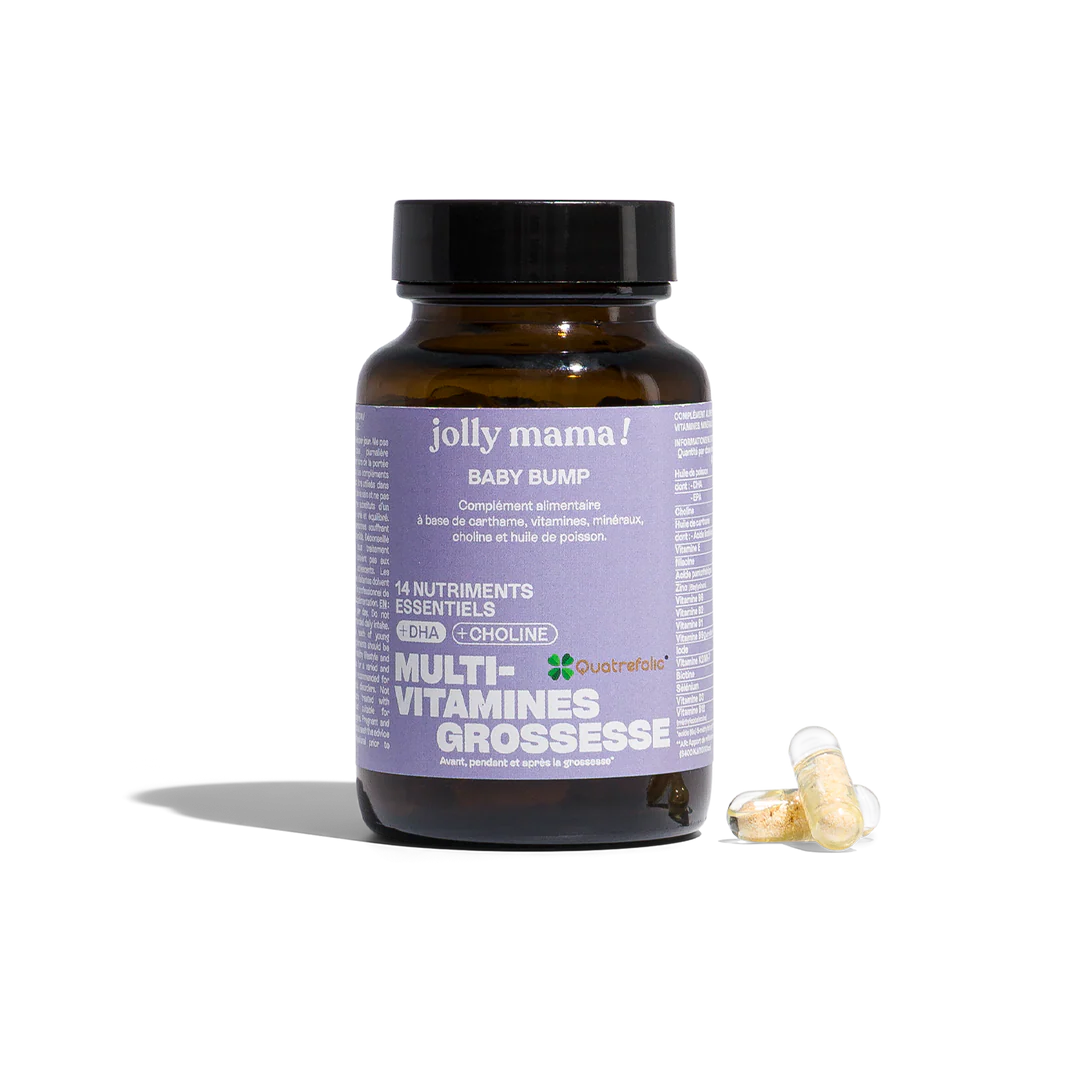
That is the stance taken by specialist brands such as Jolly Mama. Its Baby Bump multivitamin provides 400 µg of B9 as Quatrefolic®, in line with the official recommendation, while betting on bioavailability.
The value of a complete prenatal formula goes well beyond B9 alone:
- DHA (omega 3) for the brain and visual development of the foetus.
- Choline, iodine and vitamin D3, which are often in short supply.
- A single daily dose, easier to keep up over time.
This type of formula particularly appeals to women who already pay attention to ingredient quality, or to those who suspect poorer absorption. The reasoning stays the same for everyone though: cover the 400 µg a day, without ever turning a food supplement into a medical promise.
This modern positioning does not replace the advice of your midwife or your doctor, it adds to it. To dig deeper into the compositions and user feedback, read our full Jolly Mama review.
Folic acid and pregnancy: reviews from mothers to be

What are these supplements worth day to day? Folic acid pregnancy reviews converge on three points: how simple they are to take, digestive tolerance and trust in the traceability of the ingredients.
The most frequent feedback separates two product profiles:
- Folic acid only tablets, affordable and effective on prevention, popular for their price.
- Quatrefolic® based multivitamins, appreciated for digestive comfort and the feeling of a more complete formula.
Mothers to be also stress the format. Some prefer small capsules that are easy to swallow when nausea sets in, others like a single dose that is harder to forget in the daily routine. This practical detail, often overlooked, weighs heavily on how consistently the supplement is really taken month after month.
One piece of advice runs through all these accounts: consistency counts more than the brand. The best supplement is still the one you take every day, without missing a dose, across the whole recommended window. If morning sickness kicks in, moving the dose to a light meal often helps you tolerate it better.
Conclusion
Remember the essentials: 400 µg of B9 a day, from four weeks before conception until 12 weeks of amenorrhoea, unless a higher dose has been prescribed. The choice of form, classic folic acid or Quatrefolic®, then fine tunes absorption to your profile. In every case, taking it consistently and having suitable medical follow-up remain your best allies over these nine months, far more than the name on the box. For a prenatal formula with Quatrefolic®, the code LMC gives you -15% at the Jolly Mama shop.
Scientific references
- Ministry of Health (France), recommendations for the prevention of neural tube closure defects: sante.gouv.fr
- CNGOF, supplementation during pregnancy: cngof.asso.fr
- Ferrazzi E. et al., "Active Folate Versus Folic Acid: The Role of 5-MTHF in Human Health": ncbi.nlm.nih.gov
- EFSA, scientific opinion on folic acid and the neural tube: efsa.europa.eu

LMC’s editorial line is built around transparency and reliability. Our content is written to help users make better decisions, based on 7 key criteria* that support trustworthy information, verified promo codes, and useful reviews.
To support LMC, some links are affiliate links. Our recommendations remain independent and based on transparent, verifiable criteria. By using the site, you accept our terms of use and our editorial policy.






.webp)

.avif)