





What does a breastfeeding woman really need?
Producing milk puts the body under real strain. Requirements for several micronutrients climb, and it is the baby who gets served first, sometimes at the expense of the mother's own reserves.
In practice, breast milk draws continuously on your stores to stay nutritious. Some needs jump sharply: vitamin A intake has to almost double, while iodine, zinc and several B vitamins follow the same curve. That silent rise, when it is poorly covered, often ends up showing as a lack of energy.
To choose your vitamins while breastfeeding well, you first need to know which items go up. According to ANSES, needs rise in particular for:
- Iron, zinc and copper, called on by recovery and lactation.
- Magnesium and B group vitamins, key to energy.
- Iodine and vitamin D, essential for mother and infant alike.
- DHA (omega-3), passed to the baby only through breast milk.
A good vitamin for a breastfeeding woman is therefore not a single product, but a targeted answer to those specific items. That is also why postpartum and breastfeeding vitamins are often thought of as a combination, a multivitamin base topped up according to how you feel.
The starting point is still the plate: protein, vegetables, good fats and hydration. The supplement comes next, to fill in what food alone struggles to cover in such an intense period.
Fatigue and breastfeeding: where does that slump come from?
Breastfeeding fatigue is not in your head. It stacks up several physiological causes that feed into each other, especially in the first few weeks.
Three main factors explain postpartum fatigue while breastfeeding:
- The energy cost of lactation, which calls for several hundred calories a day.
- Broken nights, which get in the way of restorative sleep.
- Falling reserves, iron in particular after the blood loss of childbirth.
That last point deserves attention. An iron deficiency can develop into anaemia, which clearly worsens exhaustion, breathlessness and pallor. When breastfeeding fatigue becomes intense, a blood test is needed to check iron levels and adjust the care plan.
On top of these physical causes comes the rapid drop in hormones after birth, which weighs on mood and on the drive to get through the day. This passing tiredness should not be confused with a more marked baby blues, or with postnatal depression, which call for specific medical support.
Mental load plays its part too. Managing feeds, the baby's sleep and the house is as draining as the physical effort. Nutritional support helps you hold on, but it replaces neither rest nor the helping hands around you, two ingredients that matter just as much.
That is where the question of micronutrients makes full sense. Looking for the right vitamin against breastfeeding fatigue means targeting what is genuinely missing, rather than piling up products at random. We get to that right now.

The anti-fatigue vitamins and minerals to know
Here is the heart of the matter. A good food supplement against breastfeeding fatigue combines a few actives whose role in energy is well established.
The nutrients to know about first:
- Iron, central when reserves are low or anaemia is confirmed, only on medical advice and at a suitable dose.
- Magnesium while breastfeeding, paired with vitamin B6, which helps reduce fatigue and support the nervous system.
- Vitamin B12, important for energy and worth watching closely in vegetarian or vegan mothers.
- Vitamin D while breastfeeding, useful for the immune system and the bones, often lacking for want of sun exposure.
- Iodine, whose requirement rises to 200 µg a day, and DHA, passed to the baby through the milk.
Magnesium deserves an extra word. In bisglycinate form it is better tolerated by the gut, a real advantage when transit is already unsettled. Paired with B6, it makes a duo that is well liked for fatigue and sleep.
On vitamin D, the CNGOF mentions supplementing the mother throughout breastfeeding, something to discuss with your doctor. The aim is twofold: protect the mother and enrich the milk, whose content depends directly on the mother's intake.
Iron, on the other hand, is never taken blind. Supplementing only makes sense when reserves are low or anaemia is confirmed by a blood test, because too much iron is neither useful nor risk free. It is the one nutrient you should not add out of reflex, but only when it is indicated.
One practical detail clearly improves iron absorption: pairing it with a source of vitamin C, such as fresh fruit, and keeping it away from tea or coffee, which hold back its uptake. That kind of adjustment sometimes changes more than switching supplement.
Two nutrients mainly concern the baby. Iodine, whose requirement rises to 200 µg a day, takes part in the infant's thyroid and neurological development. DHA, an omega-3, shapes the brain and vision: as milk is the only source for a breastfed baby, its concentration directly reflects what the mother eats.
| Need you feel | Key nutrient | Recognised role |
|---|---|---|
| Fatigue, energy slump | Magnesium + vitamin B6 | Reduced fatigue, nervous system |
| Low reserves, anaemia | Iron (on medical advice) | Red blood cell formation |
| Immunity and bones | Vitamin D | Defences and bone health |
| Energy, vegetarian diet | Vitamin B12 | Normal energy metabolism |
| Baby's development | DHA + iodine | Infant brain, vision and thyroid |
Supporting lactation gently
Beyond energy, many mothers also want to keep a good milk flow going. The basics come first: frequent feeds, good hydration and eating enough.
Some plants offer support during this period. Moringa, rich in nutrients, is traditionally associated with breastfeeding, often paired with shatavari. The scientific data remains limited, so it is better seen as a companion than as a guaranteed solution.
In that spirit, Moringa Mama by Jolly Mama combines organic moringa and shatavari, in a formula designed for this stage. As with any plant, keep its use supervised and seek professional advice if you are on any treatment.
Other plants circulate in advice between mothers, fenugreek among them. They do not all have the same profile, and some do the opposite and reduce lactation, sage being one, which is rather kept for weaning. Hence the value of reading up before adding one to your routine.
A useful reminder: no plant replaces regular latching, the real engine of lactation. A supplement works alongside a well established routine, never in its place. If you have any doubt about your milk supply, a lactation consultant is still the best person to talk to.
Hair loss and postpartum recovery
A few weeks after giving birth, many women see their hair fall out. This phenomenon, linked to the drop in hormones, is worrying but most often temporary.
Nutritionally, several actives support the hair fibre and overall recovery:
- Biotin, zinc and iron, often cited for hair and nails.
- A multivitamin base, to cover a broad range after pregnancy.
- Omega-3, useful for mood and general comfort.
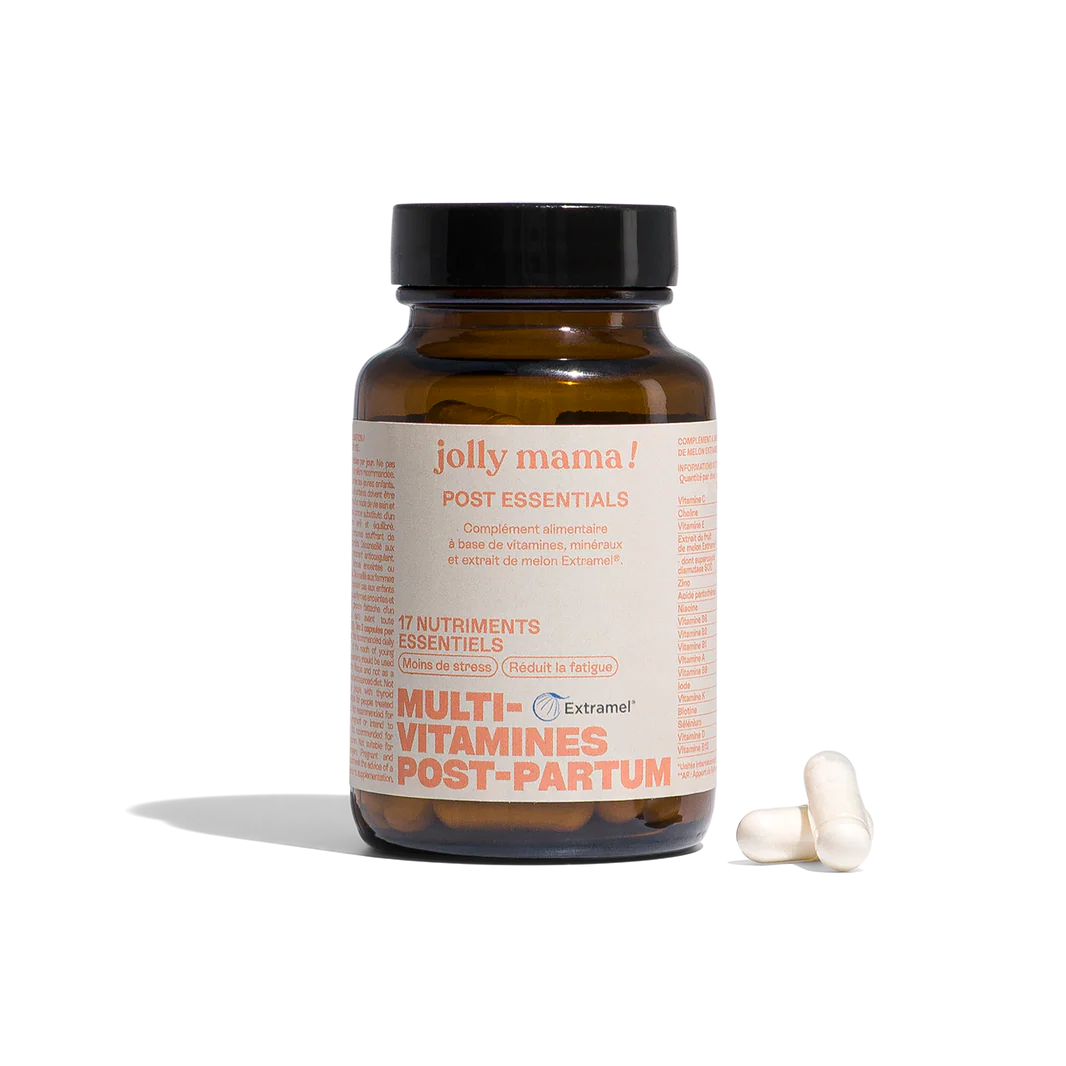
On the product side, Jolly Mama offers Mama Hair for hair loss, Post Essentials as a postpartum multivitamin compatible with breastfeeding, and Oméga Mama for DHA. Each one targets a specific need, to be brought in according to what you feel.
A word on the timeline of hair loss. It often starts around the third month after the birth and generally settles on its own within a few months. A supplement can accompany that phase, but heavy or lasting loss justifies medical advice, sometimes to check iron or the thyroid.
For broader recovery, Jolly Mama's postpartum ecosystem fills out: Iron Mama when iron is low, Mama-gnésium for fatigue and Happy Postpartum for mood. Each block answers one need, without any need to stack them all.
The idea is not to take everything at once, but to put together an answer suited to your situation. A mother who is mainly tired does not have the same priorities as one worried about her hair or her mood.
Which supplements are compatible with breastfeeding?
The safety question is a fair one, because everything the mother takes can pass, in part, into the milk. Choosing a food supplement compatible with breastfeeding therefore takes a little method.
A few simple markers to limit the risks:
- Favour formulas designed for the postpartum period, at suitable doses.
- Avoid stacking several products that overlap, so you do not overdose on certain nutrients.
- Stay alert on vitamin A and iodine, where an excess is not harmless.
ANSES says it plainly: it is better to steer clear of self-supplementing in all directions and to ask a professional, especially if you are on treatment or have a particular medical background. Follow-up lets you adjust intakes to your real needs, sometimes confirmed by a blood test.
On the label, three pieces of information deserve your attention: the dose per serving, the form of the nutrient (bisglycinate being better tolerated for iron as well as magnesium) and any plants present. A formula that clearly states its quantities always inspires more confidence than a vague blend sold on a promise.
To build a coherent routine, it is often simpler to start from a maternity specialist brand, which breaks its formulas down by need. You will find our detailed analysis and feedback from users in our full Jolly Mama review. 🤱
How to fit these supplements into your daily life
Choosing the right nutrients is not enough: you still have to keep the routine going in a period when time is desperately short. A few simple habits make the difference over the long run.
To avoid spreading yourself thin:
- Introduce one active at a time, over a few weeks, to spot what genuinely helps you.
- Tie the dose to a fixed anchor, such as breakfast or one particular feed.
- Note how your energy and your symptoms change, so you can adjust without guesswork.
Consistency beats quantity. A course followed for several weeks, in line with your diet and your sleep, brings far more than a pile of bottles taken at random. And nothing replaces delegating and resting whenever you can. 💡
Finally, reassess your needs as the months go by. They change between the first few weeks, a well established breastfeeding routine and the moment of weaning. A regular check-in with your doctor or your midwife keeps your routine suitable and safe.
Conclusion
Getting your energy back while breastfeeding comes down to a handful of well targeted nutrients: iron when reserves are low, magnesium and vitamin B6 against fatigue, vitamin D, B12, iodine and DHA for the mother as much as for the baby. The secret lies in a selection matched to your needs, combined with a healthy lifestyle and medical advice at the slightest doubt. Move forward step by step, one active after another, and allow yourself to ask for help: this period is demanding, and being well surrounded counts as much as supplementing well. To try formulas designed for this stage, the code LMC gets you -15% at the Jolly Mama shop. 🌱
Food supplements are not a substitute for a varied, balanced diet or for a healthy lifestyle.
Scientific references
- ANSES, nutritional references for breastfeeding women: anses.fr
- CNGOF, supplementation during pregnancy and breastfeeding: cngof.asso.fr
- Coletta JM et al., “Omega-3 Fatty Acids and Pregnancy”, the role of DHA: ncbi.nlm.nih.gov
- Boyle N.B. et al., “Effects of Magnesium Supplementation on Subjective Anxiety and Stress”: ncbi.nlm.nih.gov

LMC’s editorial line is built around transparency and reliability. Our content is written to help users make better decisions, based on 7 key criteria* that support trustworthy information, verified promo codes, and useful reviews.
To support LMC, some links are affiliate links. Our recommendations remain independent and based on transparent, verifiable criteria. By using the site, you accept our terms of use and our editorial policy.






.webp)

.avif)