
In just a few years, sweet potato flour has made its way into the pantries of athletes, people with gluten intolerance and families looking to vary their flours. It's credited with many virtues: low glycemic index, high fiber, help with weight loss, vitamin A content.
Some of these claims hold up, others much less so, and it all really depends on the product you bought. Here's what the labels actually say.
What exactly is sweet potato flour?
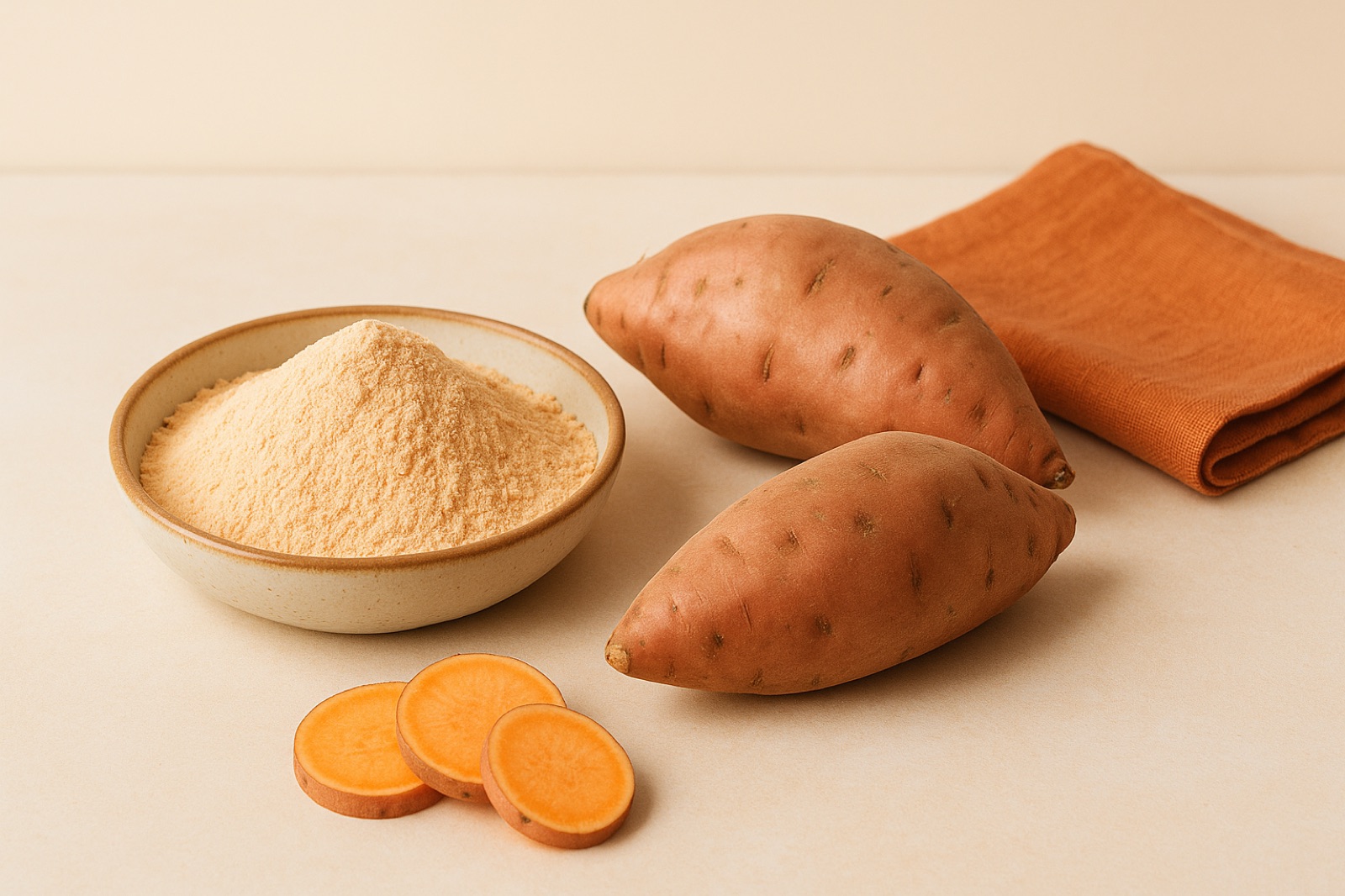
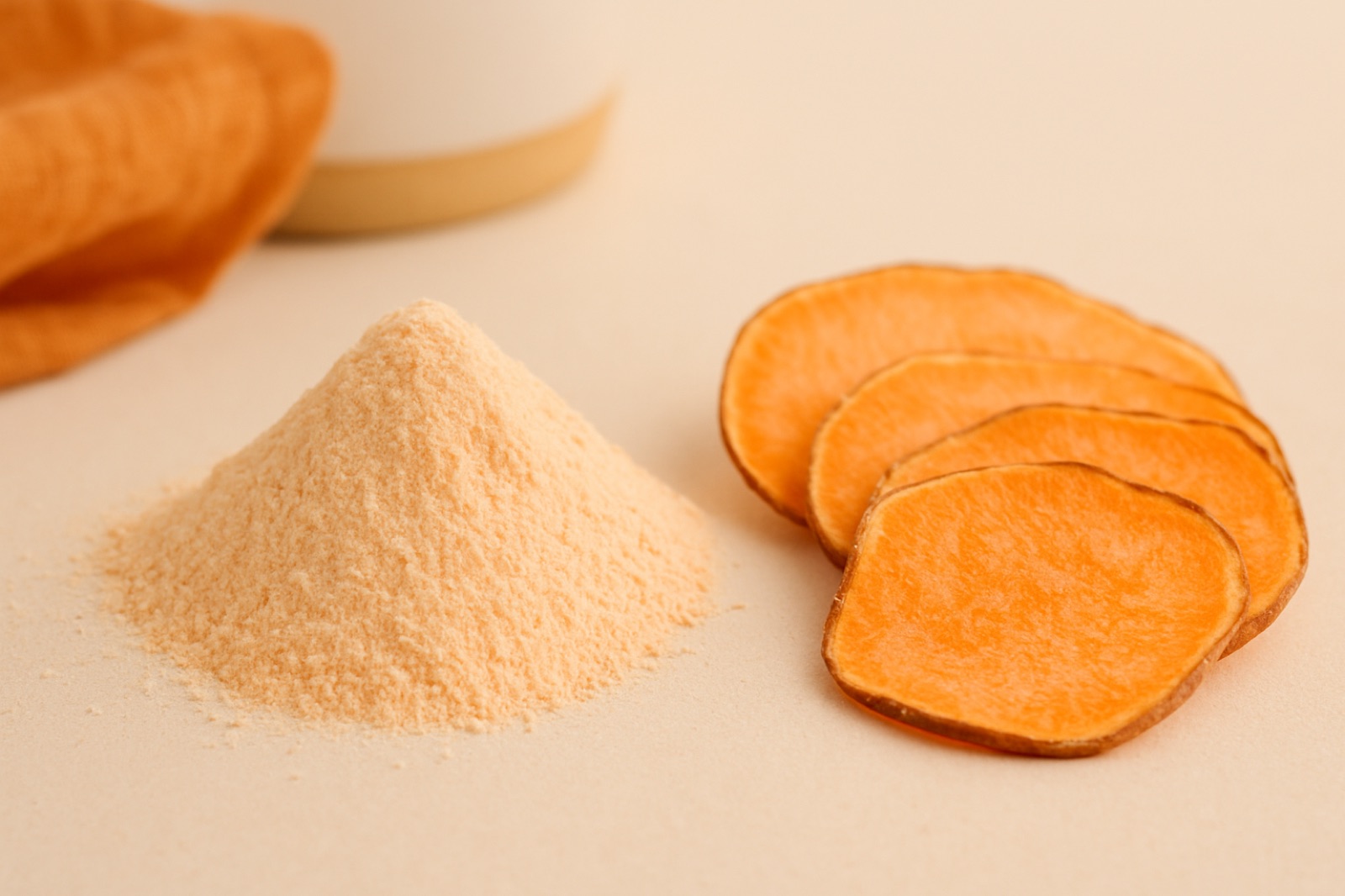
It's sweet potato that's dehydrated and then ground into powder. Nothing else in the simplest versions, sometimes a second texturizing ingredient in versions designed for sports. The tuber is washed, cut, dried and then milled, which heavily concentrates the nutrients: it takes about 5 kg of fresh sweet potato to get 1 kg of powder.
That concentration explains a figure that often surprises people: a raw sweet potato provides about 86 kcal per 100 g, its flour about 340 to 390 kcal. It's not a higher-calorie food, it's the same food without its water.
Be careful not to confuse it with sweet potato starch, which is an isolated starch used as a thickener. The flour contains the whole dried root, the starch only its starch content.
The real nutritional values
This is where products differ the most, and nobody says it clearly enough. Here are two labels recorded in August 2026 from official product pages.
| Per 100 g | YAM Nutrition flour | Organic flour, Nutrimuscle type |
|---|---|---|
| Energy | 387 kcal | 343 kcal |
| Carbohydrates | 89.1 g | 77 g |
| of which sugars | ✅ 0 g | 11.7 g |
| Protein | ✅ 6.6 g | 4.5 g |
| Fat | 0.1 g | less than 0.5 g |
| Fiber | ❌ 0.6 g | ✅ 8.6 g |
| Salt | 0.028 g | 0.07 g |
Three key takeaways:


Glycemic index: what can really be said
This is the most heavily promoted argument, and the one that deserves the most nuance. Brands advertise a moderate glycemic index, usually in a range of 50 to 70. That range is wide, and for good reason: the glycemic index of a sweet potato flour depends on three factors.
- The variety of the tuber. White flesh and orange flesh don't have the same profile.
- The drying process. The more intense the heat treatment, the more the starch is gelatinized, and the higher the index goes.
- What you eat it with. A crepe made with flour and three eggs has nothing in common, glycemically speaking, with the same flour consumed on its own in water.
In practical terms: yes, the glycemic index of sweet potato flour is generally more favorable than that of white wheat flour. No, it's not a low glycemic index food in the strict sense, and no brand can guarantee a precise value without testing its own batch.
This article is for informational purposes only and does not replace medical advice. If you are diabetic, pregnant, breastfeeding or taking medication, ask your doctor or dietitian for advice before significantly changing your carb intake.
The benefits that hold up
A gluten-free alternative you can really cook with
This is its strongest asset. Many gluten-free flours are hard to work with or have a strong taste. This one is naturally sweet, binds very well with eggs and makes crepes, cakes or lasagna sheets without a gritty texture. For someone with celiac disease or gluten sensitivity, it's a real expansion of the recipe repertoire.
A convenient carb source for athletes
A 30 g serving provides about 27 g of carbs and 116 kcal. It's a simple way to add carbs to a shake, a porridge or a breakfast, without having to cook rice or pasta. That's actually the product's original use in bodybuilding circles.
An interesting profile compared with white wheat flour
Gram for gram, sweet potato flour provides more micronutrients than a refined wheat flour, with a generally more favorable glycemic index. It's a winning swap if you were starting from a white all-purpose flour (French T45 or T55).
The claims to take with a grain of salt
"Rich in vitamins A, B6, B9 and C"
Fresh orange-fleshed sweet potato is indeed a good source of beta-carotene, a precursor of vitamin A, and contains B vitamins as well as vitamin C. But dehydration is a heat-based step: vitamin C, which is heat-sensitive and water-soluble, doesn't hold up well to drying. Think of the flour as a carb source, not a reliable source of vitamins. None of the labels we recorded declares any vitamin content, which says a lot.
"Helps you lose weight"
No flour makes you lose weight. At 340 to 390 kcal per 100 g, sweet potato flour is as energy-dense as wheat flour. It can fit into a reduced-calorie diet, notably because it allows filling recipes with little added sugar, but the effect comes from the meal as a whole, not from the flour.
"Ideal for diabetics"
That's too broad a claim. A moderate glycemic index is better than a high one, but the flour is still very high in carbs. A person with diabetes can eat it, as long as they fit it into their usual meal plan and discuss it with their doctor or dietitian.
Who is it really suited for?
- Athletes looking to easily increase their carbs around training.
- People avoiding gluten who want to expand their recipe repertoire.
- Families who want to cut added sugar in snacks, thanks to its naturally sweet taste.
- Less suited to those who are mainly looking for fiber: depending on the product, it may not deliver at all.
To choose the right product for your profile, check out our comparison which sweet potato flour to choose. To start cooking with it today, our 7 sweet potato flour recipes cover sweet and savory dishes, and our guide on how to use it details the substitution ratios.
The best deal to buy your sweet potato flour
If you use it regularly, the 5 kg size from YAM Nutrition is the most economical: €84.90, down to €76.41 with the code LMC (-10%, tested at checkout on November 3, 2026), or €15.28 per kilo. At that amount, pickup point delivery is free in mainland France (on orders from €69). To try it out, the 1 kg bag goes from €19.90 to €17.91. See YAM Nutrition sweet potato flour · LMC code terms
Frequently asked questions
What are the benefits of sweet potato flour?
Its verifiable strengths are that it's gluten-free, has a glycemic index that's generally more favorable than white flour, has a naturally sweet taste that lets you cut added sugar, and provides a convenient source of carbs for athletes.
How many calories are in sweet potato flour?
Between 340 and 390 kcal per 100 g depending on the product, or about 105 to 120 kcal per 30 g serving.
What is the glycemic index of sweet potato flour?
Brands advertise a moderate range, usually 50 to 70. The exact value depends on the variety, the drying process and the other foods eaten in the meal.
Does sweet potato flour contain gluten?
No, it's naturally gluten-free. If you have celiac disease, still check for the gluten-free label on the packaging, which guarantees there's no cross-contamination during production.
Is it really high in fiber?
That depends entirely on the product. We recorded 8.6 g of fiber per 100 g in an organic flour and 0.6 g in a flour designed for sports. Always check the label rather than general claims about sweet potato.
Can you replace wheat flour with sweet potato flour?
Partially. It works well up to 25 to 30% of the total weight in a classic recipe. Beyond that, and without gluten to give the dough structure, the texture changes noticeably, especially in recipes that need to rise.

LMC content is written by our editorial team from the information published by the brands. Scores out of 10 follow a public grid of 5 criteria*, supplemented by LMC’s editorial assessment.
To support LMC, some links are affiliate links: LMC earns a commission at no extra cost to you, and some of the brands featured are partners. By using the site, you accept our terms of use and our editorial policy.