
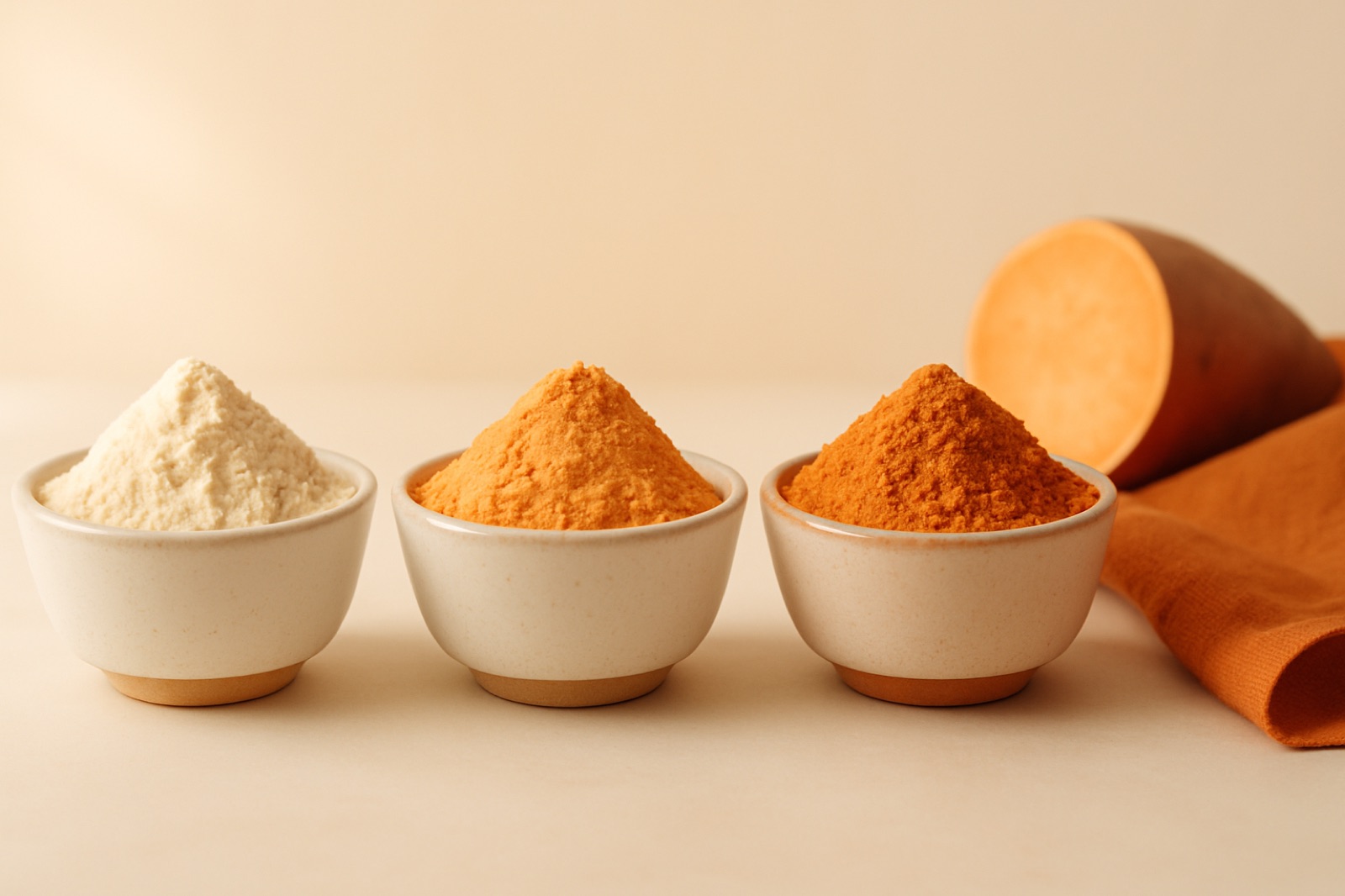
On paper, sweet potato flour is simple: sweet potato that's dried and then ground. In reality, two packs sitting side by side can show 11.7 g of sugars for one and 0 g for the other, 8.6 g of fiber for one and 0.6 g for the other.
That's no small detail. Depending on whether you want a flour for your Sunday cakes or a carb source to add every day around your workouts, you don't need the same product. Here are the four criteria that really matter, followed by a comparison of the most searched-for products.
The 4 criteria that really make the difference
1. The ingredient list
This is the first thing to check. Some flours list a single ingredient: sweet potato root flour, period. Others add a second ingredient, often an amino acid or an anti-caking agent, for texture or nutritional profile. Neither approach is a dealbreaker, but you need to know what you're buying. A single-ingredient flour is easier to read; an enriched flour follows a different logic, closer to sports nutrition.
2. Sugars and fiber
This is where the gap is most striking, and it's the most overlooked criterion. Sweet potato naturally contains simple sugars, and the drying process concentrates them to a greater or lesser degree depending on the variety and technique used. The result: some flours show more than 11 g of sugars per 100 g, others 0 g.
Same logic for fiber. A flour that keeps the skin and fibrous parts reaches 8 g per 100 g. A more refined flour drops below 1 g. If you're looking for fiber, that number should be your first guide.
3. The flesh: white or orange
White-fleshed sweet potato makes a more neutral, lighter flour, closer to a regular flour in cooking. Orange flesh makes a more colorful flour, sweeter on the palate and richer in beta-carotene. Both are available from several brands, sometimes on the same product page. Check the variant before you check out.
4. Price per kilo, not the sticker price
A 300 g pack at €6.65 looks much cheaper than a 3 kg bag at €54.90. Per kilo, it's the opposite: €22 versus €18. If you use 30 to 50 g a day, the size matters more than the sticker price. If you use it three times a year for a cake, the small size is still the right choice.


Comparison of the most searched-for products
We used the values published by the brands themselves on their official product pages, recorded in August 2026.
| Criterion | YAM Nutrition | Nutrimuscle organic | Organic flours 300 to 400 g |
|---|---|---|---|
| Ingredients | Dehydrated sweet potato, glycine | ✅ Sweet potato only | ✅ Sweet potato only |
| Organic certification | ❌ No | ✅ Yes | ✅ Yes |
| Sugars / 100 g | ✅ 0 g | 11.7 g | Variable, often 10 g or more |
| Fiber / 100 g | ❌ 0.6 g | ✅ 8.6 g | ✅ Often 8 g or more |
| Protein / 100 g | ✅ 6.6 g | 4.5 g | Variable |
| Calories / 100 g | 387 kcal | 343 kcal | Around 350 kcal |
| Sizes | ✅ 1, 3 and 5 kg | ✅ 1, 2, 6 and 20 kg | ❌ 300 to 400 g |
| Approximate price per kilo | €19.90 for 1 kg, about €17 for 5 kg | €19.95 for 1 kg, about €16.50 for 2 kg | ✅ €12 to €22 depending on the retailer |
| Availability | ✅ Consistently in stock online | ❌ Frequent stockouts on several sizes | ✅ Grocery pickup and organic stores |
Our take, criterion by criterion
If your priority is organic and fiber, Nutrimuscle's flour is the logical choice. A single ingredient, traceable origin in Benin, 8.6 g of fiber per 100 g. The downside: 11.7 g of sugars per 100 g, and frequent stockouts on the 1 kg, 6 kg and 20 kg sizes when we checked.
If your priority is daily sports use, YAM Nutrition's sweet potato flour ticks more boxes. Zero sugar listed, 6.6 g of protein, stable availability and three sizes up to 5 kg. It's the product that launched the brand in 2015, and it's the one best suited to regular use, in a shaker or in morning pancakes. Its weak point is clear and we won't hide it: 0.6 g of fiber per 100 g, and glycine as a second ingredient, so it's not a 100% sweet potato flour.
If you cook occasionally, a 300 to 400 g organic flour from a supermarket or organic store does the job perfectly, for €4.85 to €6.65 per pack. No need to pay for a 3 kg bag for two cakes a year.
Organic or not: the real trade-off
The organic label guarantees a farming method, not a better nutritional profile. In our comparison, the organic flour shows more fiber but also twenty times more sugars than the non-organic flour. If organic is non-negotiable for you, go for Nutrimuscle, Nutripure or organic store flours. If you look at the nutrition label and cost per serving first, the label shouldn't be the only judge.
Our recommendation by profile

To learn more about the nutritional profile, read our guide on the benefits and nutritional values of sweet potato flour. If you're still unsure where to buy, our guide on where to buy sweet potato flour compares retailers and prices per kilo.
The best deal to buy your sweet potato flour
If you use it regularly, the 5 kg size from YAM Nutrition is the most economical: €84.90, down to €76.41 with the code LMC (-10%, tested at checkout on November 3, 2026), or €15.28 per kilo. At that amount, pickup point delivery is free in mainland France (on orders from €69). To try it out, the 1 kg bag goes from €19.90 to €17.91. See YAM Nutrition sweet potato flour · LMC code terms
Frequently asked questions
What is the best sweet potato flour?
There's no best flour in absolute terms. For regular sports use, YAM Nutrition's flour offers the best balance of 0 g of sugars, available sizes and availability. For maximum fiber and organic certification, Nutrimuscle has the edge.
Is YAM sweet potato flour organic?
No, it isn't certified organic. That's its main weak point compared with Nutrimuscle and Nutripure. On the other hand, its ingredient list is very short: powdered dehydrated sweet potato and glycine.
White or orange sweet potato flour?
White is more neutral in taste and closer to a regular flour. Orange is sweeter on the palate and richer in beta-carotene. For savory recipes or doughs, go with white; for desserts, orange works very well.
How much does sweet potato flour cost per kilo?
Expect €12 to €22 per kilo for small 300 to 400 g organic packs, and €16 to €20 per kilo for sports sizes from 1 to 5 kg. The price per kilo drops noticeably from 2 kg up.
Can you mix several sweet potato flours?
Yes, no problem. Some people combine a high-fiber flour for satiety with a more neutral flour for texture. It's a common practice in gluten-free baking.
This article is for informational purposes only and does not replace medical advice. If you are diabetic, pregnant, breastfeeding or taking medication, ask your doctor or dietitian for advice before significantly changing your carb intake.

LMC content is written by our editorial team from the information published by the brands. Scores out of 10 follow a public grid of 5 criteria*, supplemented by LMC’s editorial assessment.
To support LMC, some links are affiliate links: LMC earns a commission at no extra cost to you, and some of the brands featured are partners. By using the site, you accept our terms of use and our editorial policy.