

In just a few years, saw palmetto has become the star ingredient of anti-hair loss supplements. It's sometimes billed as a "natural finasteride." Other pages call it useless. Who should you believe?
The honest answer lies in the studies. And they tell a nuanced story: Serenoa repens has been tested in humans, against placebo and against finasteride, with results that are real but modest, often obtained in small groups.
In this guide, we review what each trial shows, the dosage studied, timelines, side effects and interactions, differences between men and women, and the criteria for choosing a supplement that holds up. 📌
Spoiler: no, it's not a "natural finasteride." But it's not snake oil either. In between, there are specific numbers, and those are what will help you decide whether a course is worth it for you.
Our method: we didn't run a trial ourselves. Every statement about effectiveness refers to a published study, listed at the end of the article with its PubMed link. When a study is small or funded by a manufacturer, we say so.
Saw palmetto (Serenoa repens): what are we talking about?
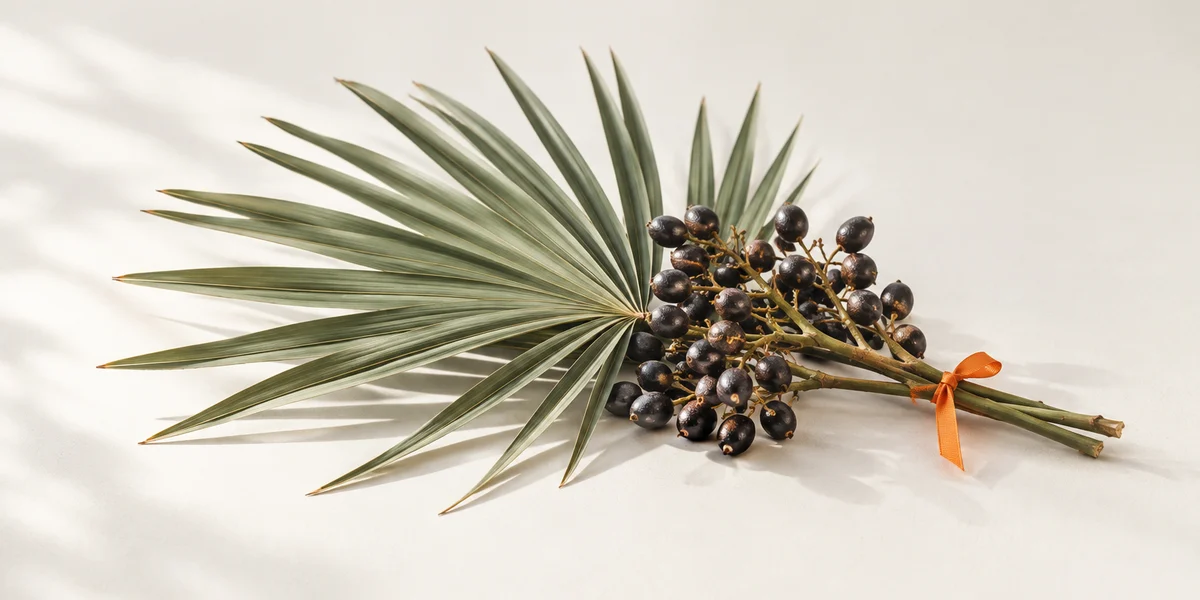
Saw palmetto, or American dwarf palm (Serenoa repens, also called Sabal serrulata), is a small palm native to the southeastern United States. It's the berries that are used.
They're rich in fatty acids (lauric, myristic, oleic) and phytosterols such as beta-sitosterol. This fatty fraction is extracted to obtain the liposterolic extract, the form used in most studies.
Historically, saw palmetto is best known in urology, for urinary problems linked to an enlarged prostate. Its interest for hair comes from a common thread: in both cases, DHT is involved.
Key point to remember right away: dried berry powder and a concentrated liposterolic extract are not the same product. Study results only apply to comparable extracts.


How saw palmetto may work on hair loss
Hormonal hair loss, or androgenetic alopecia, is linked to DHT (dihydrotestosterone). This hormone is made from testosterone by an enzyme, 5-alpha reductase.
In predisposed people, DHT causes progressive miniaturization of the follicles: hair grows back thinner and shorter, cycle after cycle.
Saw palmetto extract is being studied for its ability to inhibit 5-alpha reductase, in both its forms (type 1 and type 2). In the trial by Sudeep et al., taking a standardized extract orally was accompanied by a drop in blood DHT compared with placebo (Sudeep 2023).
But a plausible mechanism doesn't guarantee a clinical effect. In urology, its historical use, the Cochrane review by Tacklind et al. found no superiority over placebo for urinary symptoms, even at double or triple doses (Tacklind 2012). Hence the importance of looking at trials conducted specifically on hair.
To understand the broader family of DHT blockers (medications, other natural actives), read our guide: DHT blockers: what they are and do they work?
Saw palmetto and hair: what studies say

Here are the main human trials, from oldest to most recent, with their limitations.
| Study | Participants | Product and duration | Main result | Limitations |
|---|---|---|---|---|
| Prager 2002 | Men aged 23-64, mild to moderate alopecia | Liposterolic extract + beta-sitosterol vs. placebo | 6 out of 10 treated subjects rated as improved | Pilot trial, very small, two actives combined |
| Rossi 2012 | 100 men | 320 mg/day vs. finasteride 1 mg, 24 months | Improvement: 38% vs. 68% | Open-label study, no placebo |
| Wessagowit 2016 | 50 men | Topical saw palmetto products, 24 weeks | Increase in hair count at 12 and 24 weeks | No placebo, not blinded |
| Sudeep 2023 | 80 men and women, aged 18-50 | 400 mg capsule of standardized oil or 20% lotion, 16 weeks | Shedding reduced by up to 29% (oral), density +5.2% | Authors employed by the manufacturer |
| Piquero-Casals 2025 | 80 men and women | Supplement combining saw palmetto, pumpkin, pygeum, L-cystine and vitamins, 6 months | Density +12.3 hairs/cm² vs. placebo | Impossible to isolate saw palmetto's own effect |
| Ablon 2026 | 60 adults (men and postmenopausal women) | Proprietary extract vs. placebo, 180 days | Terminal hairs +18.6 vs. -10.1 on placebo | Single investigator, specific commercial extract |
The first trials: signals, not proof
The very first placebo-controlled trial (Prager 2002) showed that 60% of treated men (6 out of 10) were rated as improved. But the sample is tiny, and the capsule combined saw palmetto and beta-sitosterol: there's no way to know which did what.
The trial by Rossi et al. (Rossi 2012) is more telling: 100 men, two years, 320 mg of Serenoa repens per day versus 1 mg of finasteride. Improvement was noted in 38% of patients on saw palmetto, compared with 68% on finasteride. Saw palmetto's effect was concentrated mainly on the crown. Without a placebo group, its exact contribution can't be measured.
Recent trials: more rigorous, but industry-funded
In the double-blind, placebo-controlled trial by Sudeep et al. (Sudeep 2023), the capsule reduced shedding by up to 29% and increased density by 5.2% over 16 weeks. The ratio between the growth phase and the resting phase didn't change significantly. The authors work for the manufacturer of the extract tested.
In Ablon's trial (Ablon 2026), 60 adults with thinning hair took a proprietary extract or a placebo for 6 months. The study measured an increase in terminal hair count of 18.6 on average with the extract, versus a drop of 10.1 on placebo, including in a subgroup of postmenopausal women. This is a single trial on a proprietary extract: the data remains limited.
What the systematic review concludes
The review by Evron et al. (Evron 2020) pooled 5 randomized trials and 2 cohort studies, with doses from 100 to 320 mg. All pointed toward a benefit, in androgenetic alopecia as well as telogen effluvium, with good tolerance.
The authors remain cautious: robust data is lacking, and many products combined saw palmetto with other actives. They call for large trials focused on saw palmetto alone.
Our take: saw palmetto has a probable but modest effect on early to moderate hormonal hair loss. It won't regrow an area that has been bald for years, and it doesn't rival finasteride.
Saw palmetto vs. finasteride: the real comparison
- Effectiveness: a clear edge for finasteride in the only comparative trial (68% vs. 38% improvement, Rossi 2012).
- Status: finasteride is a prescription drug; saw palmetto is sold as a dietary supplement.
- Tolerance: saw palmetto's side effects are generally mild and close to placebo (Agbabiaka 2009). Finasteride carries a risk of sexual side effects in a minority of men, which warrants medical follow-up.
- Combination: don't combine the two without medical advice, since they act on the same enzyme.
What dosage of saw palmetto for hair?
The reference dosage is 320 mg of liposterolic extract per day, used in Rossi's trial (Rossi 2012). Evron's review mentions doses ranging from 100 to 320 mg depending on the product (Evron 2020).
A few practical rules:
- Choose a standardized extract, with a fatty acid content stated on the label.
- Be wary of very high "herb equivalent" figures without a standardized extract: they don't tell you what you're actually absorbing.
- Take it with a meal, as most manufacturers recommend: it's often easier on the stomach.
- Stay consistent: one daily dose, without interruption, for at least 3 months.
Be careful with comparisons too: a standardized dry extract isn't strictly identical to the concentrated oil extracts used in some studies. The amount shown is a benchmark, not a guarantee of equivalence.
Saw palmetto for hair before and after: what timelines and results?
Spectacular "before/after" photos are everywhere. Be skeptical: they're rarely taken under comparable conditions (lighting, wet hair, angle).
What studies show:
- Trials last from 16 weeks (Sudeep 2023) to 24 months (Rossi 2012).
- A shedding and regrowth cycle takes several months: nothing measurable before 3 months, and it often takes 6 months to judge.
- The most realistic result is shedding that slows down or stabilizes, rather than massive regrowth.
- When you stop, the hormonal process resumes its course: the effect isn't permanent.
Our advice: take your own photos every month, with the same lighting, same hairstyle and same angle. That's the best "before/after" there is.
Saw palmetto for women's hair: what you need to know
Most studies have been conducted in men. But several recent trials have included women: this is the case for Sudeep's trial (Sudeep 2023) and Ablon's, in which a benefit was observed in postmenopausal women (Ablon 2026).
- Pregnancy, breastfeeding, planning a pregnancy: avoid saw palmetto. Its anti-androgen action could theoretically disrupt the development of a male fetus.
- Recommended checkup: in women, diffuse hair loss can stem from iron deficiency or a thyroid or hormonal disorder. Get it checked before starting a course.
- Hormonal contraception or hormone therapy: ask your doctor for advice.
After giving birth, hair loss is most often temporary and not androgenetic: see our comparison for postpartum hair loss instead.
Saw palmetto for men's hair: who is it for?
In men, saw palmetto makes sense in three cases:
- early-stage balding (deepening receding temples, thinning crown);
- refusing or being unable to take a medication;
- wanting to act early, in a gradual way.
If balding is progressing quickly, seeing a dermatologist remains the best option: medical treatments are more effective.
Saw palmetto: dangers, side effects and interactions
The systematic review by Agbabiaka et al. analyzed 40 publications on the safety of saw palmetto (Agbabiaka 2009). Conclusion: side effects are mild, infrequent, reversible and comparable to placebo.
The most commonly reported: abdominal pain, diarrhea, nausea, fatigue, headaches, decreased libido and rhinitis. No drug interaction was formally identified in this review.
A few points to watch nonetheless:
- Bleeding: a case of hemorrhage during surgery was reported in a patient taking saw palmetto, with bleeding time returning to normal after stopping (Cheema 2001). As a precaution, mention your supplement before surgery and if you take an anticoagulant.
- Finasteride, dutasteride: no combination without medical advice.
- Pregnancy and breastfeeding: avoid.
- Combination formulas: check the other actives. Green tea or ginseng add their own precautions (heart problems, hyperthyroidism, diabetes medication).
And if your hair loss is sudden, patchy or persistent, see a doctor before starting any course.
Saw palmetto capsules, serum or shampoo?
Capsules are the best-studied form, notably against placebo (Sudeep 2023; Ablon 2026). This is the route that has shown a drop in blood DHT.
Lotions and serums have more limited data. In the study by Wessagowit et al., topical products increased hair count over 24 weeks, but without a placebo group (Wessagowit 2016).
Shampoos stay in contact with the scalp for too short a time to expect a significant anti-DHT effect. They mainly serve scalp hygiene.
How do you choose a saw palmetto supplement?
- Standardized Serenoa repens extract, with a stated fatty acid content.
- Dose close to the studies: around 300 to 320 mg of extract per day.
- Ingredients listed down to the milligram, with no opaque "proprietary blend."
- Useful complementary actives: zinc and biotin contribute to the maintenance of normal hair.
- A course of at least 3 months built into the package size.
- Clearly stated precautions and traceable manufacturing.
To broaden the comparison, check out our comparison of the best hair supplements.
Our recommendation: MakeMyMask's DHT Blocker
For a saw palmetto course targeting hormonal hair loss, we recommend MakeMyMask's DHT Blocker Anti-Chute Hormonale, developed by Dr. Julie Pernet, a doctor of pharmacy and trichologist.
- Serenoa repens 300 mg per day, standardized to 45% fatty acids (equivalent to 1,200 mg of herb according to the brand). That's close to the 320 mg studied by Rossi et al. It doesn't guarantee the same results, but it's a dosage consistent with the literature.
- Zinc bisglycinate and biotin: they contribute to the maintenance of normal hair.
- Green tea and ginseng at modest doses, vitamins B6 and D3, and a probiotic with an identified strain, Lactobacillus acidophilus PBS066.
- 2 capsules per day with meals, 180 capsules for a 3-month course. Made in France.
Price: €90 for the 3-month course (instead of €120), or about €76.50 with the code COMPLEMENT5 (-15%).
Please note: not recommended during pregnancy and breastfeeding, or if you have heart problems, hyperthyroidism, an ulcer or take diabetes medication, and not to be combined with finasteride, dutasteride or another green tea supplement.
Discover MakeMyMask's DHT Blocker →
Prefer to avoid capsules? The brand's Tricho-Boost anti-hair loss serum is a topical option, without minoxidil.
To learn more, read our full MakeMyMask review and check out our MakeMyMask promo code page.
Some links may be affiliate links: LMC may earn a commission at no extra cost to you.
FAQ: saw palmetto and hair
Does saw palmetto really make hair grow back?
Trials mainly show slower shedding and a modest increase in density in some people (Evron 2020). Significant regrowth on an area that has been thinning for a long time is unlikely.
What's your take on saw palmetto for hair?
It's the best-documented natural anti-DHT active, with good tolerance. But the studies remain small and are often funded by manufacturers. A serious option for early hormonal hair loss, as long as you're patient.
How long should you take saw palmetto?
At least 3 months before judging, ideally 6. Trials have lasted from 16 weeks to 2 years.
Is saw palmetto dangerous?
No, in the vast majority of cases. Reported side effects are mild and close to placebo (Agbabiaka 2009). Avoid it during pregnancy and breastfeeding, and mention it before surgery or if you're on anticoagulant treatment.
Does saw palmetto lower libido?
Decreased libido is among the reported side effects, but it remains uncommon. If you notice it, stop the course and talk to your doctor.
Can a woman take saw palmetto for her hair?
Yes, except during pregnancy, breastfeeding and when planning a pregnancy. Recent trials including women, particularly postmenopausal women, are encouraging (Ablon 2026). A medical checkup beforehand is still recommended.
Can you take saw palmetto with minoxidil?
The two don't work the same way, and nothing points to an interaction in the available safety review. Still, ask your doctor if minoxidil has been prescribed to you.
Conclusion
Saw palmetto is neither a scam nor a natural equivalent of finasteride. Studies show a modest but real effect on hormonal hair loss, especially when it's in its early stages, with good tolerance.
To give yourself the best chance: a standardized extract, a dose close to 300 to 320 mg per day, regular use for at least 3 months, and respecting the contraindications.
And if your hair loss is sudden, patchy or persistent, start with medical advice. The right treatment always depends on the right cause.
Scientific references
- Evron, E. et al. (2020). Natural Hair Supplement: Friend or Foe? Saw Palmetto, a Systematic Review in Alopecia. View on PubMed
- Prager, N. et al. (2002). A randomized, double-blind, placebo-controlled trial to determine the effectiveness of botanically derived inhibitors of 5-alpha-reductase in the treatment of androgenetic alopecia. View on PubMed
- Rossi, A. et al. (2012). Comparitive effectiveness of finasteride vs Serenoa repens in male androgenetic alopecia: a two-year study. View on PubMed
- Sudeep, H.V. et al. (2023). Oral and Topical Administration of a Standardized Saw Palmetto Oil Reduces Hair Fall and Improves the Hair Growth in Androgenetic Alopecia Subjects - A 16-Week Randomized, Placebo-Controlled Study. View on PubMed
- Ablon, G. (2026). The Safety and Efficacy of a Novel Saw Palmetto (Serenoa repens) Extract for Promoting Hair Growth in Adults With Self-Perceived Thinning Hair: 180-Day Results. View on PubMed
- Wessagowit, V. et al. (2016). Treatment of male androgenetic alopecia with topical products containing Serenoa repens extract. View on PubMed
- Piquero-Casals, J. et al. (2025). Oral Supplementation with l-Cystine, Serenoa repens, Cucurbita pepo, and Pygeum africanum in Chronic Telogen Effluvium and Androgenetic Alopecia: A Double-Blind, Placebo-Controlled, Randomized Clinical Study. View on PubMed
- Agbabiaka, T.B. et al. (2009). Serenoa repens (saw palmetto): a systematic review of adverse events. View on PubMed
- Tacklind, J. et al. (2012). Serenoa repens for benign prostatic hyperplasia. View on PubMed
- Cheema, P. et al. (2001). Intraoperative haemorrhage associated with the use of extract of Saw Palmetto herb: a case report and review of literature. View on PubMed

LMC content is written by our editorial team from the information published by the brands. Scores out of 10 follow a public grid of 5 criteria*, supplemented by LMC’s editorial assessment.
To support LMC, some links are affiliate links: LMC earns a commission at no extra cost to you, and some of the brands featured are partners. By using the site, you accept our terms of use and our editorial policy.