
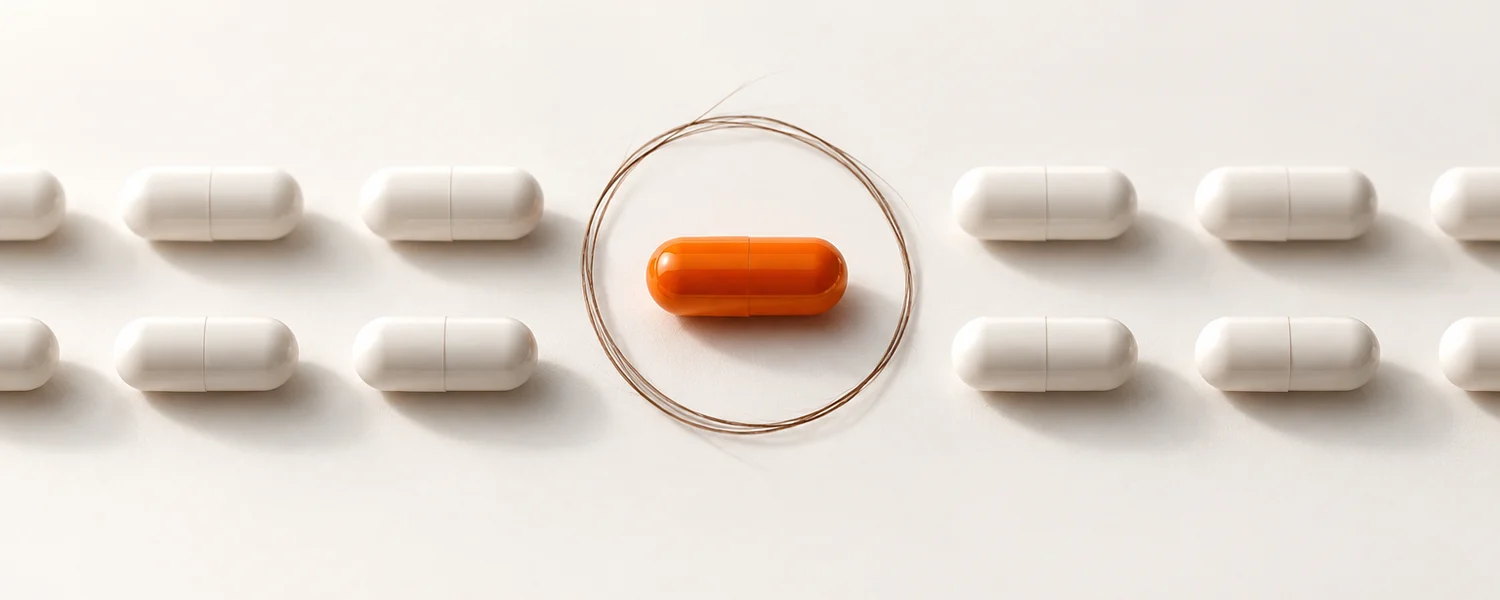
Seeing more hair in the shower, a receding hairline at your temples or a widening part? You've probably come across the term DHT blocker. It's everywhere: on supplement bottles, in shampoos, on forums.
The problem is that the term covers very different things. On one side, prescription medications whose effectiveness is solidly proven. On the other, natural actives (saw palmetto, pumpkin seeds, green tea) whose evidence is real but much more modest. And in the middle, a lot of marketing.
This guide sorts it all out. You'll understand what DHT is, why it can cause hair loss in both men and women, what the available options are really worth, how to choose a supplement and what precautions to take. With no miracle promises. 📌
Our method: we didn't run a trial ourselves. Every statement about effectiveness refers to a published study, listed at the end of the article with its PubMed link. When a study is small or funded by a manufacturer, we say so.
DHT blocker: what exactly is it?
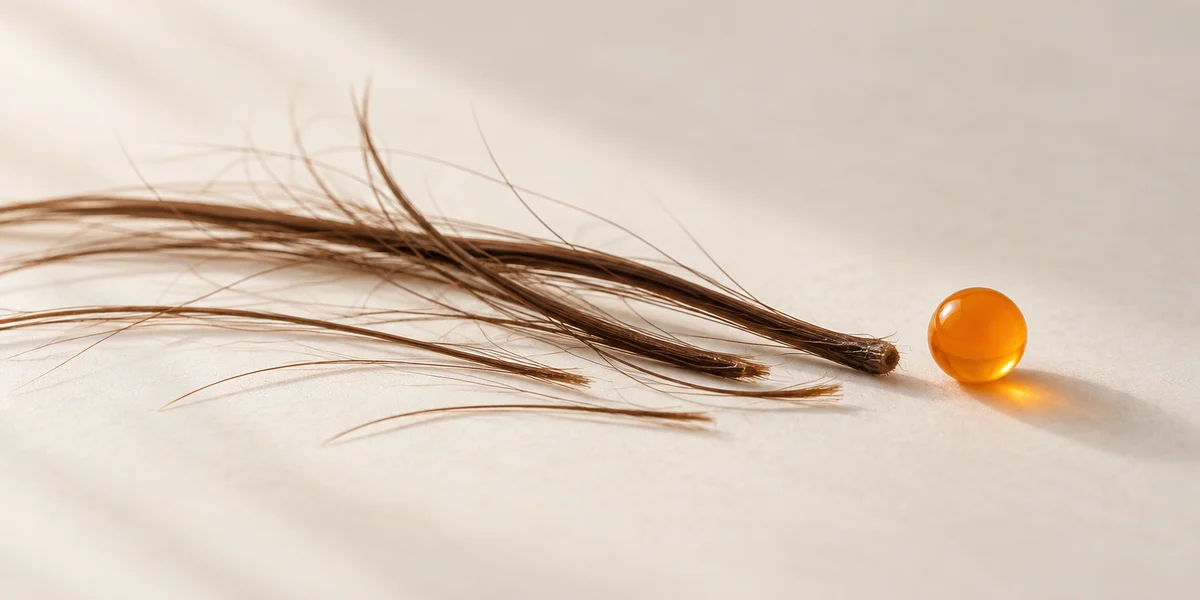
A DHT blocker is a substance that aims to reduce the production or action of dihydrotestosterone (DHT), a hormone derived from testosterone.
DHT is made by an enzyme, 5-alpha reductase. It exists in two main forms (type 1 and type 2), found in particular in the skin, scalp and prostate. Most DHT blockers act on this enzyme: less conversion means less DHT at the follicle.
DHT isn't a "bad" hormone. It plays a normal role in male development and in body and beard hair. The problem arises in people whose scalp follicles are genetically sensitive to its action.
There are therefore three main families of DHT blockers:
- Medications: finasteride and dutasteride, by prescription only.
- Dietary supplements: saw palmetto (Serenoa repens), pumpkin seed oil and green tea, often combined with zinc and biotin.
- Topical products: shampoos and serums claiming an "anti-DHT" action, generally with weaker evidence.


Why does DHT cause hair loss?
DHT-related hair loss has a medical name: androgenetic alopecia. It's the most common form of progressive hair loss in men, and it also affects many women.
According to the review by Lolli et al. (Lolli 2017), it results from an interaction between hormonal factors and genetic predisposition. Androgens, including DHT, act on genetically sensitive follicles and cause their miniaturization. The genetics involved are complex: several genes play a role.
In practice, with each cycle, the hair grows back thinner, shorter and less pigmented. The growth phase (anagen) gets shorter. Eventually, some follicles produce only an almost invisible fuzz.
Important point: having hormonal hair loss doesn't mean having "too much" testosterone. It's mainly the sensitivity of the follicles that makes the difference. That's why two people with the same hormone levels can have very different heads of hair.
How can you tell if your hair loss is really hormonal?
A DHT blocker only makes sense if your hair loss has an androgenetic component. And many types of hair loss have other causes.
Signs that point to hormonal hair loss:
- In men: receding temples, thinning on the crown (vertex), gradual onset over years.
- In women: a widening part, diffuse loss of density on the top of the head, with the front hairline often preserved.
- Hair that's getting thinner and thinner, and a family history.
What points to another cause: sudden, heavy shedding a few months after stress, illness, a diet or childbirth (telogen effluvium), seasonal shedding, bald patches, itching or redness.
After a pregnancy, for example, hair loss is most often temporary: our comparison for postpartum hair loss details the suitable options.
If your hair loss is sudden, patchy or persistent, see a doctor or dermatologist. A checkup (iron, thyroid, hormones in women) may reveal a cause that no supplement will fix.
Medication DHT blockers: finasteride and dutasteride
These are the best-studied DHT blockers. They're only available by prescription: this section is for information only, and the decision is up to your doctor.
Finasteride
Finasteride inhibits type 2 5-alpha reductase. In the two pivotal trials published in 1998 (Kaufman 1998), 1,553 men received 1 mg per day or a placebo for one year, then some of them continued double-blind for a second year.
The result: finasteride improved hair by every assessment method, with a gain of about 107 and then 138 hairs compared with placebo in a 5.1 cm² area on the crown, at 1 and 2 years. On placebo, hair loss kept progressing.
The downside: sexual side effects (decreased libido, erectile dysfunction) have been described in a minority of users, and France's medicines agency (ANSM) has strengthened patient information on these risks as well as on possible psychiatric disorders. Hence the importance of medical follow-up.
Dutasteride
Dutasteride blocks both types of 5-alpha reductase. In a 24-week randomized trial of 416 men (Olsen 2006), it increased hair count in a dose-dependent manner, and the 2.5 mg dose proved superior to finasteride 5 mg.
In France, dutasteride isn't licensed for alopecia: its use there is off-label, at a doctor's discretion.
What about women?
The Cochrane review on female hair loss (van Zuuren 2016) concludes that finasteride 1 mg did no better than placebo in the available trials (low-quality evidence). It's also contraindicated during pregnancy or when planning a pregnancy.
The same review identifies topical minoxidil as the best-documented option in women. Note: minoxidil is not a DHT blocker. It acts on growth and circulation around the follicle, not on hormonal conversion.
Natural DHT blockers: what science really says
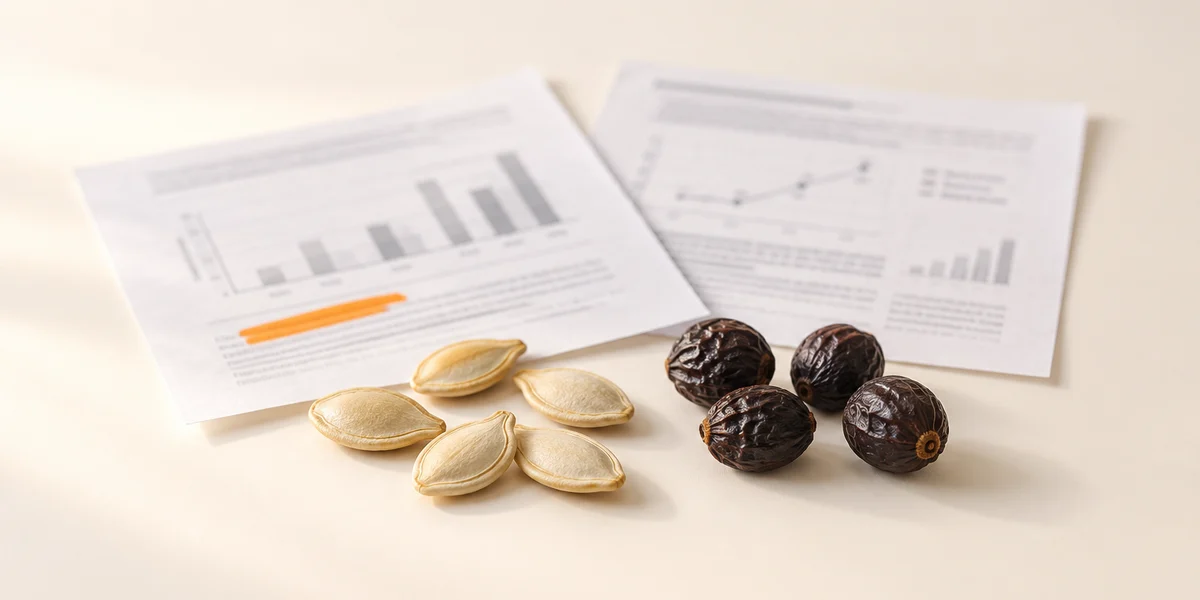
This is where promises get the most carried away. Here are the most frequently cited actives, ranked by level of evidence in humans.
| Active | Presumed action | Best available evidence | Level of evidence |
|---|---|---|---|
| Saw palmetto (Serenoa repens) | Inhibition of 5-alpha reductase | Systematic review of 7 studies (Evron 2020), trial compared with finasteride (Rossi 2012) | Moderate, promising |
| Pumpkin seed oil | Suggested anti-androgen effect | One randomized placebo-controlled trial, 76 men (Cho 2014) | Low to moderate |
| Green tea (EGCG) | Inhibition of 5-alpha reductase, effect on follicle cells | Laboratory studies (Kwon 2007) | Low (no solid oral trial) |
| Nettle, rosemary, lycopene, "anti-DHT foods" | Variable | Mostly in vitro or in animals | Very low |
Saw palmetto, the most studied active
The systematic review by Evron et al. (Evron 2020) pooled 5 randomized trials and 2 cohort studies, with doses from 100 to 320 mg. All pointed toward a benefit, in people with androgenetic alopecia or telogen effluvium, with good tolerance.
The authors remain cautious: high-quality data is lacking, and many of the products tested combined saw palmetto with other actives. They call for larger trials.
In the trial by Rossi et al. (Rossi 2012), 100 men took either 320 mg of Serenoa repens or 1 mg of finasteride for 2 years. Improvement was observed in 38% of patients on saw palmetto, compared with 68% on finasteride. The study was open-label with no placebo: saw palmetto therefore does less well than the medication, but it isn't without effect.
For details on studies, dosages and side effects, read our dedicated guide: saw palmetto and hair, what the studies say.
Pumpkin seeds
In a double-blind randomized trial (Cho 2014), 76 men took 400 mg of pumpkin seed oil per day or a placebo for 24 weeks. Hair count increased by 40% on average in the treated group, compared with 10% on placebo.
That's encouraging, but it's a single, small trial. It needs to be confirmed.
Green tea and EGCG
EGCG, the main polyphenol in green tea, stimulated the growth of human follicles cultured in the lab and the proliferation of dermal papilla cells (Kwon 2007). It's an interesting mechanism, but not proof of effectiveness in capsule form in humans.
What do recent syntheses say?
A recent network meta-analysis (Zhou 2025) compared 16 supplements across 19 randomized trials (1,658 patients). Several, including pumpkin seed oil and saw palmetto extract, did better than placebo on certain criteria, with good tolerance.
The authors present them as possible complements or alternatives to standard treatments, while stressing the small size of the studies. That's the right way to look at them.
DHT blockers for women: what's different
The search "DHT blocker for women" is common, and for good reason: female hormonal hair loss is underestimated. But it isn't managed the same way as in men.
- Checkup first: in women, a hormonal disorder (polycystic ovary syndrome, menopause), iron deficiency or a thyroid problem should be looked for.
- Pregnancy and breastfeeding: no DHT blocker, natural or medication, should be taken. Acting on androgens during pregnancy could theoretically disrupt the development of a male fetus.
- On the medical side, a dermatologist may offer minoxidil or, off-label, other anti-androgen treatments.
- On the supplement side, some recent saw palmetto trials have included women, but the data remains limited.
DHT blockers for men: where do they fit alongside treatments?
For men, let's be clear: if your goal is maximum effectiveness on progressing baldness, medical treatments remain the gold standard. A supplement doesn't match them.
A natural DHT blocker may, however, be of interest if:
- your hair loss is in its early stages and you want to act early;
- you don't want to, or can't, take medication;
- you're looking for a gradual approach, alongside good scalp hygiene.
On the other hand, never combine an anti-DHT supplement with finasteride or dutasteride without medical advice: you'd be stacking two actions on the same pathway.
How do you choose a natural DHT blocker?
With dozens of formulas on the market, here are the criteria that really matter:
- A standardized saw palmetto extract, with a stated fatty acid content. A simple berry powder isn't comparable to the extracts studied.
- A dosage close to the studies: around 320 mg of extract per day in Rossi's trial (Rossi 2012).
- A transparent ingredient list, dose by dose, rather than a "proprietary blend" with no amounts.
- Nutrients with authorized claims: zinc and biotin contribute to the maintenance of normal hair.
- A realistic course length: at least 3 months, the time of one renewal cycle.
- Clearly stated precautions: a sign of a serious brand.
To compare several formulas, check out our comparison of the best hair supplements.
Precautions and contraindications
"Natural" doesn't mean "risk-free." Before taking a natural DHT blocker:
- Pregnancy, breastfeeding, planning a pregnancy: avoid.
- Treatment with finasteride or dutasteride: do not combine.
- Heart problems (arrhythmia, high blood pressure), hyperthyroidism, peptic ulcer, diabetes medication: contraindications listed for some formulas containing green tea or ginseng.
- Anticoagulants or planned surgery: ask your doctor or pharmacist for advice.
- Green tea: don't combine several supplements that contain it. Rare cases of liver damage have been reported with extracts providing from 140 to about 1,000 mg of EGCG per day, and the USP recommends taking them with a meal (Oketch-Rabah 2020).
Finally, a supplement doesn't replace a diagnosis. If your hair loss gets worse despite a well-followed course, check in with a healthcare professional.
Our recommendation: MakeMyMask's DHT Blocker
If you're looking for a well-designed natural DHT blocker, we recommend MakeMyMask's DHT Blocker Anti-Chute Hormonale, from a French hair care laboratory founded by Dr. Julie Pernet, a doctor of pharmacy and trichologist.
What won us over is the transparency of the formula:
- Serenoa repens 300 mg per day, an extract standardized to 45% fatty acids (equivalent to 1,200 mg of herb according to the brand): a dosage close to the 320 mg used in studies.
- Zinc bisglycinate and biotin: they contribute to the maintenance of normal hair.
- Green tea (60 mg of extract, including 0.6 mg of EGCG according to the brand) and ginseng as supporting ingredients: modest doses that aren't the product's main driver.
- A probiotic with an identified strain, Lactobacillus acidophilus PBS066, as well as vitamins B6 and D3.
- 2 capsules per day with meals, a bottle of 180 capsules for a 3-month course. Made in France.
Price: €90 for the 3-month course (instead of €120), or about €76.50 with the code COMPLEMENT5 (-15% storewide). That works out to about €25 per month.
The brand's precautions: not recommended during pregnancy and breastfeeding, or if you have an ulcer, heart problems, hyperthyroidism or take diabetes medication, and not to be combined with finasteride, dutasteride or another supplement containing green tea.
Discover MakeMyMask's DHT Blocker →
Don't want a supplement? MakeMyMask also offers the Tricho-Boost anti-hair loss serum, a topical option without minoxidil.
To learn more, read our full MakeMyMask review and find the code's terms on our MakeMyMask promo code page.
Some links may be affiliate links: LMC may earn a commission at no extra cost to you.
FAQ: your questions about DHT blockers
What is a DHT blocker, in one sentence?
It's a medication, supplement or topical product that aims to slow the conversion of testosterone into DHT, the hormone involved in follicle miniaturization in androgenetic alopecia.
Do natural DHT blockers really work? What's our take?
The data is encouraging for saw palmetto and pumpkin seed oil, but it comes from studies that are often small (Evron 2020; Cho 2014). Our take: a reasonable option for early hormonal hair loss, not a miracle solution. We haven't tested these products ourselves over the long term.
Is a natural DHT blocker as effective as finasteride?
No. In the comparative trial by Rossi et al., 38% of men improved on saw palmetto versus 68% on finasteride (Rossi 2012). The natural option is less powerful, with a generally favorable tolerance profile.
Can a woman take a DHT blocker?
Yes, except during pregnancy, breastfeeding or when planning a pregnancy, and ideally after a medical checkup. Female hair loss often has several causes that need to be identified before choosing.
How long does it take to see results?
Allow at least 3 months, often 6. Supplement trials have lasted from 24 weeks to 2 years. Take photos under the same conditions every month to judge objectively.
Can a natural DHT blocker lower libido?
Decreased libido is among the side effects reported with saw palmetto, but they remain rare and generally mild. If you notice a change, stop and talk to a doctor.
Can you combine a DHT blocker with minoxidil?
Minoxidil doesn't act on DHT, so the two approaches are different. MakeMyMask states that its DHT Blocker can be used alongside a routine that includes minoxidil. Still, ask your doctor for advice if you're undergoing treatment.
Conclusion
A DHT blocker is only useful if your hair loss is truly hormonal. Medications (finasteride, dutasteride) remain the most effective, but they're a medical decision.
On the natural side, saw palmetto is the best-documented active, followed by pumpkin seed oil. Results are modest and gradual, and require at least 3 months of consistent use.
Choose a standardized, well-dosed extract with a transparent ingredient list, respect the contraindications, and see a doctor if your hair loss is sudden, patchy or persistent. That's the best way to give yourself every chance.
Scientific references
- Lolli, F. et al. (2017). Androgenetic alopecia: a review. View on PubMed
- Kaufman, K.D. et al. (1998). Finasteride in the treatment of men with androgenetic alopecia. Finasteride Male Pattern Hair Loss Study Group. View on PubMed
- Olsen, E.A. et al. (2006). The importance of dual 5alpha-reductase inhibition in the treatment of male pattern hair loss: results of a randomized placebo-controlled study of dutasteride versus finasteride. View on PubMed
- van Zuuren, E.J. et al. (2016). Interventions for female pattern hair loss. View on PubMed
- Evron, E. et al. (2020). Natural Hair Supplement: Friend or Foe? Saw Palmetto, a Systematic Review in Alopecia. View on PubMed
- Rossi, A. et al. (2012). Comparitive effectiveness of finasteride vs Serenoa repens in male androgenetic alopecia: a two-year study. View on PubMed
- Cho, Y.H. et al. (2014). Effect of pumpkin seed oil on hair growth in men with androgenetic alopecia: a randomized, double-blind, placebo-controlled trial. View on PubMed
- Kwon, O.S. et al. (2007). Human hair growth enhancement in vitro by green tea epigallocatechin-3-gallate (EGCG). View on PubMed
- Zhou, L. et al. (2025). Effects of dietary supplements on androgenetic alopecia: a systematic review and network meta-analysis. View on PubMed
- Oketch-Rabah, H.A. et al. (2020). United States Pharmacopeia (USP) comprehensive review of the hepatotoxicity of green tea extracts. View on PubMed

LMC content is written by our editorial team from the information published by the brands. Scores out of 10 follow a public grid of 5 criteria*, supplemented by LMC’s editorial assessment.
To support LMC, some links are affiliate links: LMC earns a commission at no extra cost to you, and some of the brands featured are partners. By using the site, you accept our terms of use and our editorial policy.