




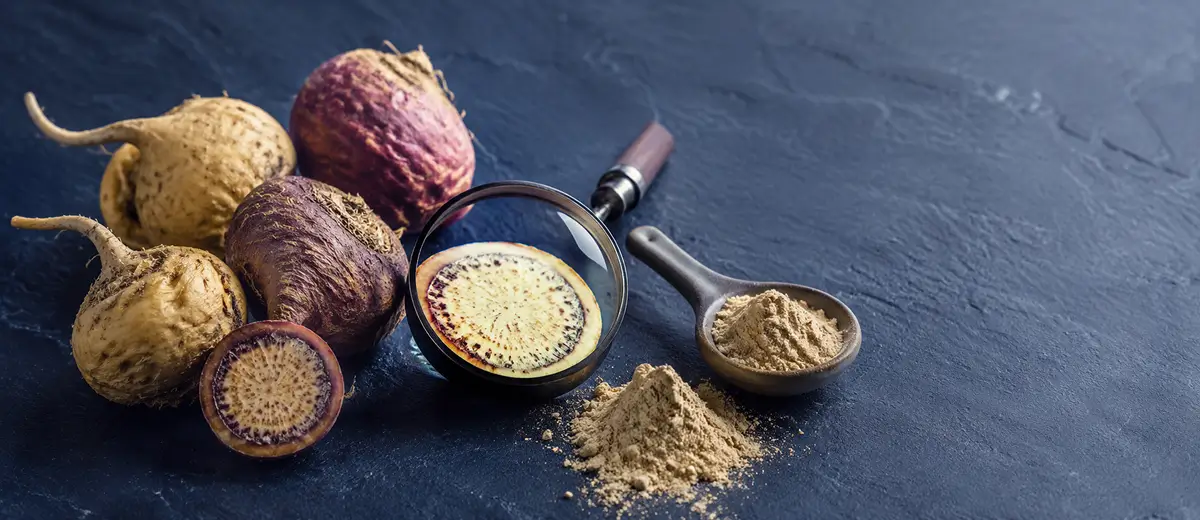
What is Maca? Origin and varieties of the Peruvian root
Maca (scientific name Lepidium meyenii) is a root grown on the high plateaus of the Andes, above 4,000 metres. Peruvian maca grows in extreme conditions, which is thought to explain how rich it is in active compounds. Local populations have been eating it for thousands of years, both as a food and as a tonic.
Botanically, Maca belongs to the brassica family, like broccoli or radish. It is an adaptogenic plant, a category of plants believed to help the body cope better with stress and fatigue. The useful part is the tuber, dried and then ground into a powder.
Nutritionally, the root is rich in complex carbohydrates, fibre, plant protein and minerals such as iron and zinc. That profile makes it as much a superfood as a supplement, which explains its status as a staple food in the Peruvian Andes.
There are several varieties, told apart by their colour, and that detail matters.
Yellow, red and black Maca, what are the differences?
- Yellow Maca: the most common, versatile, geared towards energy and general tone.
- Red Maca: studied for prostate health and bone comfort.
- Black Maca: the most sought after for libido, fertility and cognitive function.
The colour you pick therefore shapes the effects you can expect. A quality powder usually states its variety, a good sign of a serious manufacturer.
How does Maca work in the body?
This is the heart of the matter, and where many articles get it wrong. To understand how maca works, one stubborn myth needs breaking: Maca contains no hormones, no testosterone and no oestrogen. Nor does it contain phytoestrogens, unlike soy.
Its action is indirect, through the endocrine system. Maca is thought to act as a regulator, helping the body manage its own hormone secretions and its stress response. That is exactly what an adaptogen does: support balance rather than force one hormone upwards.
The active compounds identified are mainly:
- The macamides and macaenes, lipids specific to Maca, linked to its effects on libido and energy.
- The glucosinolates, molecules from the brassica family, with antioxidant properties.
- Amino acids, minerals (iron, zinc) and vitamins that feed the ground.
One important scientific point sheds light on this mechanism. In studies, Maca improves male libido without raising testosterone or luteinising hormone. That proves it does not act like a steroid, but through other pathways (probably the nervous system and cortisol management). ⚡
On the energy side, Maca supports physical and mental vitality by helping the body absorb fatigue better. It is not a stimulant like caffeine: no spike, no crash, just a background tone that settles in.
To grasp this mechanism properly, you need to understand the idea of an adaptogen. An adaptogenic plant helps the body move back towards its balance (homeostasis) when stress, fatigue or effort knock it off course. Maca does not push one dial in a single direction: it modulates. That is why its effects vary with each person's needs, and why they take a little time to show.


What are the benefits of Maca?
Let's move on to the concrete effects. When you look up what the benefits of maca are, you have to separate what is well documented from what belongs to tradition. Some effects also differ between men and women, which is why it is worth treating them separately.
Benefits of Maca for men
In men, the most studied maca benefits for men concern the sexual sphere and energy. Maca libido is the flagship benefit: several trials show a rise in desire after a few weeks of regular use.
Maca is also studied for maca fertility. Some work reports an improvement in certain sperm parameters (sperm concentration and motility). Be careful though, these effects are no substitute for medical follow-up if a genuine disorder is present.
The benefits most often cited for men:
- Support for libido and sexual desire.
- Possible improvement in sperm quality.
- A boost in energy and endurance during exercise.
- Better day to day stress management.
Let's clear up a point that is often misunderstood about maca testosterone: Maca does not raise that level. Its effect on libido works through other mechanisms, which makes it gentler than a hormonal booster.

Benefits of Maca for women
In women, maca benefits for women mainly touch on hormonal balance and comfort. Maca is particularly studied for easing some of the discomforts of the menopause, such as hot flushes or mood swings.
Here too the mechanism is indirect: Maca helps the body regulate its hormonal balance better, without supplying oestrogens. That is an asset for women looking for a natural alternative, especially when hormone treatments are not advised.
The benefits women report most often:
- Reduced menopause symptoms.
- Support for libido and mood.
- A boost in energy and vitality. 🔥
Men and women alike also share one common effect: better general tone and a steadier mood, linked to the adaptogenic action on stress.
On the energy front, Maca is also of interest to athletes. Small studies suggest a supporting effect on endurance, without the drawbacks of a stimulant. Nothing miraculous, but a welcome nudge for holding a long effort or getting through a busy spell. This "clean energy" benefit partly explains its popularity with biohacking fans.
How long does Maca take to work?
This is a central question, because expectations are often disappointed. Many people hope for an immediate maca effect, the way a stimulant works. The reality is more nuanced and calls for patience.
In the very short term, the effect you feel stays mild. Some people notice a small lift in tone in the first few days, but nothing spectacular. Maca is not a fast acting stimulant.
The real question is rather: how long does maca take to work? Studies and user feedback converge on 2 to 6 weeks of regular use. That is the time the adaptogenic action needs to settle in and produce its effects on libido, energy and mood.
Here are some realistic markers:
- Days 1 to 7: subtle effect, sometimes a slight lift in energy.
- Weeks 2 to 4: gradual rise in tone and libido.
- Weeks 4 to 6: effects well established for most users.
Consistency is therefore the key. A one off dose does not achieve much: Maca is meant as a course, not a quick fix.
Dosage: how to take Maca?
Getting the dose right shapes both the results and the safety. The usual maca dosage sits between 1.5 and 3 grams a day for the powder, but it varies with the concentration of the product and the goal you are after.
Maca comes in two main forms, each with its own advantages:
- Powder: economical and versatile, to be mixed into a smoothie, a yoghurt or a porridge.
- Capsules: practical, without the earthy taste, with a precise and consistent dose.
As for timing, the morning or midday is ideal, because Maca supports energy. Sensitive people are better off avoiding the evening, so as not to disturb falling asleep.
A few practical tips for an effective course:
- Start with a small dose and increase gradually.
- Prefer taking it during a meal for better tolerance.
- Consider a course of 6 to 12 weeks, followed by a break.
Choosing a gelatinised (pre cooked) powder improves digestibility, a useful detail for sensitive guts.
A word on quality, because that is where everything is decided. Go for an organic Maca, grown in Peru and ideally tested for heavy metals. Andean altitude and soil directly influence how rich it is in macamides and glucosinolates, a criterion the best brands highlight on their label.
Side effects, risks and contraindications
No supplement is harmless, and an honest guide has to cover the risks. The good news: Maca is generally well tolerated. But there are situations where caution is called for.
What are the most common side effects of maca? They stay mild and mostly digestive:
- Bloating or gut discomfort, often linked to too high a dose.
- Sleep problems if it is taken too late in the day.
- Passing jitteriness in very sensitive people.
The danger of maca mainly concerns certain specific profiles. Because Maca acts on the hormonal and thyroid systems, vigilance is needed in several cases.
The contraindications and precautions to know:
- Pregnancy and breastfeeding: to be avoided for lack of data.
- Thyroid disorders: glucosinolates can interfere, medical advice required.
- Hormone dependent cancers: caution and medical clearance are essential.
- Ongoing treatment: ask for advice to avoid interactions.
As for the liver, no hepatic toxicity has been established at usual doses. If in doubt or if you have a health condition, professional advice remains the best compass.
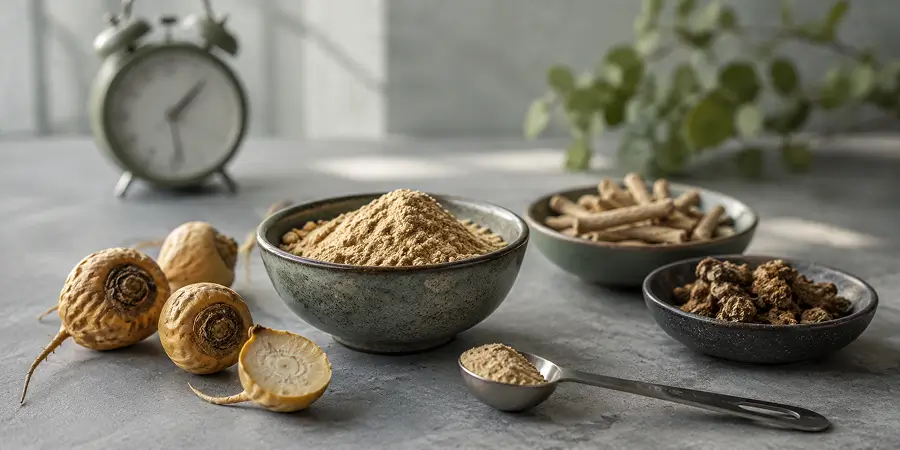
Maca and other adaptogens: fitting it in well
Maca never works better than inside a coherent strategy. It combines well with other adaptogenic plants, each covering a specific need. That is the principle behind synergistic formulas.
Compared with ashwagandha, Maca is more geared towards energy and libido, whereas ashwagandha excels at relaxation and lowering cortisol. Against rhodiola, which is oriented towards mental endurance and fighting fatigue, Maca brings the vitality and hormonal side. The three complement each other rather than compete.
That is the logic some complete formulas follow. Maca (dosed at 120 mg) features for example in the MushNGo Energy range, combined with cordyceps and Siberian ginseng for an overall vitality effect without caffeine.
To dig into a complementary and heavily studied adaptogen, read our guide "Ashwagandha: benefits, limits and uses", ideal to pair with Maca in an anti stress and energy routine.
What to remember about how Maca works
Let's recap the essentials. Maca is an adaptogenic root from Peru that acts without supplying hormones, by supporting endocrine balance and the stress response. That is what makes it both interesting and relatively safe. 💪
The key points to remember:
- It regulates rather than stimulating abruptly.
- Its effects on libido and energy settle in within 2 to 6 weeks.
- It is taken as a course, at a gradual dose, preferably in the morning.
- It calls for caution in case of a thyroid or hormonal disorder.
Used properly, Maca is a natural ally of vitality, provided you keep realistic expectations and stick to a good lifestyle. ✅
FAQ: your questions about Maca
Should you choose Maca or ashwagandha?
It depends on your goal. Maca targets energy, libido and hormonal balance. Ashwagandha mainly targets stress and sleep. The two can be combined.
Can you take Maca every day?
Yes, as a course of several weeks. It is still advisable to take regular breaks to preserve its effectiveness and let the body rest.
Does Maca make you put on weight?
No, Maca does not make you gain weight as such. It can whet the appetite in some people and support muscle gain alongside exercise, but it is not calorific at a normal dose.
Does Maca disturb sleep?
Taken too late, it can get in the way of falling asleep because of its tonic effect. Go for a morning or midday dose.
Is Maca suitable for vegetarians and vegans?
Yes. It is a plant root, naturally suited to vegetarian and vegan diets, with no ingredient of animal origin.
Scientific references
- Gonzales G.F. et al., Effect of Lepidium meyenii (Maca) on sexual desire in adult healthy men, Andrologia, 2002. https://pubmed.ncbi.nlm.nih.gov/12472620/
- Gonzales G.F. et al., Lepidium meyenii (Maca) improved semen parameters in adult men, Asian Journal of Andrology, 2001. https://pubmed.ncbi.nlm.nih.gov/11753476/
- Meissner H.O. et al., Hormone-Balancing Effect of Pre-Gelatinized Organic Maca in postmenopausal women, International Journal of Biomedical Science, 2006. https://pubmed.ncbi.nlm.nih.gov/23674976/
- Gonzales G.F., Ethnobiology and Ethnopharmacology of Lepidium meyenii (Maca), Evidence-Based Complementary and Alternative Medicine, 2012. https://pubmed.ncbi.nlm.nih.gov/21977053/

LMC’s editorial line is built around transparency and reliability. Our content is written to help users make better decisions, based on 7 key criteria* that support trustworthy information, verified promo codes, and useful reviews.
To support LMC, some links are affiliate links. Our recommendations remain independent and based on transparent, verifiable criteria. By using the site, you accept our terms of use and our editorial policy.




.webp)

.avif)