

How does the gut barrier work?
To understand what colostrum can do, you first need to know what it is supposed to protect. And the gut barrier is far thinner than most people imagine.
Across roughly 300 square meters of surface area, your intestine separates its digestive contents from the rest of your body with a single layer of cells, the enterocytes. It is both the site where nutrients are absorbed and a border that has to stay sealed against everything else.
That seal relies on several complementary layers:
- Mucus, a viscous layer that prevents direct contact between bacteria and cells.
- Tight junctions, protein complexes that bind enterocytes together and control what gets through.
- Secretory IgA, antibodies released into the intestinal lumen that neutralize unwanted agents.
- The microbiota, whose composition directly influences how robust the whole system is.
This barrier is not a wall, it is a dynamic filter. It lets nutrients through and blocks the rest, constantly adjusting. When that balance goes off track, molecules that should stay inside the gut cross the intestinal wall, which is what we call increased permeability.
What is intestinal hyperpermeability, and how much is the term "leaky gut" worth?
You need to separate two things that marketing is happy to lump together.
On one hand, increased intestinal permeability is a real, measurable phenomenon. It is quantified in the lab using the ratio of two non-metabolized sugars in urine, lactulose and rhamnose. It has been documented in several specific situations: taking anti-inflammatory drugs, intense physical exertion, certain inflammatory bowel diseases, extensive burns, and chronic alcoholism.
On the other hand, "leaky gut syndrome", popularized online, presents this permeability as the cause of just about everything, from fatigue to eczema to mood disorders. That particular entity is not recognized by any medical society, and the causal link it assumes has not been established.
The nuance matters, and it is not just academic: in several diseases, increased permeability is indeed observed, but we still do not know whether it is the cause or the consequence of the condition. Correcting a marker therefore does not guarantee correcting the disease.
Keep this distinction in mind for what follows: serious studies measure permeability, they do not treat a syndrome.


Through what mechanisms would colostrum work?
Colostrum is the first milk produced after a calf is born. Its biological role is precisely to protect an immature digestive tract, which explains the logic behind using it in adults.
Four components are usually highlighted:
- Immunoglobulins, mainly IgG, which make up the most abundant fraction and can bind to pathogens in the intestinal lumen.
- Lactoferrin, which sequesters iron and deprives certain bacteria of a nutrient essential to their growth.
- Growth factors, notably EGF and TGF-beta, involved in the renewal of cells in the intestinal lining.
- Oligosaccharides, which serve as a substrate for certain gut bacteria.
One objection comes up often, and it is a fair one: aren't these proteins simply digested? Partly, yes. But unlike an active ingredient that is supposed to reach the bloodstream, colostrum works where it is, that is, in the intestinal lumen. Its supposed benefit therefore does not depend on absorption, which completely changes the reasoning.
One clarification about immunoglobulins is needed, because it is almost always glossed over. The IgG in standard bovine colostrum are directed against the pathogens the cow has encountered, not against yours. That is why some laboratories produce so-called hyperimmune colostrum, obtained by vaccinating the animals against targeted germs. A commercial colostrum therefore does not offer targeted protection against a given infection, and brands that suggest otherwise go well beyond what the data support.
These mechanisms remain coherent working hypotheses. They explain why researchers are interested, but on their own they prove nothing.
What do human studies show?
This is where precision matters, because not every situation has been studied with the same rigor.
| Situation studied | Type of data | What we can conclude |
|---|---|---|
| Permeability induced by anti-inflammatory drugs | Controlled trials in humans | Effect measured on an objective marker |
| Permeability induced by intense exercise | Randomized trials and meta-analysis | Best-documented area |
| Infectious diarrhea | Clinical trials, targeted settings | Existing data, specific populations |
| Distal colitis | Preliminary study, small sample | Old lead, never confirmed on a large scale |
| Irritable bowel syndrome | Very little data | No conclusion possible at this stage |
| Gut microbiota | Mostly preclinical | Coherent hypotheses, thin human evidence |
The most interesting work is old and still rarely cited in France. In 1999, Playford's team published a study in the journal Gut on permeability caused by nonsteroidal anti-inflammatory drugs. In subjects given indomethacin, intestinal permeability increased roughly threefold. Giving bovine colostrum at the same time significantly reduced that increase. A second study by the same team, published in 2001, confirmed the result.
These two lines of research point in the same direction: two very different causes of barrier damage, anti-inflammatory drugs on one side and intense exercise on the other, produced the same type of response to colostrum. A meta-analysis of randomized trials, published in 2024 in Digestive Diseases and Sciences, pooled this work and concluded that there is a favorable effect on increased intestinal permeability; the data nonetheless remain limited.
A third area deserves a mention for the sake of completeness: infectious diarrhea. Trials have been run in very targeted settings, notably in immunocompromised patients or in cases of traveler's diarrhea, with broadly favorable results. However, this work concerns specific populations and germs, sometimes with specially prepared hyperimmune colostrum. It does not carry over to a commercial product taken preventively by a healthy person.
Elsewhere, the picture is thinner. A preliminary study from the 2000s explored its use in distal colitis, with no large-scale confirmation since. For irritable bowel syndrome, the data are too scarce to conclude anything, despite the flood of commercial promises in exactly this area.
Does colostrum affect the microbiota?
This is the most heavily marketed claim and the least supported one, and that needs to be said clearly.
The reasoning is appealing: colostrum's oligosaccharides would feed beneficial bacteria, lactoferrin would limit the growth of certain unwanted strains, and the whole thing would rebalance the gut flora.
In reality, most of this data comes from animal models and in vitro studies. Human studies that actually measure changes in the microbiota after supplementation are few, involve small samples, and their results do not overlap enough to draw a general rule.
There is a fundamental difference between a documented prebiotic and a product whose prebiotic effect is assumed. For now, colostrum belongs in the second category.
When might it be useful, and when not?
Let's sum up honestly, since that is what you want to know.
The best-supported situation is permeability increased by an identified cause: regular use of anti-inflammatory drugs, intense and prolonged training, especially in high heat. In those cases, there are objective measurements and trials.
Conversely, if you suffer from chronic digestive problems without a diagnosis, colostrum is not the right first step. Persistent bloating, a lasting change in bowel habits, pain, or blood in the stool call for medical advice ⚠️. These symptoms may point to celiac disease, a chronic inflammatory bowel disease, or something else entirely, and no supplement replaces a diagnosis.
One in-between case is worth mentioning, because it applies to many readers: someone who regularly takes ibuprofen or aspirin, for joint pain for example, and feels some digestive discomfort. This is the situation closest to Playford's trials. Be careful not to reverse the logic, though: if an anti-inflammatory gives you digestive problems, the first question to ask your doctor is about the treatment itself, not about a supplement that might soften its effects.
A few contraindications to know: colostrum is a dairy product, so it is ruled out if you are allergic to cow's milk proteins. It contains variable amounts of lactose. It is not recommended for pregnant or breastfeeding women or for minors, due to lack of data. Finally, if you are on immunosuppressive treatment, your doctor's advice is essential.

How to take it and which product to choose?
Two practical pointers before choosing a product.
The doses used in studies are high. Protocols that showed an effect on permeability used 10 to 20 g per day, while many commercial products offer 1 to 3 g. That gap is significant and worth knowing before you buy. Duration also matters: the trials ran for at least two weeks.
In practice, take colostrum away from meals and never in a hot drink, since heat denatures the immunoglobulins that make it worthwhile.
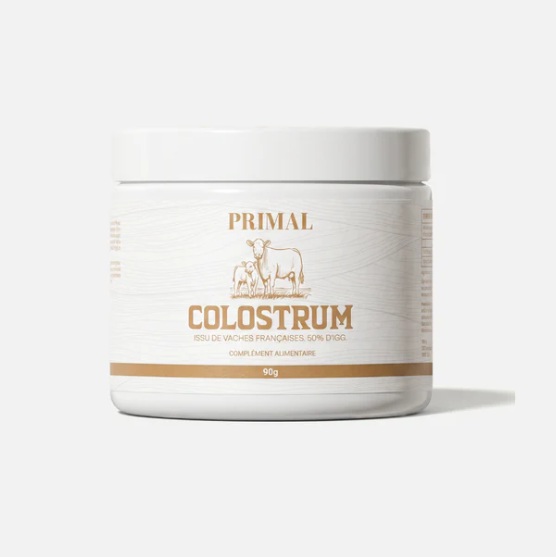
When choosing a product, the IgG content remains the only objective marker of potency, along with traceable origin and available lab analyses. Among the French brands we have evaluated, Primal offers colostrum of French origin standardized to 50% IgG, which places it at the top of the market on this criterion.
👉 Discover the Primal range (code LMC for 10% off)
We have covered all the buying criteria in our guide on choosing a colostrum powder, and its use by athletes in our article on colostrum and bodybuilding.
Frequently asked questions
Does colostrum repair the gut?
That term is too strong. Trials suggest it may limit the increase in permeability caused by certain stressors, such as anti-inflammatory drugs or intense exercise. That is not the same as repairing a damaged intestinal lining.
Is it useful for irritable bowel syndrome?
The data are too scarce to say so, despite what many commercial pages claim. Irritable bowel syndrome is a medical diagnosis that requires appropriate care.
Should you take it on an empty stomach?
Away from meals rather than strictly on an empty stomach, and above all never in a hot drink. Immunoglobulins are heat-sensitive.
Can you combine it with probiotics?
Nothing stands in the way, since the two work through different pathways. However, no study has evaluated this combination, so you should not expect any proven synergy.
How long before you see an effect?
The protocols lasted at least fourteen days. Allow at least two to four weeks before judging, and base it on a concrete criterion rather than a general impression.
Key takeaways
For colostrum, controlled trials and a meta-analysis have observed a smaller increase in intestinal permeability caused by anti-inflammatory drugs and by intense exercise. That is a specific finding, rare for a supplement, but the data remain limited to these situations.
Everything else, the microbiota, irritable bowel, chronic digestive problems, is for now a matter of hypothesis or marketing. And if your symptoms persist, it is a doctor you need to see, not the supplement aisle.
Scientific references
- Playford RJ, Macdonald CE, Calnan DP, et al. "Bovine colostrum is a health food supplement which prevents NSAID induced gut damage". Gut, 1999;44(5):653-658. PubMed 10205201
- Playford RJ, MacDonald CE, Johnson WS, et al. "Co-administration of the health food supplement, bovine colostrum, reduces the acute non-steroidal anti-inflammatory drug-induced increase in intestinal permeability". Clinical Science, 2001. PubMed 11352778
- "Bovine Colostrum in Increased Intestinal Permeability in Healthy Athletes and Patients: A Meta-Analysis of Randomized Clinical Trials". Digestive Diseases and Sciences, 2024. PubMed 38361147
- Marchbank T, Davison G, Oakes JR, et al. "The nutriceutical bovine colostrum truncates the increase in gut permeability caused by heavy exercise in athletes". American Journal of Physiology, 2011;300(3):G477-484. PubMed 21148400
Dietary supplements are not a substitute for a varied, balanced diet or a healthy lifestyle. If you have persistent digestive problems, consult a healthcare professional.

LMC content is written by our editorial team from the information published by the brands. Scores out of 10 follow a public grid of 5 criteria*, supplemented by LMC’s editorial assessment.
To support LMC, some links are affiliate links: LMC earns a commission at no extra cost to you, and some of the brands featured are partners. By using the site, you accept our terms of use and our editorial policy.