

What is colostrum, and why are athletes interested in it?
Colostrum is the first milk a cow produces in the hours after calving, before regular lactation sets in. Its composition has nothing in common with milk: it is far richer in functional proteins and far lower in fat.
Three groups of components explain the interest in it:
- Immunoglobulins, mainly IgG, which make up the most abundant fraction and serve as a quality marker.
- Lactoferrin, a protein that binds iron and has antimicrobial activity.
- Growth factors, including IGF-1, involved in tissue renewal. We will come back to these, because they raise a specific question for drug-tested athletes.
To give you an idea, bovine colostrum can contain several dozen times more immunoglobulins than ordinary milk, and its total protein content is significantly higher. That richness collapses within a few days: after seventy-two hours, the composition gradually becomes that of regular milk. That is why the collection window is so short, and why the product is expensive.
In sports, colostrum came in through the immunity door, with the idea of limiting the infections that follow heavy training loads. Research then took a more specific direction, that of the gut barrier, and that is where the data are strongest today.
What happens in the gut during intense exercise?
Few athletes know about this mechanism, yet it explains a good share of digestive problems during training.
During sustained effort, the body redirects blood flow to the working muscles, the heart, and the skin. The digestive tract, meanwhile, sees its blood supply drop. This relative ischemia weakens the intestinal lining, which is only one cell thick.
The tight junctions, the structures that bind cells together and control what gets through, then loosen. Permeability increases, and molecules that should stay in the gut, notably bacterial fragments called endotoxins, cross the barrier.
The consequences show up during training: abdominal cramps, nausea, sudden urges, sometimes diarrhea. In extreme cases, this leakage of endotoxins contributes to the mechanism of exertional heat stroke.
Three situations make the problem significantly worse:
- Long efforts, beyond an hour of sustained intensity.
- Heat, which diverts even more blood to the skin.
- Dehydration, which reduces available blood volume.
Someone lifting weights in an air-conditioned gym is therefore far less affected than a distance runner in summer. That is an important nuance when deciding whether this supplement is really relevant to you.


Does colostrum really reduce this permeability?
This is the only area where the data are truly convincing, and they deserve a closer look.
The reference trial is the one by Marchbank and his team, published in 2011 in the American Journal of Physiology. Twelve volunteers, a double-blind, placebo-controlled crossover protocol, fourteen days of supplementation before a standardized bout of exercise. Intestinal permeability was measured using the urinary lactulose to rhamnose ratio, an objective method.
The result is clear: in the placebo group, permeability increased 2.5-fold after exercise. In the colostrum group, that rise was strongly limited.
A word on this measurement method, because it explains why these results deserve to be taken seriously. Lactulose and rhamnose are two non-metabolized sugars that the subject swallows. Rhamnose, a small molecule, easily crosses a healthy intestinal lining. Lactulose, which is larger, only gets through if the barrier is damaged. By measuring their ratio in urine, you get an objective indicator of the state of the gut barrier, independent of how the athlete feels. It is not a digestive comfort questionnaire, it is a physiological measurement.
On its own, this result would have limited reach, but it has since been confirmed. A meta-analysis of randomized trials, published in 2024 in Digestive Diseases and Sciences, pooled studies conducted in athletes and in patients, and concluded that bovine colostrum has a favorable effect on increased intestinal permeability.
Two caveats, because they change the practical takeaway. Sample sizes remain small and protocols vary. Above all, the doses used are high: the Marchbank trial used 20 g of colostrum per day. Many commercial products offer 1 to 3 g per serving, that is seven to twenty times less than what was studied. This is the point brands never highlight, and everything else depends on it.
This mechanism is not limited to sports, by the way: intestinal permeability also increases with certain medications, a topic we cover in detail in our article on colostrum and gut health.
What about muscle mass and performance?
Let's be blunt: this is the disappointing part, and it is better to know before you buy.
| Desired effect | Level of evidence | What we can conclude |
|---|---|---|
| Intestinal permeability during exercise | Best documented | Consistent randomized trials and meta-analysis |
| Respiratory infections in athletes | Moderate | Encouraging results, heterogeneous protocols |
| Digestive problems during training | Moderate | Consistent with the effect on permeability |
| Post-exercise recovery | Weak | Few trials, variable measurement criteria |
| Maximal strength | Not demonstrated | No established effect on this parameter |
| Muscle mass gain | Not demonstrated | Contradictory results, no anabolic effect |
For maximal strength, no effect has been established. For muscle gain, the few available trials give contradictory results, and none allows us to speak of an anabolic effect. Colostrum does contain growth factors, but these proteins are digested like any others, which severely limits the comparison with an injected hormone.
For recovery, the data are weak and measurement criteria vary too much from one study to the next to draw a conclusion.
Immunity sits somewhere in between. Several studies report fewer upper respiratory infections in athletes under heavy training loads, with heterogeneous protocols. That is encouraging without being proven.
To sum up honestly: if you are looking to build muscle or lift heavier, colostrum is not the tool. If you suffer from digestive problems during exercise or keep catching infections during heavy training blocks, the question is worth asking.
Is colostrum a problem for doping tests?
This question comes up constantly and never gets a clear answer in French. Here it is, on three levels ⚠️.
Bovine colostrum is not a prohibited substance. It does not appear on the World Anti-Doping Agency's prohibited list. So you are not breaking any rule by taking it.
But WADA advises against using it. In a statement published in 2013, it pointed out that bovine colostrum contains IGF-1 and other growth factors at levels that could influence the outcome of a test. IGF-1 itself is very much on the prohibited list. The agency reminds athletes that those who use this type of product do so at their own risk.
The scientific data, for their part, are reassuring. Studies in healthy adults show that oral colostrum supplementation does not raise circulating IGF-1 levels, since the protein is digested in the digestive tract rather than absorbed intact.
What should you make of these three contradictory pieces of information? The reasonable position depends on your situation. If you are not subject to any testing, the issue does not concern you. If you are a licensed member of a federation that tests, WADA's opinion should take precedence over the scientific argument: choose a product certified by a supplement testing program, or abstain and talk to your federation's doctor.
There is also a more concrete risk, and it is rarely mentioned: adulteration. As with any supplement, the main danger is not the advertised ingredient, but what might be in it without appearing on the label. Positive test cases linked to contaminated supplements are well documented, and they almost never involve the product's main ingredient.
That is exactly what sports supplement certification programs are for. They have batches analyzed by independent laboratories to detect prohibited substances, and they issue a verifiable logo on the package. They do not guarantee a hundred percent result, no program can, but they considerably reduce the risk. For a tested athlete, this is the one criterion that outweighs all others, IgG content included.
How do you fit it into a training routine?
A few practical pointers, keeping in mind the dosage gap mentioned above.
Quantity first. Protocols that showed an effect on permeability used 10 to 20 g per day. If your product provides 1 g per dose, you are very far off, and it is better to know that than to hope for a result.
Timing next. Colostrum is best taken away from meals, since its proteins are sensitive to digestion. In the trials, intake was spread across the day rather than taken all at once.
Temperature matters too: do not mix it into a hot drink, since heat denatures immunoglobulins. Cool or lukewarm water, never boiling.
Duration, finally. Fourteen days is the minimum used in the protocols. A one-off dose the day before a competition has no basis.
The right time to consider it is a heavy training block, preparation in hot conditions, or a period when digestive problems during exercise become a nuisance. During maintenance phases, the benefit is much smaller.
Which colostrum should you choose when you train?
Three criteria matter more than the others in this specific context.
- IgG content, the only objective marker of colostrum potency. Below 20%, the benefit becomes questionable.
- Traceable origin, since this is a farm-derived product, with all the questions about milk quality and animal welfare that implies.
- Transparent lab testing, especially if you are subject to drug testing.
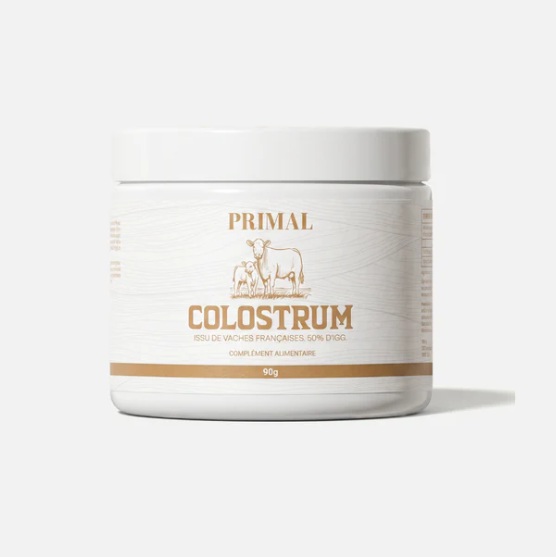
Among the French brands we have evaluated, Primal offers colostrum of French origin standardized to 50% IgG, which places it at the top of the market on this criterion, with analyses carried out in a French laboratory. One honest point of caution: like most commercial products, its daily dose remains below the amounts used in clinical trials on intestinal permeability.
👉 Discover the Primal range (code LMC for 10% off)
For a detailed look at quality criteria, we reviewed them in our guide on choosing a colostrum powder.

Frequently asked questions
Does colostrum help you build muscle?
No, no data demonstrate it. Trials on body composition give contradictory results, and the growth factors it contains are digested rather than absorbed intact.
Can you take it with whey?
Nothing stands in the way, they are two dairy products with different roles. Take them at separate times, though, since colostrum does not mix well into a hot or very high-protein drink.
Is colostrum banned in competition?
It is not on the prohibited list, but WADA advises against using it because of its growth factor content. If you are tested, choose a certified product or skip it.
How long does it take to work?
Protocols that showed an effect lasted at least fourteen days. Taking a single dose before a session makes no sense.
Is it suitable if you are lactose intolerant?
Colostrum does contain lactose, in amounts that vary by manufacturing process. Very sensitive people should check the stated content, and anyone allergic to cow's milk proteins should avoid it.
Key takeaways
Colostrum is not a mass-gain product, and presenting it that way is marketing. Its documented benefit for athletes lies elsewhere: it limits the increase in intestinal permeability caused by intense exercise, a mechanism responsible for digestive problems during training.
Two points of caution to keep in mind: the effective doses in studies far exceed those of commercial products, and drug-tested athletes need to take WADA's position on growth factors into account.
Scientific references
- Marchbank T, Davison G, Oakes JR, et al. "The nutriceutical bovine colostrum truncates the increase in gut permeability caused by heavy exercise in athletes". American Journal of Physiology: Gastrointestinal and Liver Physiology, 2011;300(3):G477-484. PubMed 21148400
- "Bovine Colostrum in Increased Intestinal Permeability in Healthy Athletes and Patients: A Meta-Analysis of Randomized Clinical Trials". Digestive Diseases and Sciences, 2024. PubMed 38361147
- World Anti-Doping Agency, statement on IGF-1 and products containing it. WADA
- "The Use of Bovine Colostrum in Sport and Exercise". Nutrients, 2021;13(6):1789. MDPI
Dietary supplements are not a substitute for a varied, balanced diet or a healthy lifestyle.

LMC content is written by our editorial team from the information published by the brands. Scores out of 10 follow a public grid of 5 criteria*, supplemented by LMC’s editorial assessment.
To support LMC, some links are affiliate links: LMC earns a commission at no extra cost to you, and some of the brands featured are partners. By using the site, you accept our terms of use and our editorial policy.