


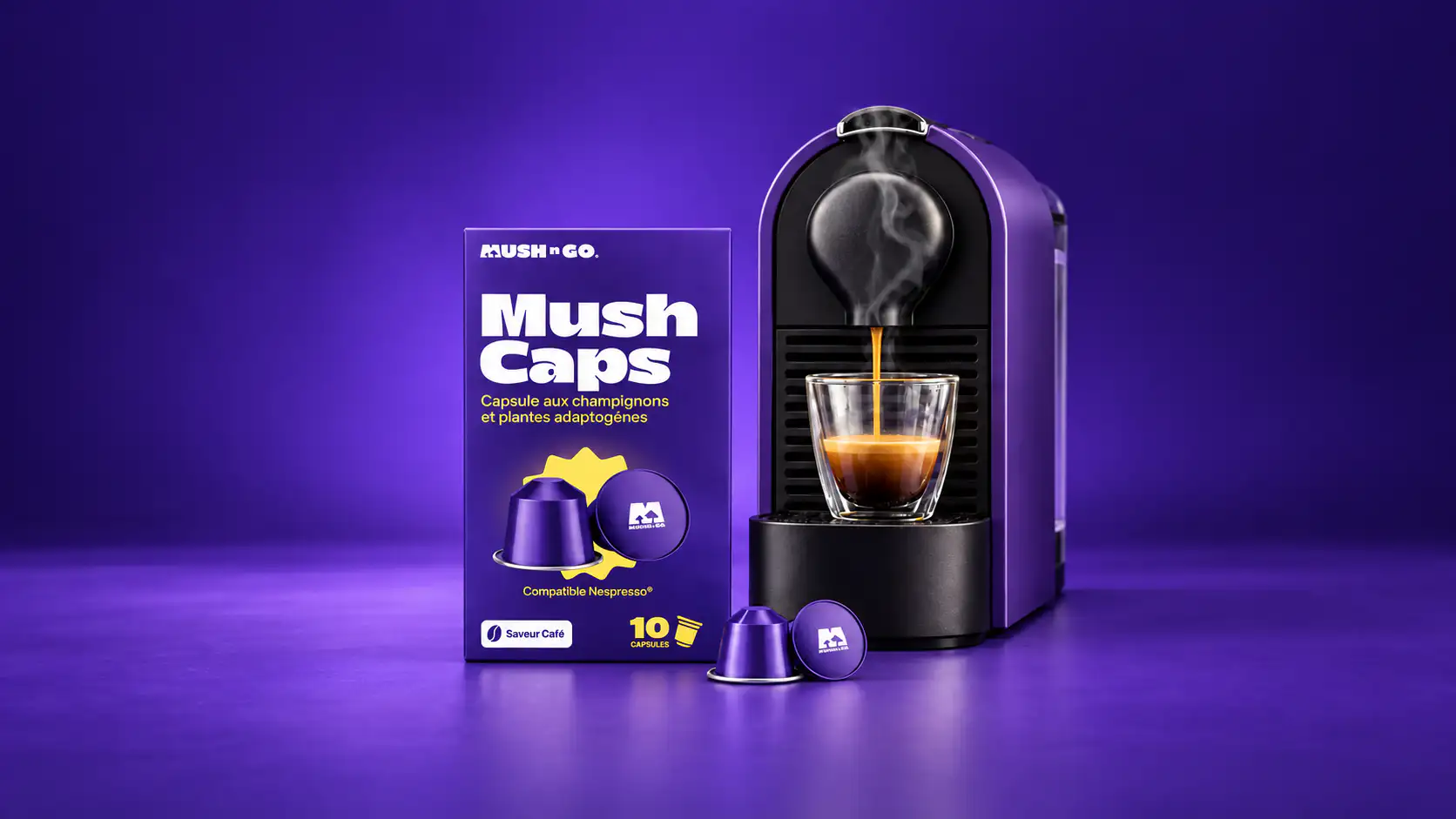


Can you really find adaptogenic mushrooms in a pharmacy?
The answer is yes, more and more of them. Looking for an adaptogenic mushroom at the pharmacy is no longer an exotic idea: several laboratories and brands have made their way onto pharmacy and para-pharmacy shelves over the past few years.
In practice, the offer comes in several forms. You will find capsules from laboratories such as Granions, specialist brands distributed through para-pharmacies, and even functional drinks sold over the counter in some larger pharmacies. The « stress, sleep, immunity » aisle now makes room for Reishi, Cordyceps and Lion's Mane.
This arrival in pharmacies reflects a deeper trend. Mycotherapy, long confined to specialist shops, now appeals to a much wider audience, and pharmacists are training up on it. Searches for « adaptogenic mushrooms pharmacy » keep climbing, a sign of genuine public interest.
If you are wondering where to buy an adaptogenic mushroom, several channels coexist:
- The high street pharmacy, with advice from a healthcare professional.
- The online para-pharmacy (Pharma GDD, DocMorris), with a wider choice.
- Organic food shops and direct-to-consumer brands, often more specialised.
So the real question is not just where to buy an adaptogenic mushroom, but how to recognise a product that delivers on its promise. Behind that search there is usually a legitimate worry: ending up with something ineffective or badly dosed. The pharmacy then looks like a filter you can trust.
One important nuance remains: being sold in a pharmacy says nothing about the actual quality of the product. That is exactly what we are going to unpack.
Adaptogenic mushroom: definition and main types
Before judging, let us set the basics. The definition of an adaptogenic mushroom is simple: these are mushrooms said to help the body adapt better to stress, fatigue and imbalance, without overstimulating it the way a stimulant would.
They are food supplements, not medicines. An adaptogenic mushroom food supplement treats no illness: it supports the body, within a framework regulated by the DGCCRF, the French consumer protection authority. They are non-hallucinogenic and perfectly legal.
The word « adaptogen » comes from research into substances that increase the body's non-specific resistance to stress. Applied to mushrooms, it refers to species rich in beta-glucans and bioactive compounds, used for centuries in traditional Asian medicine and studied today by modern science.
People usually talk about the five main functional mushrooms, each with its own speciality:
- Reishi: traditionally linked to relaxation and immune support.
- Cordyceps: valued for energy and endurance.
- Lion's Mane: studied for memory and focus.
- Chaga: rich in antioxidants, immunity oriented.
- Shiitake: a source of beta-glucans, all-round support.
Other species are worth knowing, such as Maitake, Tremella or Oyster mushroom, but those five form the backbone of most formulas on the market. A good product sometimes combines several species for a complementary action.
The species you choose therefore depends on your goal. For focus, go for Lion's Mane. For energy, Cordyceps. For relaxation and immunity, Reishi and Chaga. This « right mushroom for the right need » logic should guide your purchase, even before the question of where to buy it.
Each one works differently, which is why a good product always states the species used and its form. A vague blend with no detail is already a bad sign.
These differences between species explain why two products labelled « with adaptogenic mushrooms » can have almost nothing in common. One concentrates a pure, properly dosed Lion's Mane extract, the other dilutes a little of everything without ever reaching an effective dose. Hence the importance of looking beyond the generic label and checking the detailed spec sheet before buying.
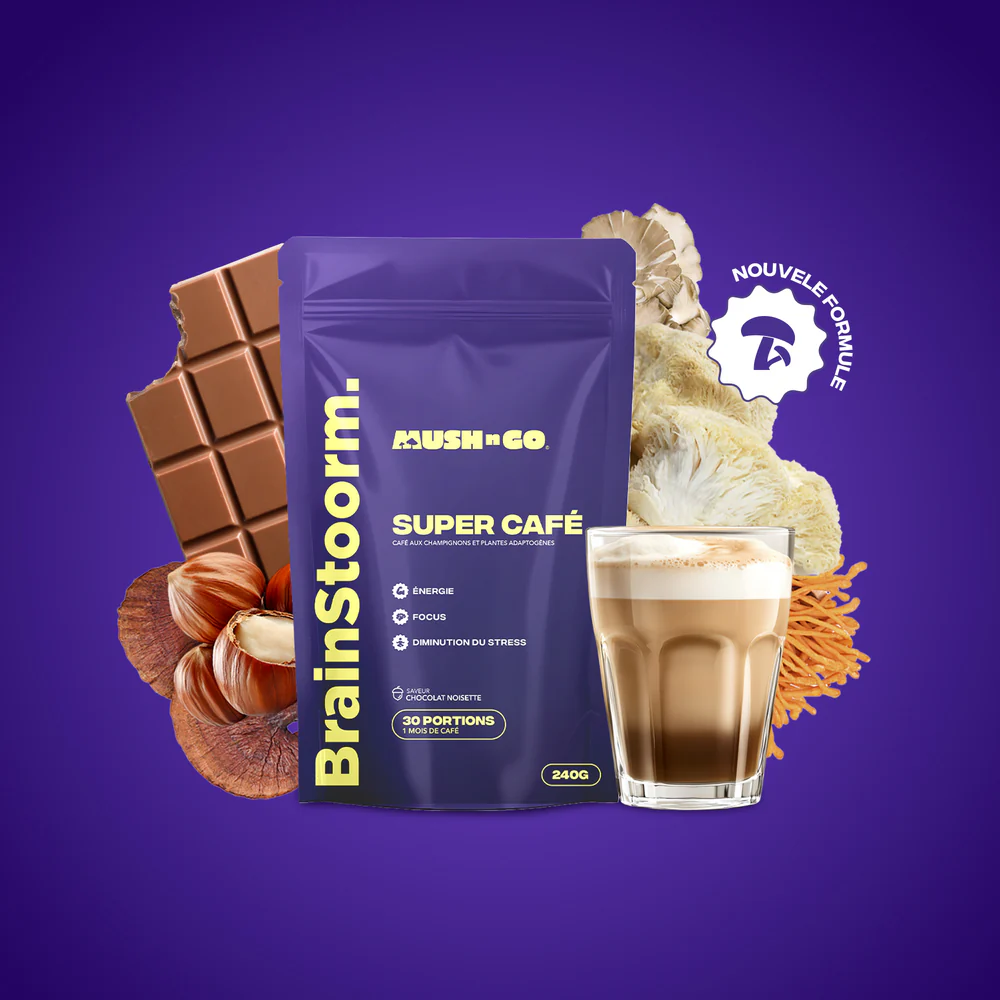

What the pharmacy guarantees, and what it does not
This is the heart of the matter. Buying from a pharmacy brings real guarantees, but only partial ones. You need to know what going through a pharmacy actually changes.
Let us drop the binary view. The pharmacy is neither an absolute mark of quality nor a trap to avoid. It is one channel among others, strong on safety and limited on the selection of extracts.
What the pharmacy does guarantee:
- A regulatory framework that is respected (supplement status, DGCCRF compliance).
- The advice of a pharmacist, useful for spotting an interaction or a contraindication.
- Traceability of the purchase and a serious supply chain.
What the pharmacy does not guarantee:
- An optimal dose: many pharmacy products stay lightly concentrated.
- The quality of the extract: nothing forces a brand to use fruiting body rather than grain-grown mycelium.
- The best value for money, sometimes better when you buy direct.
In other words, the « sold in pharmacies » label reassures you about the supply chain, not about the formula. A pharmacist is still an excellent person to talk to about safety, but a product's performance depends above all on its composition. 🏥
In practice, the pharmacist is irreplaceable on one point: checking that the mushroom you have chosen does not clash with your medication or your state of health. On that safety ground, their advice is worth its weight in gold, and no website fully replaces it. Fine-grained selection of functional extracts, on the other hand, is a recent field where specialist brands are often a step ahead.
How to judge the quality of an adaptogenic mushroom
This is where everything is decided. Finding the best adaptogenic mushroom does not depend on where you buy it, but on precise technical criteria. Once you know them, you stop getting caught out.
The points to check systematically on the label:
- Fruiting body rather than grain-grown mycelium: the noble part of the mushroom, richer in actives.
- A high extraction ratio (10:1, for example): the higher it is, the more concentrated the extract.
- A stated beta-glucan content: this is the key quality marker, more reliable than raw weight alone.
- Clear origin and traceability, ideally with controlled manufacturing.
- An organic label: an organic adaptogenic mushroom limits pesticide and heavy metal residues.
Reviews count too, but keep some distance. A reliable adaptogenic mushroom review describes a concrete experience over several weeks, not a first-day impression. Be wary of extreme ratings and cross-check your sources.
Price, finally, is no guarantee of quality in itself. Expensive but poorly formulated products exist, just as excellent options exist at a sensible price. What should guide your choice is the ratio between active content and cost per course, not the price on the shelf or the prestige of the point of sale.
Watch out for misleading formulations as well. A high dose in milligrams means nothing if the extract is poor in actives. A gram of raw powder is often worth less than a concentrated extract dosed lower but standardised in beta-glucans. It is the active content that counts, not the weight printed on the box.
Here are the signals that should make you put the box back:
- No mention of the exact species or of the part used.
- A proprietary « complex » that hides the individual doses.
- Zero information on beta-glucans or on the extraction ratio.
- Promises of spectacular results, which are banned on a supplement.
One last useful marker: transparency. A serious brand states its doses, its species and its ratio without hiding behind an opaque « patented complex ». That clarity is worth more than a pharmacy logo. 🔍
Pharmacy, para-pharmacy, organic shop or direct sales: where should you buy?
The right channel depends on what you are looking for. Each route has its strengths and its weaknesses, and none is perfect for everyone.
Here is how to place them:
- Pharmacy: health advice and safety, but limited choice and sometimes modest doses.
- Online para-pharmacy: wide selection, competitive prices, without the face to face conversation.
- Organic shop: natural, values-driven products, but variable freshness and stock rotation.
- Direct sales (the brand's own website): full range, better traceability and guarantees, often the best price.
Format matters too. Capsules give you a precise dose, powder more flexibility, and adaptogenic mushroom coffee appeals to anyone who wants to swap their morning coffee for a functional drink. The drinks sold in pharmacies answer that trend, but often cost more per serving.
One tip to find your way: define your goal first, then choose the channel. For a simple, supervised trial, a pharmacy or a para-pharmacy is enough. For a serious course over several months, buying direct from a specialist brand generally offers the best quality-to-price compromise.
Do not forget the budget over time either. A drink at 30 euros can look appealing as a one-off, but a course of well-dosed capsules often works out cheaper per month for a comparable effect.
Put simply, the pharmacy reassures, direct sales optimise. The choice depends on how much advice you need against how demanding you are on quality and price.

Our verdict: choosing your adaptogenic mushroom well
After this overview, our position is a nuanced one. The pharmacy is a reassuring starting point, especially if you already take medication and want to confirm compatibility. But it is not a synonym for the best product. ✅
For a quality adaptogenic mushroom in France, we have a preference for transparent brands with a readable formula and traceable manufacturing. A brand like MushNGo, French and clear about its doses, illustrates this approach, with concentrated extracts and a money-back guarantee.
It is no accident that these specialist brands are gaining ground. They answer a demand for transparency that traditional channels sometimes struggle to meet. Informed consumers compare the composition before the logo, and that is exactly what we invite you to do.
There is no universally best brand: it all depends on your goal (energy, sleep, focus, immunity) and on your tolerance. The right reflex is still to read the label before trusting the point of sale. To compare buying channels in detail, see our guide « Mush N Go in pharmacies: where to buy the brand ».
In short, the pharmacy is a good way in, not an absolute guarantee of quality. The best adaptogenic mushroom is the one whose species, dose and origin you can verify, wherever you buy it.
FAQ: your questions about adaptogenic mushrooms in pharmacies
What are the five best known adaptogenic mushrooms? Reishi, Cordyceps, Lion's Mane, Chaga and Shiitake. Each has its speciality, from immunity to focus and energy.
Where can you buy a quality adaptogenic mushroom? In pharmacies and para-pharmacies for the advice, but often direct from the brand for the full range, the traceability and the best price. The deciding factor is still the quality of the extract.
Are adaptogenic mushrooms from a pharmacy any better? Not necessarily. The channel is a serious one, but the dose and the concentration vary. A well formulated product bought direct can beat a pharmacy reference.
Do you need a prescription to buy them? No. They are over-the-counter food supplements. Medical advice is still recommended if you are on medication, pregnant or living with a health condition.
Is an adaptogenic mushroom coffee a good choice? Yes, if the formula is a serious one. Adaptogenic mushroom coffee is a pleasant replacement for classic coffee, with steadier energy. Just check the dose and the species, as you would for a capsule.
Are adaptogenic mushrooms reimbursed? No. As food supplements, they are not covered by French health insurance, whether you buy them in a pharmacy or elsewhere.
Scientific references
- Wachtel-Galor S. et al., Ganoderma lucidum (Reishi): A Medicinal Mushroom, Herbal Medicine, 2011. https://www.ncbi.nlm.nih.gov/books/NBK92757/
- Mori K. et al., Improving effects of the mushroom Hericium erinaceus (Lion's Mane) on mild cognitive impairment, Phytotherapy Research, 2009. https://pubmed.ncbi.nlm.nih.gov/18844328/
- Hirsch K.R. et al., Cordyceps militaris improves tolerance to high-intensity exercise, Journal of Dietary Supplements, 2017. https://pubmed.ncbi.nlm.nih.gov/27736283/
Food supplements are not a substitute for a varied, balanced diet or for a healthy lifestyle. If in doubt, ask a healthcare professional for advice.

LMC’s editorial line is built around transparency and reliability. Our content is written to help users make better decisions, based on 7 key criteria* that support trustworthy information, verified promo codes, and useful reviews.
To support LMC, some links are affiliate links. Our recommendations remain independent and based on transparent, verifiable criteria. By using the site, you accept our terms of use and our editorial policy.



.webp)

.avif)