

Skin, hair, joints: marine collagen has become a staple of beauty routines and pharmacy shelves. But one objection keeps coming up: once swallowed, it would simply be destroyed by digestion. Money down the drain or a real lead? We went back to the clinical studies to get a clear picture, then looked at the criteria that separate a good collagen from a product that is all marketing.
Collagen is not completely destroyed by digestion. Part of it enters the bloodstream as small peptides, such as Pro-Hyp and Gly-Pro-Hyp, measured in humans.
Clinical trials are encouraging, but not unanimous. Skin results do exist, but they remain modest and depend heavily on the product tested and on who funded the study.
No health claim is authorised for collagen in Europe. Only vitamin C may state that it contributes to normal collagen formation.
Not all collagens are equal. Tripeptide form, molecular weight, actual dose and marine origin make the difference between two tubs.
What is collagen, and why is everyone talking about it?
Collagen is the most abundant protein in the human body, about a quarter of all our proteins. It forms the framework of the skin, tendons, bones and cartilage.
Our body makes it itself from amino acids such as glycine, proline and hydroxyproline. This production slows down with age, which largely explains the craze for collagen supplements.
In supplements, collagen is almost always sold as hydrolysed peptides: the protein is cut into shorter fragments, extracted from fish skin or scales for marine collagen, or from bovine and porcine hide for the others.
On paper, the idea is simple: give the body back the building blocks of collagen. It still has to survive digestion, though. That is the whole question.
Collagen myths and facts
❌ Myth #1: collagen is completely destroyed by digestion.
✅ The reality: false.
A large part is indeed broken down into amino acids, but not all of it. In humans, researchers find small intact collagen-derived peptides in the blood, mainly Pro-Hyp and Gly-Pro-Hyp, one to two hours after intake (Iwai 2005, Yazaki 2017).
❌ Myth #2: all collagens are the same.
✅ The reality: false.
Peptide size, tripeptide content, actual dose and raw material vary a lot from one tub to another. And each study looks at one specific ingredient, at one specific dose, so its results do not automatically carry over to another product.
❌ Myth #3: marine collagen is always better absorbed than bovine.
✅ The reality: not proven.
No solid study shows that marine collagen is consistently better absorbed than bovine collagen in an equivalent form. What matters is the form and size of the peptides. Marine collagen is mainly chosen for its origin, its type I collagen and the traceability of its supply chain.
❌ Myth #4: swallowed collagen goes straight to your skin.
✅ The reality: it's more subtle.
Swallowed collagen does not simply settle back into the skin as it is. The hypothesis being studied is different: some peptides circulating in the blood may act as a signal to the cells that make collagen. It is a serious line of research, not a promise.
❌ Myth #5: you see the effects within a few days.
✅ The reality: rarely.
Clinical trials usually last 8 to 12 weeks, with daily intake. A single 30-day tub is not enough to form an opinion.
What the studies really show

Once the digestion objection is out of the way, the real question remains: does collagen have a measurable effect? Here is what the literature says, unfiltered.
Passage into the bloodstream is proven
Several human studies have measured, after intake of hydrolysed collagen, hydroxyproline-containing peptides in the blood, peaking one to two hours after ingestion. A 2017 Japanese study identified 17 different ones, led by Gly-Pro-Hyp (Yazaki 2017).
Encouraging clinical trials on skin
A meta-analysis of 26 placebo-controlled trials involving 1,721 participants concluded that hydrolysed collagen led to improved skin hydration and elasticity (Nutrients, 2023). In the Proksch trial (2014), 2.5 g per day for 8 weeks was enough to measure an effect on elasticity.
But there are limits to know about
Most of these trials are funded by ingredient manufacturers. A 2025 meta-analysis published in the American Journal of Medicine no longer found any effect when it kept only independent or higher-quality studies. The results exist, but they remain modest and depend heavily on the product tested.
Only vitamin C may state that it contributes to normal collagen formation for the normal function of skin. That is why serious formulas include it.
This does not mean collagen is useless. It means the choice of product matters: form, dose and transparency make all the difference between a tub that resembles the studies and one that only borrows their vocabulary.

Our recommendation
Novagen provides 5 g of Naticol® x3Peptide marine collagen per day, a quarter of it as Gly-Pro-Hyp tripeptides, with 120 mg of vitamin C. Made in France, Friend of the Sea certified.
The tripeptide lead: collagen cut even shorter
It is in this context that another form has caught researchers' attention: collagen tripeptide. Instead of peptides of around 2,000 Daltons, part of the collagen is cut into fragments of three amino acids, Gly-Pro-Hyp, of around 300 Daltons. It is the shortest form there is.
This absorption advantage, measured but still to be confirmed on clinical endpoints, explains the growing interest in this form. It is also why we made it our first criterion.
What makes a good marine collagen?
Based on these findings, we score each marine collagen on five criteria, using the same grid as our marine collagen comparison.
Does the collagen contain tripeptides, and does the brand publish the molecular weight of its peptides?
Does the daily collagen dose reach the 2.5 to 10 g used in studies?
Are the marine origin, raw material and fishing label named and verifiable?
Does the formula provide vitamin C, which contributes to normal collagen formation, without unnecessary additives?
Is the price per day with the LMC code justified by the collagen form and dose?
Based on these criteria, we compared Novagen by Nutrition Pro with three of the best-selling marine collagens in France: Cuure, Nutri&Co and Granions. Scores follow our public rating grid, identical for all brands.
Our ranking: 4 marine collagens compared

Novagen®



brand

LMC rating
Novagen is Nutrition Pro's premium marine collagen, sold in tubs of 30 doses. It should be judged mainly on three things: the form of the collagen, the actual daily dose and transparency about the raw material.
Composition. 5 g of Naticol® x3Peptide per dose, 25% of it as Gly-Pro-Hyp tripeptides at 300 Daltons (1,250 mg), plus 120 mg of vitamin C. No flavouring or sweetener.
Why it ranks first. It is the only product in the comparison with a quantified share of its collagen in tripeptide form, the shortest form. It also ticks the other boxes: sufficient dose, vitamin C, identified raw material and fishery.
Ideal profile. A course of at least 8 weeks, the length of the studies. A good fit if you want a marine collagen whose form and origin are documented. Less suited if you are looking for the lowest price per gram.
- The shortest form in the ranking. A quarter of the collagen is in Gly-Pro-Hyp tripeptide form, the form studied in absorption trials.
- A named, traceable raw material. Naticol® x3Peptide, type I marine collagen, Friend of the Sea certified fishing.
- A dose within the range used in studies: 5 g of collagen per day, with 120 mg of vitamin C, which contributes to normal collagen formation.
- Made in France, unflavoured powder, 30 doses per tub.
- A no-commitment subscription. €38.24 per tub, or €34.42 with the LMC code, which you can pause or cancel at any time.
- A little pricier than average: €1.15 per day on subscription with the LMC code, the price of a collagen form shorter than conventional peptides.
- Powder to mix every day, one more step than a capsule, but with no added flavouring or sweetener.
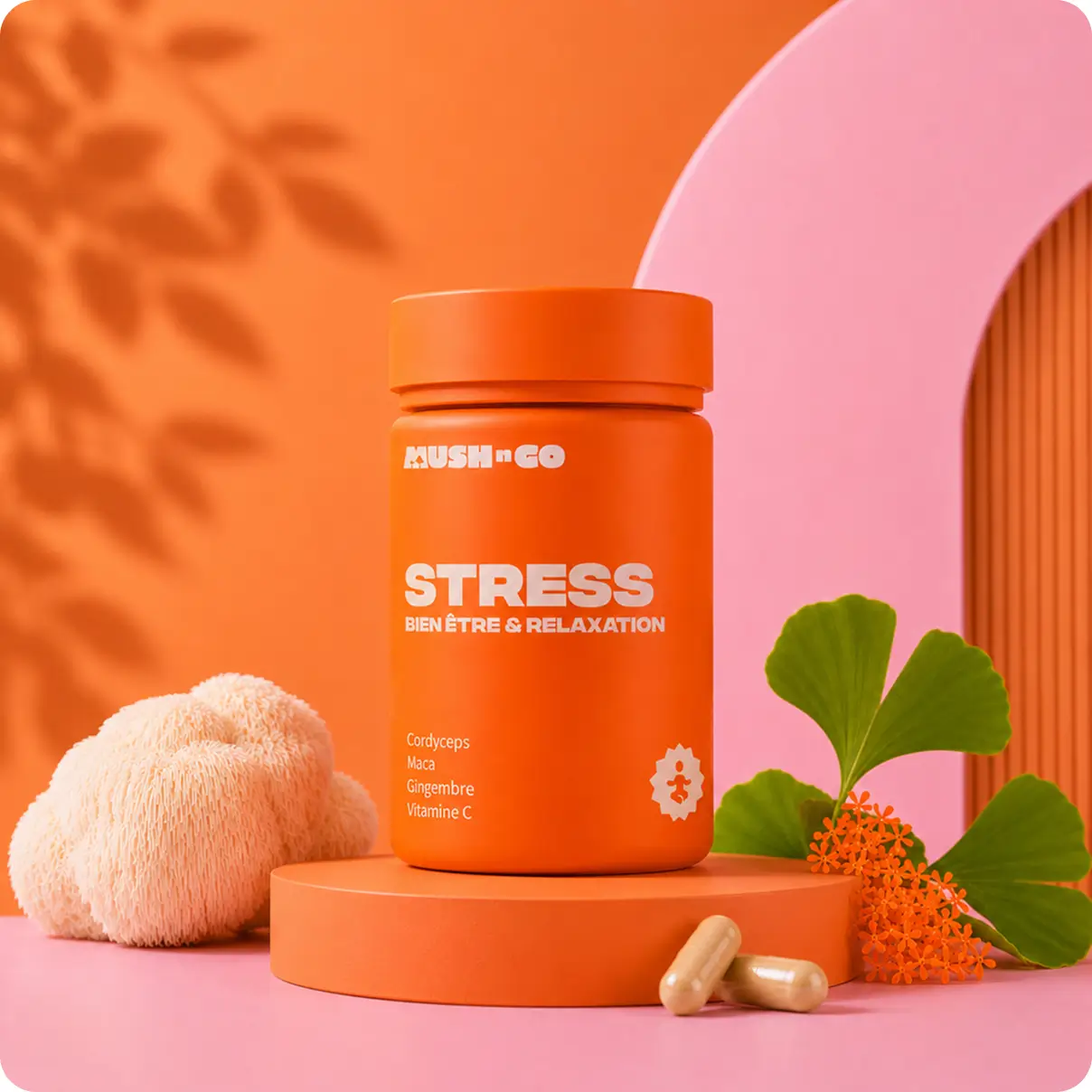
Anti-Stress - Mush N Go
LMC rating
- Two named branded collagens: Naticol® and Cartidyss®.
- 6 g of collagen per day, within the range used in studies.
- 80 mg of vitamin C per dose.
- The biggest discount in the comparison with LMC20: €0.80 per day.
- No stated tripeptide content.
- Peptides of around 2,000 Da, the standard size.
- “Sustainable fishing” claimed, with no named label.
- Returns only if the product is sealed and unopened.

Ashwagandha KSM-66 - AqeeLab
LMC rating
- The highest dose in the ranking: 10 g of collagen per day
- 80 mg of vitamin C from acerola
- Neutral taste, no additives or flavouring
- Peptides under 2,000 Da
- Also available in pharmacies
- Raw material not named by the brand
- No fishing label stated
- Tub lasts only 25 days
- No stated tripeptide content
Scientific references
Studies cited in this article
- Iwai K. et al. (2005). Identification of food-derived collagen peptides in human blood after oral ingestion of gelatin hydrolysates. Journal of Agricultural and Food Chemistry.
- Yazaki M. et al. (2017). Oral ingestion of collagen hydrolysate leads to the transportation of highly concentrated Gly-Pro-Hyp and its hydrolyzed form of Pro-Hyp into the bloodstream. Journal of Agricultural and Food Chemistry.
- Pu S.Y. et al. (2023). Effects of oral collagen for skin anti-aging: a systematic review and meta-analysis. Nutrients.
- Proksch E. et al. (2014). Oral supplementation of specific collagen peptides has beneficial effects on human skin physiology: a double-blind, placebo-controlled study. Skin Pharmacology and Physiology.
- Myung S.K. et al. (2025). Effects of collagen supplements on skin aging: a systematic review and meta-analysis of randomized controlled trials. The American Journal of Medicine.
- Yamamoto S. et al. (2016). Absorption and urinary excretion of peptides after collagen tripeptide ingestion in humans. Biological and Pharmaceutical Bulletin.
- Commission Regulation (EU) No 432/2012 of 16 May 2012 establishing a list of permitted health claims made on foods (vitamin C and collagen formation).
- Anses (2024). Avis relatif aux risques liés à la consommation de compléments alimentaires contenant de l’ashwagandha (Withania somnifera), saisine n° 2021-SA-0077.
Frequently asked questions
Only partly. A large part is broken down into amino acids, but human studies also find small collagen-derived peptides in the blood, such as Pro-Hyp and Gly-Pro-Hyp, one to two hours after intake.
Several placebo-controlled trials show effects on skin hydration and elasticity, but they are modest and often funded by manufacturers. No health claim is authorised for collagen in Europe: only vitamin C contributes to normal collagen formation.
Clinical trials usually last 8 to 12 weeks, with intake every day. Consistency is what counts, not the time of day.
Skin studies most often use between 2.5 and 10 g of collagen per day. Check the actual collagen dose on the label, not just the weight of powder: a capsule often provides only a fraction of it.
Tripeptide is the shortest form, and a human study measured more Gly-Pro-Hyp in the blood than with a conventional collagen. That is an absorption advantage, not yet proof of a superior effect. Both forms remain serious hydrolysed collagens if the dose is sufficient.
It is generally well tolerated. Mild digestive discomfort is occasionally reported. Avoid it if you are allergic to fish.
That is a question for your doctor or pharmacist. This article is not intended to replace medical advice.
Our recommendation
Novagen provides 5 g of Naticol® x3Peptide marine collagen per day, a quarter of it as Gly-Pro-Hyp tripeptides, with 120 mg of vitamin C. Made in France, Friend of the Sea certified.
