
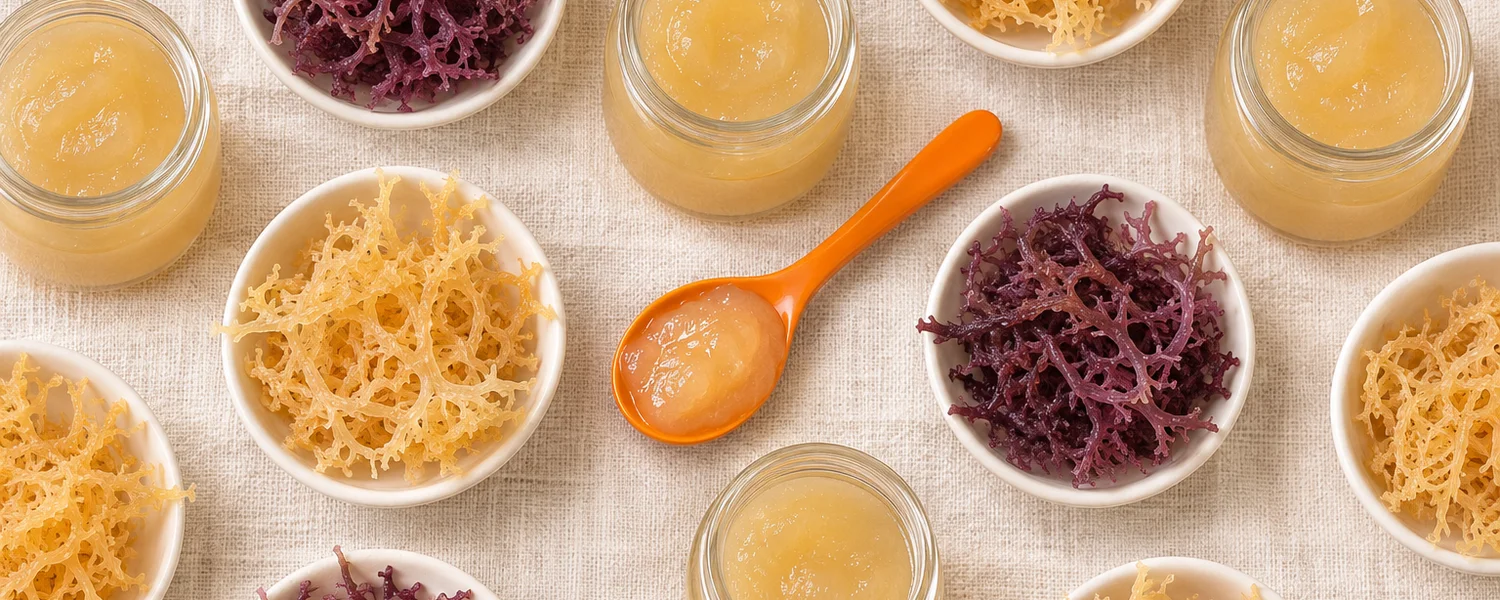
Smoothies, recipe videos, supplement aisles: sea moss is a red seaweed sold dried, as a gel or in capsules. It's credited with plenty of virtues. The reality is more modest: it's a food rich in gelling fibers and minerals, but there are virtually no human clinical trials on sea moss itself. Its main point of caution is well known and measurable: iodine.
- What it is: several red seaweeds sold under the same name, including Chondrus crispus (Irish moss) and tropical seaweeds such as Eucheuma.
- What's solid: its composition (fiber, carrageenans, minerals) and its long-standing food use as a thickener.
- What's missing: human trials on its health effects (Cherry 2019).
- The real risk: an iodine content that varies widely from one product to another and is rarely shown on the label (Aakre 2021).
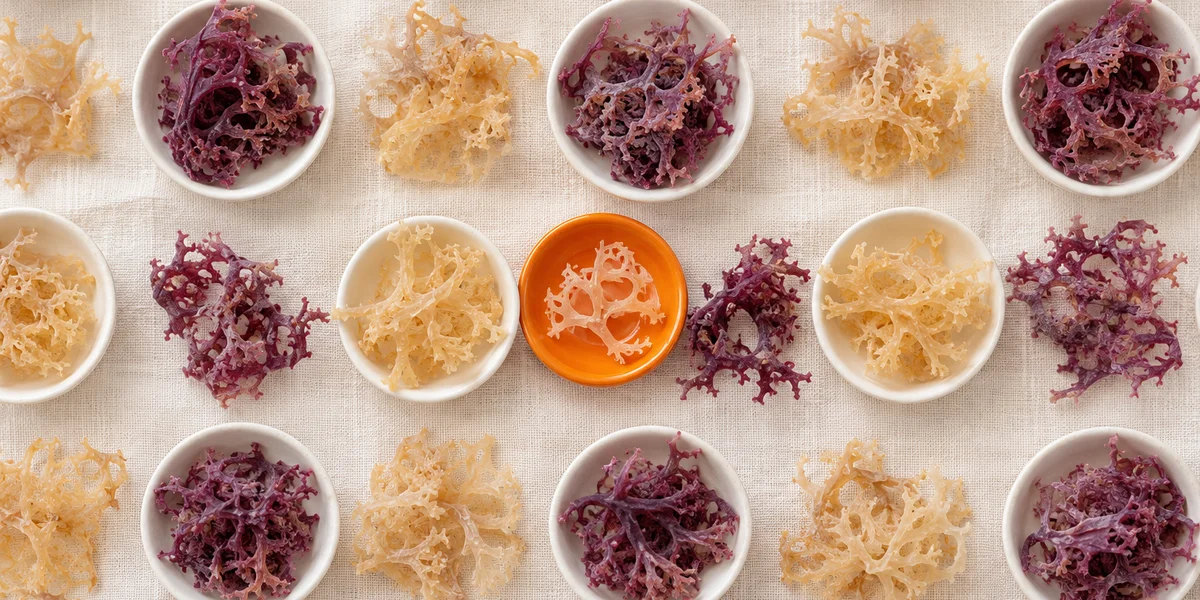


Sea moss, Irish moss, carrageen: which seaweed are we talking about?
"Sea moss" is a trade name, not a species name. It covers at least three families of red seaweed, which don't grow in the same places and don't have quite the same composition:
| Common name | Species | Origin |
|---|---|---|
| Irish moss, carrageen, carrageen moss | Chondrus crispus | Rocky North Atlantic coasts (Ireland, Brittany, Canada) |
| Golden sea moss, "Caribbean sea moss" | Eucheuma cottonii (also classified as Kappaphycus alvarezii) | Tropical waters (Caribbean, Indian Ocean, Southeast Asia) |
| "Purple" or fine-branched sea moss | Gracilaria spp. | Warm and temperate waters |
What these seaweeds have in common: they're rich in carrageenans (or, for Gracilaria, agar), fibers that form a gel on contact with water. That's what gives the gel its texture. Extracted carrageenans are the additive E407; processed Eucheuma seaweed corresponds to the additive E407a (EFSA 2018).
The color (golden, purple) depends on the species and how it's dried. What matters is that the label states the exact species and the origin, which determine iodine and contaminant levels.
Sea moss composition: fiber, minerals and highly variable iodine
Once rehydrated, sea moss is mostly water, fiber (carrageenans) and minerals. Among three European seaweeds compared, Chondrus crispus was the richest in calcium, iron, manganese and zinc, with amino acids and omega-3s (Čmiková 2024). These data refer to the dried seaweed: a spoonful of gel, which is mostly water, provides far less.
The often-quoted figure of "92 of the 102 minerals" doesn't come from any study we could identify, and says nothing about quantities.
Iodine: the number that changes everything
Seaweeds concentrate iodine from seawater, but in proportions that vary enormously depending on the species, location and season:
- Across 12 species of edible seaweed analyzed, Teas et al. (2004) measured from 16 µg of iodine per gram (nori) to more than 8,000 µg/g (kelp granules). Iodine, which is water-soluble, can also be lost during soaking or storage.
- For Irish moss, Darias-Rosales et al. (2020) found an average of 3.86 mg of iodine per kg of dried seaweed in their samples, a low value: 4 g per day posed no risk in their assessment.
- Across 96 seaweed-based products sold in Norway, Aakre et al. (2021) measured from 5 to 5,600 µg of iodine per daily dose for dietary supplements. For 54 products, a single serving exceeded the upper safety limit, and the species or iodine content was poorly indicated or missing on several labels.
To put these numbers in perspective: the reference value for labeling is 150 µg of iodine per day, and the upper safety limit set by EFSA is 600 µg per day for adults, as Anses (the French food safety agency) points out. In France, a dietary supplement can't provide more than 150 µg of iodine per day (Anses). The problem isn't iodine, which is essential, but the lack of information on the amount provided.
For sodium, potassium or magnesium (exercise, heat), a dosed product is more predictable than a seaweed: our comparison of the best electrolyte powders compares their contents.
Sea moss benefits: what studies really say
Thyroid, immunity, skin, digestion, energy: here's what we actually know.
- In humans, almost nothing on sea moss itself. We found no published controlled clinical trial testing a sea moss gel or capsules on a health outcome. A review on edible seaweeds from Ulster University concludes that more human intervention studies are needed to assess their benefits and justify claims (Cherry 2019).
- In the lab, some leads. Chondrus crispus extracts act on cultured cells (Čmiková 2024), which doesn't predict any effect in humans.
- Fiber, with what you'd expect from fiber. Carrageenans aren't absorbed intact by the gut (EFSA 2018): they behave like fiber. No trial has measured their effect on digestion with sea moss.
- A source of iodine, but an unpredictable one. Iodine contributes to normal thyroid function, that's established. But seaweeds whose content varies by a factor of several hundred depending on the species (Teas 2004) aren't a reliable way to correct a deficiency: Anses points out that eating seaweed is not an appropriate way to correct an iodine deficiency.
What Europe allows brands to say
No health claim is authorized for sea moss, Chondrus crispus or Eucheuma in Regulation (EU) No 432/2012, which lists authorized claims. Claims about iodine (for example "iodine contributes to normal thyroid function") are only permitted there for a product that is at least a source of iodine, which requires a declared and sufficient content. A product that doesn't display its iodine content therefore can't make use of them.
Sea moss dangers: iodine, heavy metals, carrageenans and interactions
In culinary amounts, sea moss isn't toxic. Its risks come down to four points.
1. Excess iodine and the thyroid
Excess iodine is generally well tolerated, but people with a thyroid condition, even a past one, can develop hypothyroidism or hyperthyroidism after a large intake, whether one-off or repeated (Leung 2012). Seaweeds are among the identified sources of excess. In 2018, Anses assessed this risk and judged exceeding safety limits to be "not negligible", especially when combining seaweed in your diet with seaweed-based supplements. Unless advised by a doctor, it recommends against foods and supplements containing seaweed for:
- people with a thyroid disorder, heart disease or kidney failure;
- people taking a medication containing iodine (such as amiodarone) or lithium;
- pregnant or breastfeeding women.
It also recommends caution for children, due to a lack of data (Anses opinion on iodine in seaweed). Think about the cumulative effect: iodized salt, fish, dairy, multivitamins and other seaweed supplements (bladderwrack, kelp) also provide iodine.
2. Heavy metals, arsenic and microbiological quality
Seaweeds also absorb undesirable elements from their environment. Researchers at Cornell University analyzed 66 sea moss products bought online in the United States (53 dried, 13 gels): arsenic, cobalt and mercury were detected in the dried seaweed, while in the gels arsenic and cobalt were below detection limits and mercury was present in trace amounts (Rejuso 2026). The gels also varied widely in pH (2.7 to 7.1) and microbial load, sometimes with Salmonella or Staphylococcus. Hence two rules: a traceable origin with tested batches, and strict cold storage.
3. Carrageenans and sensitive guts
EFSA re-evaluated carrageenans in 2018: no concern about genotoxicity or carcinogenicity at the doses tested in animals, but enough uncertainty to make the acceptable daily intake of 75 mg/kg of body weight "temporary", pending further data (EFSA 2018). In people with ulcerative colitis, the two small trials available disagree: earlier relapse in 3 patients receiving carrageenans versus none on placebo, out of 12 patients (Bhattacharyya 2017); no difference over 7 days in 7 patients (Laatikainen 2023). If you have inflammatory bowel disease, talk to your gastroenterologist. For everyone, the fiber can cause bloating at first.
4. Medications: anticoagulants and thyroid
You often read that sea moss "thins the blood". We found no human study documenting an interaction with anticoagulants: the data are lacking, either way. If you take an anticoagulant, a thyroid treatment (levothyroxine, antithyroid drug), lithium or amiodarone, ask your doctor or pharmacist before taking it regularly.
| Situation | Advice |
|---|---|
| Thyroid disorder, thyroid treatment | Not without medical advice (Anses) |
| Pregnancy, breastfeeding | Not without medical advice (Anses) |
| Heart disease, kidney failure | Not without medical advice (Anses) |
| Lithium, amiodarone or another iodine-containing medication | Not without medical advice (Anses) |
| Anticoagulant | Ask your doctor or pharmacist, as a precaution |
| Inflammatory bowel disease | Ask your gastroenterologist |
| Children | Caution, insufficient data |
Gel, capsules, dried seaweed or gummies: which form should you choose?
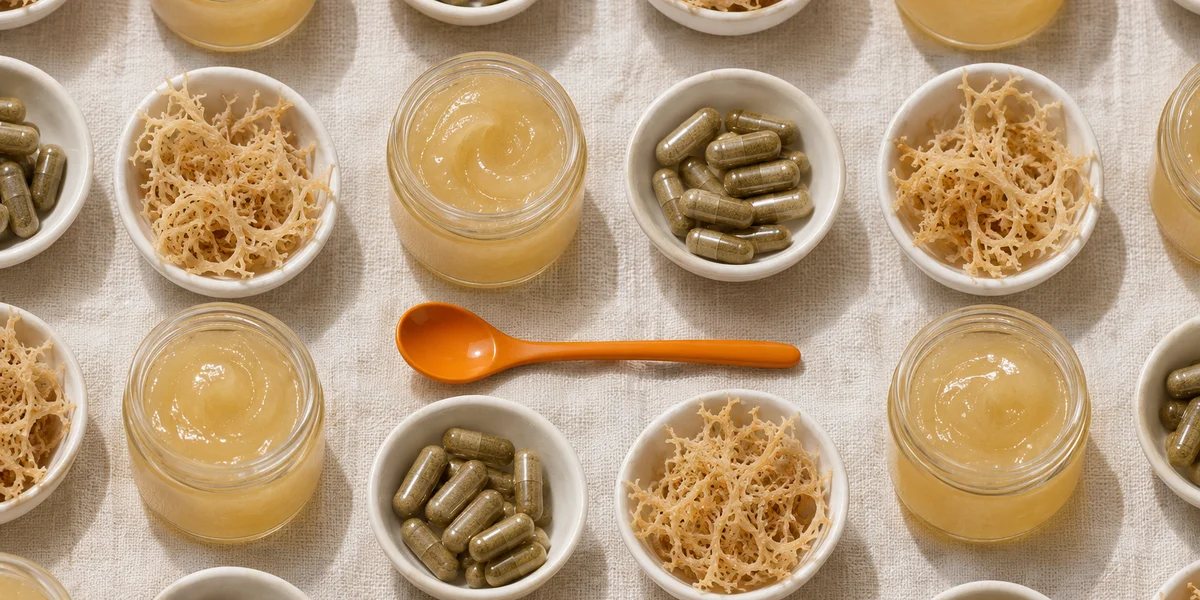
| Form | Advantages | Limitations |
|---|---|---|
| Sea moss gel | Ready to use; gels contained less arsenic than dried seaweed in the Cornell study (Rejuso 2026) | Fresh product: keeps in the fridge and for a few weeks after opening |
| Capsules | Fixed dose, tasteless, easy to carry | Small amount of seaweed per capsule; some combine other seaweeds richer in iodine, such as bladderwrack |
| Raw dried seaweed | The cheapest per serving, you make your own gel | Soaking, rinsing and blending; preparation hygiene is up to you |
| Gummies | Pleasant taste | Often added sugar, little sea moss per gummy; keep out of children's reach |
Criteria for choosing well
- The exact species (Chondrus crispus, Eucheuma, Gracilaria) rather than just the word "sea moss".
- The origin and how it's harvested (wild or farmed, country).
- Lab tests: heavy metals and microbiology. A serious manufacturer should be able to share them with you.
- The iodine content per serving: it's the most useful piece of information, and the one most often missing; Anses has in fact called for it (Anses). If it's not there, ask the seller.
- The ingredient list: short for a gel (seaweed, water, possibly an acidifier or fruit); check for other seaweeds in blends.
- Organic labeling: it says nothing about iodine or contaminants.
Sea moss at the pharmacy or online?
At the pharmacy, in an organic store or online, the criteria are the same. The pharmacy offers advice: your pharmacist can check for interactions with your medications. Online, favor a seller established in the European Union who answers your questions about lab tests.
How to take sea moss and store the gel
No study has established a dose of sea moss. Here are some cautious guidelines:
- Amount: follow the dose indicated by the manufacturer, usually 1 to 2 spoonfuls of gel a day or 2 capsules, without exceeding it.
- Go gradually: start with a teaspoon, then increase over one to two weeks.
- No stacking: one seaweed source at a time. Don't combine a sea moss gel with bladderwrack or kelp capsules, or with an iodine-rich multivitamin, without talking to a healthcare professional.
- How: by the spoonful, or in a smoothie, yogurt, oatmeal or soup.
- Take breaks: since there's no long-term data, opt for periods of use with breaks in between.
Storing the gel
The gel is a fresh, moist product, and therefore fragile, as shown by the variations in microbial load observed between products (Rejuso 2026). Keep it in the fridge after opening, always use a clean, dry spoon, close the jar tightly and respect the shelf life on the label. Sour smell, bubbles or mold: throw it out.
Making your own gel at home
Rinse the dried seaweed, soak it overnight in clean water, rinse again, then blend with fresh water. Pour into a clean jar, store in the fridge and use it quickly. Soaking and rinsing remove some of the iodine, which is water-soluble (Teas 2004), though there's no way to quantify how much remains.
Our recommendation: Sea Moss Gel Golden by The Seamoss Jungle
If you want to try sea moss in its simplest form, Sea Moss Gel Golden by The Seamoss Jungle, a Dutch brand based in The Hague that ships to France, ticks the most important boxes in this guide: a single, clearly named seaweed, a stated origin, a short ingredient list and announced lab tests. Here's what the brand states on its product page (checked on November 3, 2026).
| Point | What The Seamoss Jungle states |
|---|---|
| Ingredients | Wild sea moss (Eucheuma cottonii), water and a small amount of citric acid |
| Origin | Hand-harvested in the wild around Saint Lucia (Caribbean), and processed on site |
| Size | 500 ml glass jar |
| Dose recommended by the brand | 1 to 2 spoonfuls a day, plain or in a smoothie, tea, juice or soup; start with a smaller amount |
| Storage | Up to 3 months unopened; after opening, keep in the fridge and use within 3 to 4 weeks |
| Lab tests | Lab-tested for heavy metals and food safety, according to the brand |
| Brand precautions | Pregnancy, breastfeeding or a thyroid disorder: talk to a healthcare professional first |
| Retail price | €29.95 for the 500 ml jar; 3-month supply at €56.95 |
Why we chose it: species and origin are specified, which is still rare, and the composition is limited to the seaweed, water and an acidifier, with no added sugar. Flavored versions (mango, strawberry, pineapple, mango-pineapple) are available at the same price.
What you should know: as with almost every gel on the market, the iodine content per spoonful isn't stated. So no health claim applies to this product, and the precautions in the "dangers" section apply to it as to any seaweed-based product: stick to the recommended dose, without combining it with other seaweed supplements.
Prefer capsules? The Seamoss Jungle offers two products at €27.95 for 60 capsules (2 a day): sea moss-only capsules, and capsules combining sea moss, bladderwrack and burdock root. Bladderwrack is Fucus vesiculosus, a brown seaweed: brown seaweeds are among the richest in iodine according to Anses, and the product page specifies neither the amount of bladderwrack nor the iodine content. If you're watching your iodine intake, the sea moss-only version or the gel are easier to assess.
LMC promo code: 10% off with the code LMC (discount verified at checkout on November 3, 2026). Details on our The Seamoss Jungle promo code page. To go further: our The Seamoss Jungle review, the Sea Moss Gel product page and the brand page.
See Sea Moss Gel Golden by The Seamoss Jungle
Some links are affiliate links: LMC may earn a commission at no extra cost to you.
Frequently asked questions about sea moss
Is sea moss dangerous?
Not for a healthy adult who sticks to the recommended dose. The main risk is excess iodine (thyroid, pregnancy, combining seaweeds).
What are the proven benefits of sea moss?
No health benefit has been demonstrated by a clinical trial on sea moss itself, and no claim is authorized in Europe.
What's the difference between sea moss and Irish moss?
"Mousse de mer" is simply the French translation of sea moss. Irish moss refers specifically to Chondrus crispus, the North Atlantic seaweed. Sea moss sold as "Caribbean" is often Eucheuma or Gracilaria, other red seaweeds: check the species on the label.
How many spoonfuls of sea moss gel per day?
The manufacturer's dose, often 1 to 2 spoonfuls, starting lower, without exceeding it.
Can you take sea moss while pregnant?
Not without medical advice. Anses recommends against foods and supplements containing seaweed for pregnant or breastfeeding women, unless advised by a doctor, because of the risk of excess iodine.
Is sea moss sold in pharmacies?
You can find it in pharmacies, organic stores and above all online. Where you buy it matters less than the information on the label: species, origin, lab tests and iodine content.
Conclusion
Sea moss is neither a remedy nor a product to avoid. It's an edible seaweed rich in carrageenans and minerals, to which human studies have not yet attributed any proven health effect. Its real issue is iodine: useful in small amounts, something to watch if you have a fragile thyroid, are pregnant or combine it with other seaweeds. Choose a product whose species, origin and lab tests are stated, stick to the recommended dose, keep the gel cold, and ask your doctor or pharmacist for advice if you're in an at-risk situation. For a simple first try, Sea Moss Gel Golden by The Seamoss Jungle meets these criteria.
Scientific references
- Teas, J. et al. (2004). Variability of iodine content in common commercially available edible seaweeds. View on PubMed
- Darias-Rosales, J. et al. (2020). Risk assessment of iodine intake from the consumption of red seaweeds (Palmaria palmata and Chondrus crispus). View on PubMed
- Aakre, I. et al. (2021). Commercially available kelp and seaweed products - valuable iodine source or risk of excess intake? View on PubMed
- Leung, A. M. et al. (2012). Iodine-induced thyroid dysfunction. View on PubMed
- Cherry, P. et al. (2019). Risks and benefits of consuming edible seaweeds. View on PubMed
- Čmiková, N. et al. (2024). Seaweed Nutritional Value and Bioactive Properties: Insights from Ascophyllum nodosum, Palmaria palmata, and Chondrus crispus. View on PubMed
- Rejuso, A. et al. (2026). Microbial and Heavy Metal Analyses of Commercially Available Sea Moss and Sea Moss Products. View on PubMed
- EFSA Panel on Food Additives and Nutrient Sources added to Food (ANS) (2018). Re-evaluation of carrageenan (E 407) and processed Eucheuma seaweed (E 407a) as food additives. View on PubMed
- Bhattacharyya, S. et al. (2017). A randomized trial of the effects of the no-carrageenan diet on ulcerative colitis disease activity. View on PubMed
- Laatikainen, R. et al. (2023). Randomized controlled pilot study: effect of carrageenan emulsifier on inflammation and gastrointestinal symptoms in quiescent ulcerative colitis. View on PubMed
Official texts consulted: Anses (2018), seaweed consumption: stay alert to the risk of excess iodine intake; Regulation (EU) No 432/2012 (authorized health claims).

LMC content is written by our editorial team from the information published by the brands. Scores out of 10 follow a public grid of 5 criteria*, supplemented by LMC’s editorial assessment.
To support LMC, some links are affiliate links: LMC earns a commission at no extra cost to you, and some of the brands featured are partners. By using the site, you accept our terms of use and our editorial policy.