
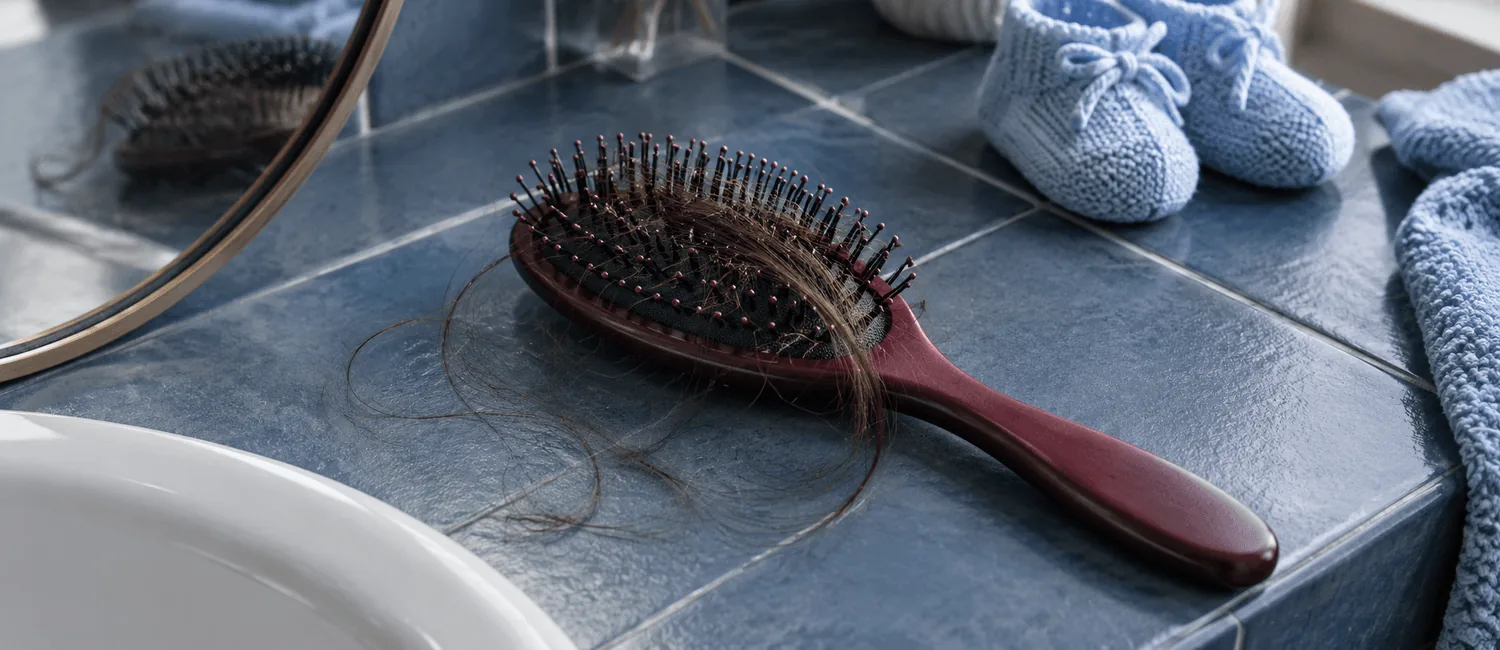
Why does hair fall out after giving birth?
To understand it, you need to go back to the life cycle of a hair. Each hair goes through three phases: a long growth phase, called anagen, which lasts several years; a short transition phase; and then a resting phase, called telogen, of about three months, at the end of which it falls out to make way for a new one. Normally, these cycles are staggered from one hair to the next, and you lose between 50 and 100 hairs a day without even noticing.
What pregnancy had changed
During pregnancy, high estrogen levels prolong the growth phase. Many hairs that should have fallen out stay put, hence the thicker, shinier hair that many women notice from the second trimester onward.
After giving birth, hormone levels drop sharply. The hairs that had been "held back" then all switch to the resting phase at the same time, and fall out together a few weeks later. This is what dermatologists call telogen effluvium: diffuse shedding across the whole scalp, with no patches or bald spots.
What science really knows
That's the classic explanation, the one you'll read everywhere, and it describes well what most new moms go through. Yet the objective data is thinner than you might think. In 2016, a review published in Skin Appendage Disorders found no statistically significant data showing that shedding differs between pregnant women and postpartum women, and its authors consider the phenomenon still poorly defined.
What nobody disputes, however, is what matters most to you: the shedding is temporary, and the hair cycle gets back on track by itself. Fatigue, stress, broken nights and possible deficiencies can add to it, and those are precisely the levers you can act on.
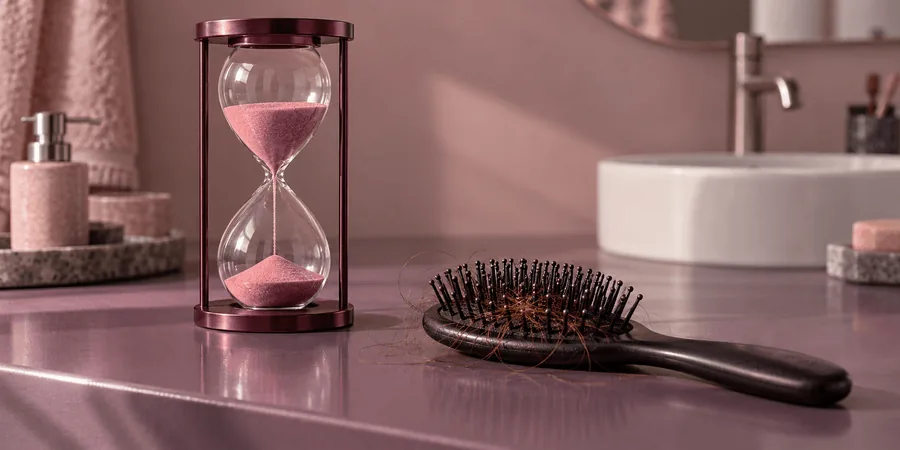
When does the shedding start and how long does it last?
The shedding doesn't start right after birth, which often comes as a surprise. It most often begins between two and four months after delivery, the time it takes for the hairs that entered the resting phase to reach the end of their three months. It then lasts six to twenty-four weeks depending on the woman, with a fairly clear peak in the middle.
| Period | What's happening | What you notice |
|---|---|---|
| During pregnancy | Growth phase prolonged by estrogen | Thicker hair, little shedding |
| From birth to 2 months | Hormone drop, hairs enter the resting phase | Nothing visible yet |
| From 2 to 4 months | Resting hairs start to fall out | Shedding begins, often suddenly |
| From 4 to 6 months | Peak shedding | Clumps in the brush, more visible thinning at the temples |
| From 6 to 12 months | The cycle resynchronizes | Short regrowth hairs along the forehead and temples |
| After 12 months | Cycle back to normal | Density close to pre-pregnancy levels |
So the shedding isn't a permanent loss: these are hairs that would have fallen out during pregnancy and are falling out a few months late. The volume lost can seem huge, yet it's the same stock of hair renewing itself. 🌱

When should you worry about hair loss after giving birth?
In the vast majority of cases, postpartum shedding requires nothing more than patience. Some signs should nevertheless prompt you to see your doctor or a dermatologist.
- The shedding lasts more than six months, or shows no sign of slowing down after a year.
- It happens in patches, with clearly bald areas, rather than diffusely across the whole scalp.
- Your scalp itches, turns red or becomes flaky.
- Other signs come with it: crushing fatigue, palpitations, feeling cold or, on the contrary, hot flashes, unexplained weight gain or loss.
- Your part gradually widens on the top of your head, which may reveal another form of hair loss that pregnancy simply unmasked.
Two causes are especially worth ruling out. The first is postpartum thyroiditis, an inflammation of the thyroid that can occur in the year after giving birth and is detected with a simple blood test. The second is iron deficiency: blood loss during delivery often depletes your stores. A 2022 meta-analysis of 10,029 women showed that those who lose their hair have, on average, significantly lower ferritin than others. Asking for a ferritin test is therefore a simple, useful step.
How long does it take for hair to grow back?
Hair grows about one centimeter (just under half an inch) per month. That figure explains why regrowth seems so slow: the new hairs that appear around the sixth month are only a few centimeters long a year after giving birth.
You'll spot them first along your hairline and at your temples, as short, unruly little hairs that stick straight up. They're the best proof that the cycle has restarted. It generally takes between one year and eighteen months to get back to a length and density comparable to before your pregnancy.
These baby hairs are often the hardest part to style. A little light wax, a headband or a shifted part is usually enough to tame them until they reach the length of the rest of your hair.
Does breastfeeding make your hair fall out?
No. It's a stubborn myth, but hair loss after giving birth is linked to the hormone drop at the end of pregnancy, not to breastfeeding. Women who breastfeed and those who don't experience it the same way.
Breastfeeding can, however, have an indirect effect, because it increases your need for certain nutrients and often comes with very short nights. If you're breastfeeding, the main thing is to check that your intake keeps up, and to choose supplements that are compatible with breastfeeding, which isn't the case for every anti-hair-loss product.
How can diet help after giving birth?
Hair is a non-priority tissue: when your body is short on something, it serves the vital organs first. A diet that's sufficient in both quantity and quality is therefore the first condition for good regrowth. The nutrients to watch first:
- Protein, since hair is made up of more than 90% keratin. Eggs, fish, legumes and dairy at every meal.
- Iron, which contributes to the reduction of tiredness and to normal red blood cell formation. Red meat, blood sausage, lentils, paired with a source of vitamin C for better absorption.
- Zinc and selenium, which both contribute to the maintenance of normal hair according to authorized health claims. Seafood, meat, nuts and seeds, and Brazil nuts for selenium.
- Biotin, which also contributes to the maintenance of normal hair. Egg yolk, yeast, legumes.
- Vitamin D, a common deficiency in France and one that's easy to check with a blood test.
In practice, a day that checks all these boxes can look like this, with nothing complicated:
- For breakfast, two eggs or a Greek yogurt, a slice of whole-grain bread and a fruit rich in vitamin C such as a kiwi or an orange.
- For lunch, a plate of lentils or chickpeas with green vegetables, or a piece of red meat once or twice a week.
- As a snack, a handful of almonds and two Brazil nuts, which are enough to cover your selenium needs.
- For dinner, an oily fish such as salmon or sardines, which also provides vitamin D and omega-3s.
A word of honesty about biotin: a review published in 2017 went through the published cases of supplementation, and improvement was only observed in people who had a deficiency or an underlying condition. Biotin supports the maintenance of normal hair; it doesn't make hair grow faster in someone who isn't lacking it.
Are supplements and popular remedies worth it?
It's the question everyone asks in the supplement aisle, and the answers aren't all equal.
- Brewer's yeast is the most frequently cited remedy. It provides B vitamins, but no health claim links it to hair as such, and its nutrients are present in variable amounts. It's an interesting food, not a treatment.
- Keratin is the protein hair is made of. It has no authorized claim, but some hydrolyzed, patented forms have been studied, and it remains compatible with pregnancy and breastfeeding in the formulas that state so.
- Collagen is often associated with hair. It doesn't carry an authorized claim either; it's vitamin C that contributes to normal collagen formation.
- Horsetail and bamboo, very common in anti-hair-loss supplements, are generally not recommended during pregnancy and breastfeeding. Always read the ingredient list before buying.
- Minoxidil is a medication, not a supplement. Discuss it with a doctor or dermatologist, especially if you're breastfeeding.
How do you read a supplement label when you're breastfeeding?
Three checks are enough to avoid unpleasant surprises. First, the compatibility statement: a reputable manufacturer clearly states whether its product is suitable during pregnancy and breastfeeding, and if there's no statement, it's better to skip it. Next, the list of herbs: horsetail, bamboo or concentrated extracts of plants that have been little studied during breastfeeding have no place in a postpartum formula without medical advice. Finally, the doses: a supplement listing several times the reference intake for biotin or zinc is no more effective, and high-dose biotin can even skew some blood tests, including thyroid tests. If you take it and have a thyroid panel scheduled, tell the lab before your blood draw.
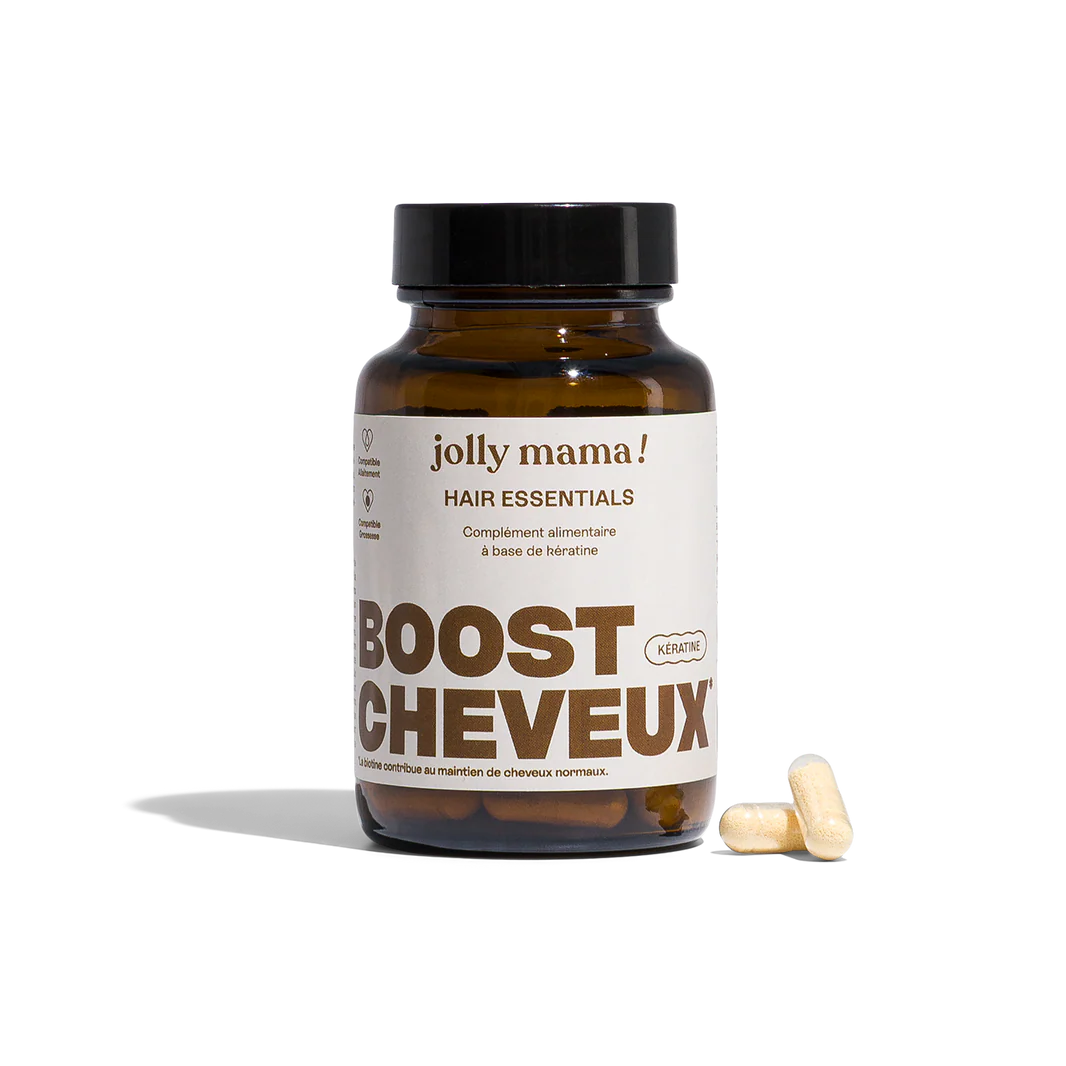
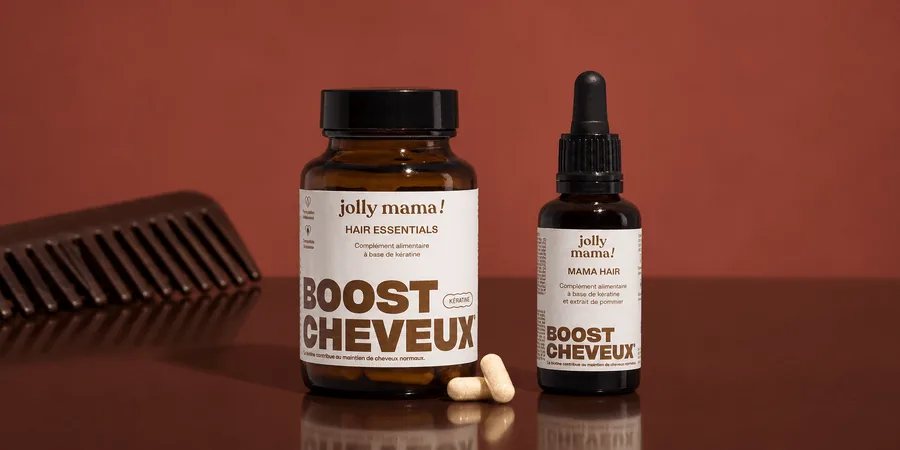
At Jolly Mama, the same formula comes in two formats, both compatible with pregnancy and breastfeeding. They combine 500 mg of patented Cynatine HNS keratin with 25 µg of biotin, or 50% of the reference intake. The liquid format adds 400 mg of Annurca apple extract, a variety grown in Italy.
Hair essentials | Mama hair | |
|---|---|---|
| Format | Capsules, 2 per day | Liquid, 34 drops per day |
| Cynatine HNS keratin | 500 mg | 500 mg |
| Biotin | 25 µg, 50% of RI | 25 µg, 50% of RI |
| Annurca apple extract | None | 400 mg |
| Pregnancy and breastfeeding | Compatible | Compatible |
| Price for 30 days | €35 | €55.20 |
The capsule format is therefore much cheaper per month, while the liquid format stands out for its extra active ingredient and is easier to take if you have trouble swallowing capsules. In both cases, the keratin comes from sheep's wool: the formulas are not vegan.
The whole range is gathered in Jolly Mama's hair supplement collection, and the brand presents the liquid formula as a postpartum hair treatment. The code LMC15 gives you 15% off. To compare these formulas with those of other brands, our comparison of supplements for postpartum hair loss reviews them one by one.

How should you care for your hair during this period?
Nothing you do will stop hormonal shedding, but some habits avoid damaging weakened hair and breaking the hairs that are growing back.
- Detangle gently, on damp hair, with a wide-tooth comb, starting from the ends.
- Avoid tight hairstyles, ponytails and pulled-back buns, which put tension on the roots.
- Limit flat irons, curling irons and overly hot blow-dryers.
- Choose a gentle shampoo and don't pile on harsh treatments or hair coloring during peak shedding.
- A shorter or layered cut can restore visual volume while regrowth catches up. 💇♀️
Your questions about postpartum hair loss
When does hair loss stop after giving birth?
It generally slows down between the sixth and twelfth month after birth. If it continues beyond a year, or remains heavy after six months, seeing a doctor can rule out iron deficiency or a thyroid disorder.
How can you help postpartum hair loss?
By first checking your stores, starting with ferritin and vitamin D, eating enough protein, and treating your hair gently every day. A breastfeeding-compatible supplement can support your intake, with no promise of faster regrowth.
How do I know if my hair loss is hormonal?
Postpartum hormonal shedding is diffuse, across the whole scalp, starts two to four months after giving birth and slows down on its own. Patchy hair loss, an irritated scalp or shedding that lasts more than a year point to another cause, which should be checked out.
When does the hormone drop happen after giving birth?
In the hours and days after birth, with the delivery of the placenta. But its effects on your hair only show two to four months later, the time it takes for the hairs that entered the resting phase to reach the end of their cycle.
Should you cut your hair when it's falling out?
Cutting doesn't slow the shedding, which happens at the root. However, a shorter cut lightens your hair, limits breakage and makes the difference in density less visible during regrowth. It's an aesthetic choice, not a treatment.
Key takeaways
Hair loss after giving birth is common, dramatic and temporary. It starts two to four months after birth, peaks a few weeks later and settles down within the year. Checking your ferritin and thyroid, eating enough protein and treating your hair gently are the steps that really count. The rest is mostly patience, and a few months of unruly baby hairs along your forehead. 🤍
Dietary supplements should not replace a varied, balanced diet and a healthy lifestyle. This article is for informational purposes and does not constitute medical advice: if your hair loss is heavy or prolonged, see your doctor or a dermatologist.
Scientific references
- Mirallas O, Grimalt R. The Postpartum Telogen Effluvium Fallacy. Skin Appendage Disorders, 2016: pubmed.ncbi.nlm.nih.gov
- Treister-Goltzman Y, Yarza S, Peleg R. Iron Deficiency and Nonscarring Alopecia in Women: Systematic Review and Meta-Analysis. Skin Appendage Disorders, 2022: pubmed.ncbi.nlm.nih.gov
- Patel DP, Swink SM, Castelo-Soccio L. A Review of the Use of Biotin for Hair Loss. Skin Appendage Disorders, 2017: pubmed.ncbi.nlm.nih.gov
- The Role of Vitamins and Minerals in Hair Loss: A Review. Dermatology and Therapy, 2019: pubmed.ncbi.nlm.nih.gov
- The diagnosis and treatment of iron deficiency and its potential relationship to hair loss. Journal of the American Academy of Dermatology, 2006: pubmed.ncbi.nlm.nih.gov
- Postpartum Thyroiditis. Clinical Obstetrics and Gynecology, 2019: pubmed.ncbi.nlm.nih.gov
- Interferences With Thyroid Function Immunoassays: Clinical Implications and Detection Algorithm. Endocrine Reviews, 2018: pubmed.ncbi.nlm.nih.gov
- ANSES, Nutritional references for vitamins and minerals: anses.fr
- Regulation (EU) No 432/2012 establishing a list of permitted health claims made on foods: eur-lex.europa.eu
- DGCCRF, Dietary supplements: what you need to know, economie.gouv.fr, updated July 15, 2025: economie.gouv.fr

LMC content is written by our editorial team from the information published by the brands. Scores out of 10 follow a public grid of 5 criteria*, supplemented by LMC’s editorial assessment.
To support LMC, some links are affiliate links: LMC earns a commission at no extra cost to you, and some of the brands featured are partners. By using the site, you accept our terms of use and our editorial policy.