
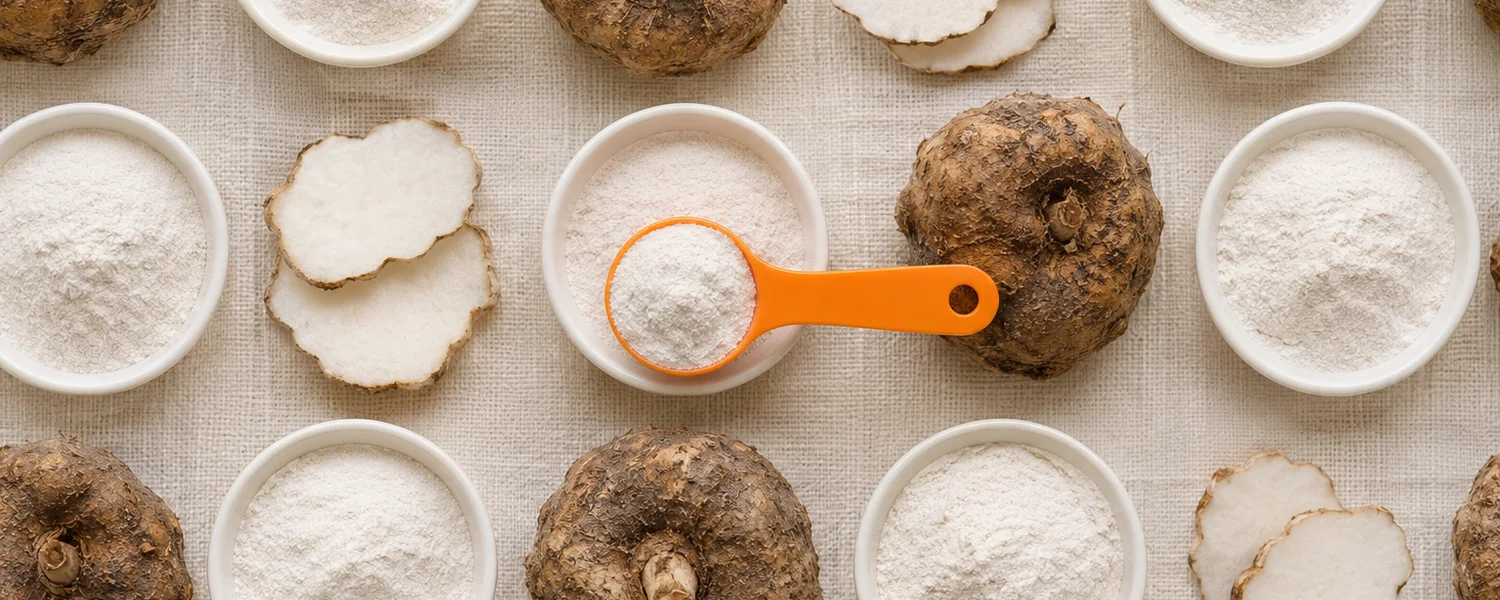
Shirataki noodles in the grocery aisle, capsules and powders in the weight-loss aisle: konjac is everywhere. Behind the name is a fiber, glucomannan, which can absorb large amounts of water. That's what earned it its reputation as a "natural appetite suppressant", but also its rare accidents.
The short answer: glucomannan has two authorized health claims in Europe, one on weight loss (as part of a calorie-restricted diet), the other on cholesterol, at specific doses. Studies show a real but modest effect on weight. Its main danger is mechanical: a fiber that swells before it reaches the stomach. So everything comes down to how you take it.
- What's proven: a drop in LDL cholesterol of about 10% with 3 g per day (Ho 2017) and more regular bowel movements.
- What's debated: the effect on weight, small or not significant depending on the meta-analysis.
- The key habit: always with plenty of water, never if you have trouble swallowing.
- Keep apart from: medications, whose absorption may be affected.


What is konjac? From the plant to glucomannan
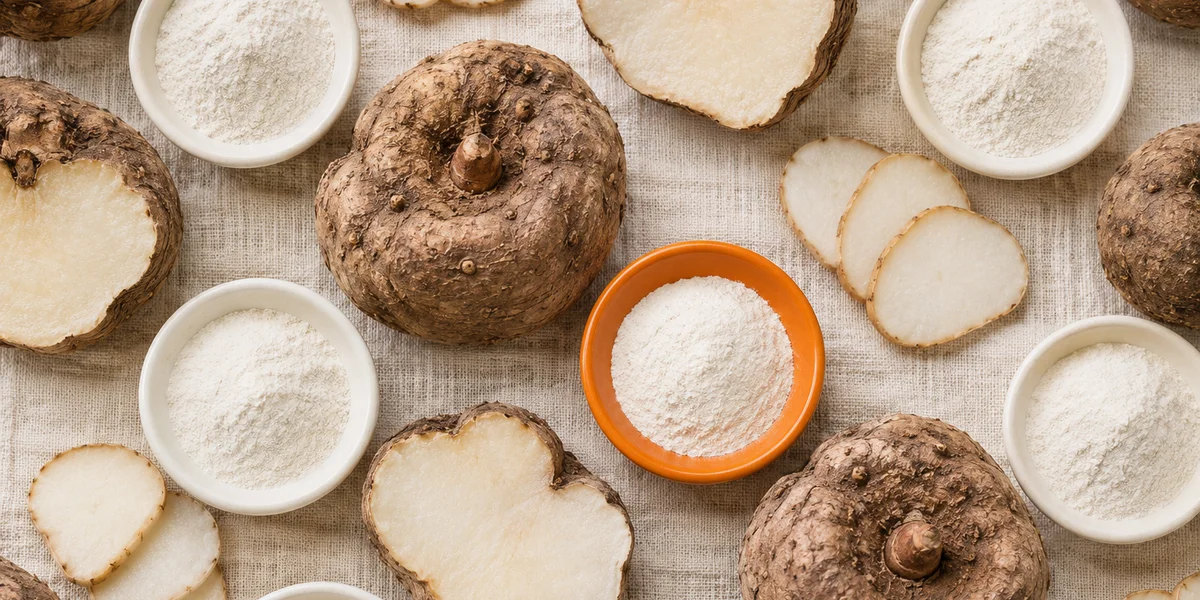
Konjac (Amorphophallus konjac) is an Asian plant whose tuber, a large, brown, knobby root, is eaten. Dried and then ground, this tuber yields a flour that's very rich in glucomannan, a soluble fiber. In Japan, it has been used for centuries to make konnyaku, a firm paste, and shirataki noodles.
What makes it special is physical. Glucomannan holds an enormous amount of water and forms very viscous solutions; it quickly swells to several times its original volume, as Vanderbeek et al. (2007) point out. In the stomach, this gel takes up space: that's the explanation put forward for the feeling of fullness.
Konjac comes in three main forms:
- food: shirataki noodles, konjac rice or pasta, very low in calories because they're mostly water;
- powder: pure glucomannan or mixed with other fibers, to be dissolved in water;
- capsules: a fixed dose of glucomannan per capsule.
It's also used as a thickening food additive, under the code E425.
Konjac benefits: what studies show
Glucomannan is one of the best-studied fibers. Here's what the abstracts of the trials and meta-analyses we read say, topic by topic.
Konjac and weight loss: a modest effect
It's the most widespread promise, and the most debated.
- An encouraging first trial: Walsh et al. (1984) gave 1 g of glucomannan (or a placebo) with a large glass of water, one hour before each of three meals, to 20 people with obesity for 8 weeks, without changing their diet. The glucomannan group lost an average of about 2.5 kg (5.5 pounds). The sample size is still very small.
- A favorable but limited meta-analysis: Sood et al. (2008) pooled 14 studies (531 participants) and observed an average weight reduction of 0.79 kg compared with control groups.
- A more recent, negative trial: Keithley et al. (2013) followed 53 overweight adults for 8 weeks, with 1.33 g of glucomannan and a glass of water one hour before each meal. No difference from placebo, either in weight or in perceived hunger and fullness. The product was well tolerated.
- An inconclusive meta-analysis: Onakpoya et al. (2014) included 9 trials; in 8 of them, the weight difference from placebo (-0.22 kg) was not statistically significant.
- A corrected review: Zalewski et al. (2015) concluded there might be a short-term effect in adults, but not on BMI. After a correction of data errors published by the authors the same year, the two-week effect was no longer significant.
In practice, konjac can support a calorie-restricted diet, it doesn't replace one. That's exactly what the claim authorized by the European Union says (see below).
Fullness: mostly a volume effect
The study by Au-Yeung et al. (2018) sheds useful light on its use as food. In 16 healthy adults, replacing a pasta dish with the same amount of konjac noodles reduced cumulative calorie intake by 47% (about 421 fewer kcal), without participants eating more at the dessert that followed. However, they reported feeling hungrier than with the pasta (+31%). So konjac mainly helps cut a meal's calories at the same volume, more than it "curbs hunger".
Cholesterol: the best-established effect
Ho et al. (2017) analyzed 12 trials (370 participants). Glucomannan lowered LDL cholesterol by 0.35 mmol/L and non-HDL cholesterol by 0.32 mmol/L on average. The authors estimate that about 3 g per day can lower LDL by 10% and non-HDL by 7%. Sood et al. (2008) also found a reduction in total cholesterol, LDL, triglycerides and fasting blood sugar, with no effect on HDL or blood pressure. A supplement doesn't replace prescribed treatment: if you have high cholesterol, talk to your doctor.
Digestion: an effect on regularity
In 8 healthy adults on a low-fiber diet, Chen et al. (2006) observed that with 4.5 g of glucomannan per day (1.5 g per meal) for 21 days, stool frequency increased by about 27% and stool weight by about 30%, with more lactobacilli and bifidobacteria in the stool. The study is small, but it points to a classic fiber effect.
| Desired effect | What studies show | Level of evidence |
|---|---|---|
| Weight loss | From 0 to -0.8 kg on average depending on the meta-analysis (Sood 2008, Onakpoya 2014) | Low to moderate, contradictory results |
| Fullness | Fewer calories at the same volume with noodles, but no less perceived hunger (Au-Yeung 2018, Keithley 2013) | Low, small trials |
| LDL cholesterol | About -10% with 3 g per day (Ho 2017) | Moderate, 12 trials |
| Digestion | More frequent and bulkier stools (Chen 2006) | Low, 8 participants |
What Europe allows brands to say
Regulation (EU) No 432/2012 authorizes two claims for glucomannan, each with its own conditions:
- "Glucomannan in the context of an energy-restricted diet contributes to weight loss." The product must contain 1 g of glucomannan per serving, and the effect is obtained with 3 g per day, in three doses of 1 g, taken with 1 to 2 glasses of water, before meals, as part of a calorie-restricted diet.
- "Glucomannan contributes to the maintenance of normal blood cholesterol levels." The effect is obtained with 4 g of glucomannan per day.
In both cases, the label must carry a warning about the risk of choking for people with swallowing difficulties or when taken with too little fluid, and advise taking it with plenty of water (Regulation (EU) No 432/2012).
Konjac dangers: side effects and contraindications
Konjac isn't a toxic product. Its risks almost all come from its ability to swell and from the fact that it's a fiber.
The risk of choking and obstruction
This is the most serious danger, and the reason for the mandatory warning. If the powder or capsule swells before reaching the stomach, it can block the throat or esophagus. Vanderbeek et al. (2007) report the case of a 37-year-old woman who suffered an esophageal obstruction after taking a glucomannan weight-loss product; a membrane narrowing her esophagus was discovered afterward. The authors highlight the risk for people with a history of upper digestive disorders.
Konjac jelly confectionery, for its part, has been banned in the European Union since Directive 2003/52/EC: mini-cup jellies had caused several children and elderly people to die from choking in non-EU countries (Directive 2003/52/EC). This risk comes from the product's form, a mouthful of firm gel sucked in all at once. It doesn't apply to noodles, or to powders and capsules taken correctly, but it's a reminder that konjac must always be swallowed with enough liquid.
Digestive issues
Bloating, gas, abdominal pain, diarrhea or, conversely, constipation: these are the side effects reported in trials (Onakpoya 2014). They're generally temporary. To limit them, increase the dose gradually over one to two weeks and drink enough throughout the day.
Medications
Like all viscous fibers, glucomannan can alter the absorption of other medications. Take your medications at a different time from konjac, and ask your pharmacist about the right interval for each of them (birth control pill, thyroid treatment, diabetes medications, etc.). If you're being treated for diabetes, your blood sugar may drop slightly (Sood 2008): monitor it and talk to your doctor.
Who should avoid konjac?
| Situation | Why | What to do |
|---|---|---|
| Trouble swallowing, narrowing of the esophagus | Risk of obstruction | Avoid as a supplement |
| History of bowel obstruction, stomach surgery (sleeve, bypass) | A fiber that swells in a fragile digestive tract | Medical advice; in practice, avoid |
| Children | Risk of choking, different needs | No supplement without medical advice |
| Pregnancy and breastfeeding | Little data | Medical advice before taking it |
| Long-term medication, treated diabetes | Medication absorption, blood sugar | Space out doses, ask your pharmacist or doctor |
| Eating disorders | An appetite suppressant isn't an appropriate answer | Talk to a healthcare professional |
How to take konjac for fullness
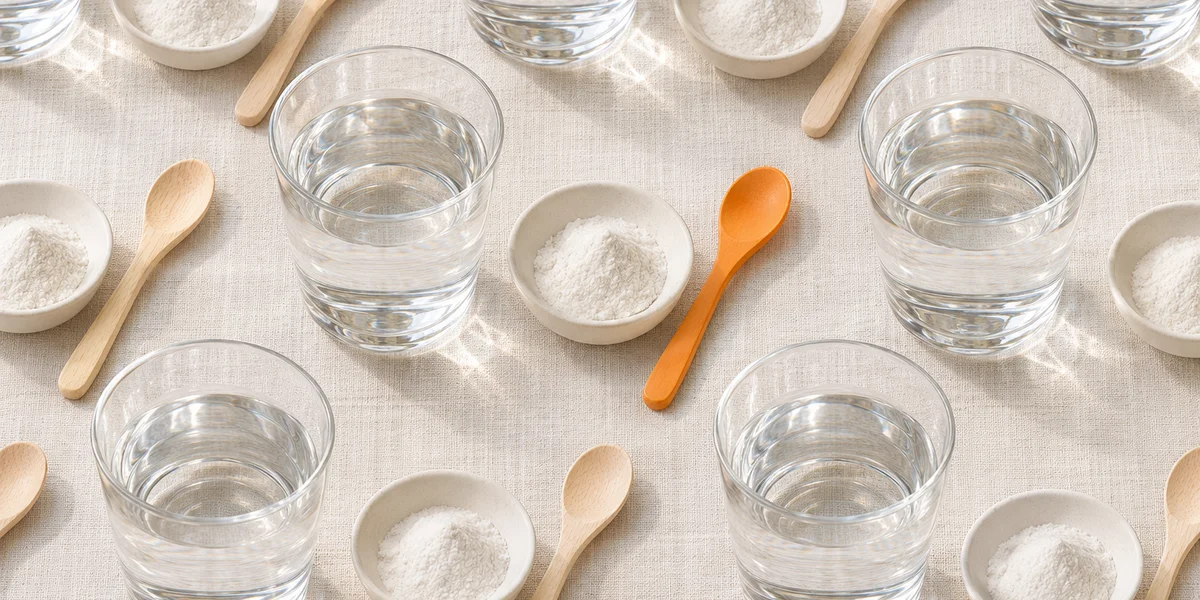
Taken properly, konjac is easy to use. The trials that measured an effect on weight gave glucomannan before meals, with a large glass of water (Walsh 1984). Here are the guidelines to follow:
- Dose: 1 g of glucomannan before each of three meals, i.e. 3 g per day, which is the dose of the European weight claim. For cholesterol, the claim specifies 4 g per day.
- Timing: 15 minutes to one hour before the meal, so the gel forms in your stomach when you eat.
- Water: 1 to 2 large glasses of water with each dose. A powder should be drunk as soon as it's mixed, before it thickens.
- Position: standing or sitting, never right before lying down.
- Go gradually: start with one dose a day, then increase.
- Duration: trials most often last 4 to 8 weeks, combined with an appropriate diet.
Always check the amount of glucomannan per dose on the label: that's what counts, not the weight of the powder or capsule. If you're mainly looking for an appetite suppressant and are hesitating between several ingredients (fibers, plants, gums), our guide pharmacy appetite suppressants: which ones really work compares the product families.
Powder, capsules or shirataki noodles: which form should you choose?

All three forms provide the same fiber, but not in the same amounts or for the same use.
| Form | Advantages | Limitations | Who is it for? |
|---|---|---|---|
| Shirataki noodles, konjac rice | Replace pasta or rice with very few calories; fewer calories at the same volume (Au-Yeung 2018) | Unusual texture, few nutrients; glucomannan dose rarely stated | Lightening a meal without shrinking the portion |
| Capsules | Fixed dose, tasteless, easy to carry | Often 2 to 3 capsules per dose; swallow with plenty of water | Following the claim's dosage precisely |
| Powder | Drunk like a beverage, often flavored; may combine other fibers | Drink right away, before it thickens; glucomannan content varies between products | People who don't like capsules, or who want an occasional dose before a meal or when a snack craving hits |
For a powder as for capsules, look at the composition: glucomannan alone, or a blend of fibers? How much glucomannan per dose? Are there stimulants (caffeine, guarana)? If you're comparing several approaches to support weight loss, our comparison of the best fat burners reviews other products.
Our recommendation: Magic Powder by Wandernana
If you'd rather take konjac as a drink than in capsules, Magic Powder by Wandernana is a powder presented as an "appetite moderator", to be mixed into a glass of water. Here's what the brand states on its product page (checked on November 3, 2026).
| Point | What Wandernana states |
|---|---|
| Form | Flavored powder, in a 300 g jar (also available in sticks) |
| Active ingredients | Three fibers: konjac, psyllium and cactus |
| Flavors | Red berries, exotic fruits, lemon mint |
| Nutrition facts | Per 20 g serving: 11.62 kcal, 5.20 g of total fiber, 1.29 g of carbohydrates |
| Directions | One tablespoon in a glass of water or another drink, to drink immediately, 15 minutes before a meal or when a snack craving hits; drink a glass of water after each dose |
| Brand precautions | Not recommended for pregnant or breastfeeding women or for people who have had a sleeve or stomach reduction; drink plenty of water; keep out of children's reach |
| Price | €32.90 per jar; €59.20 for 2 jars; €78.90 for 3 jars |
Strengths: taken as a drink, which is more pleasant for those who don't like swallowing capsules, directions that emphasize water, and few calories per serving. Psyllium and cactus are also fibers that swell in water.
What you should know: the brand doesn't specify the glucomannan content or the amount of each active ingredient. So the European weight claim, which requires 3 g of glucomannan per day in three 1 g doses, can't be applied to this product. Psyllium and cactus don't have any authorized weight claim either. See it as an extra fiber drink before a meal, to be combined with an appropriate diet, and stick to the indicated dose.
LMC promo code: ELIAS3948 for 10% off (€32.90 → €29.61 per jar when we checked on November 3, 2026). Terms on our Wandernana promo code page, and our full Wandernana review to go further.
See Magic Powder by Wandernana
Some links may be affiliate links: LMC may earn a commission at no extra cost to you.
Frequently asked questions about konjac
Is konjac bad for your health?
No, for most adults, as long as you take it with plenty of water and at the indicated dose. The real risk is mechanical: a fiber that swells before reaching the stomach can block the throat or esophagus. Avoid it if you have trouble swallowing or have had stomach surgery, and space it out from your medications.
Does konjac really help you lose weight?
Its effect is modest. Meta-analyses find an average difference of 0 to 0.8 kg compared with placebo (Sood 2008, Onakpoya 2014). The authorized claim specifies that it contributes to weight loss as part of a calorie-restricted diet, at 3 g per day.
What are the side effects of konjac?
Mostly temporary digestive issues: bloating, gas, abdominal pain, diarrhea or constipation (Onakpoya 2014). Increasing the dose gradually and drinking enough helps limit them.
When should you take konjac capsules or powder?
Before meals, 15 minutes to one hour beforehand, with 1 to 2 large glasses of water. A powder should be drunk as soon as it's mixed.
Can you eat konjac noodles every day?
Yes, they're common foods in Asia. They provide very few nutrients: keep your plate varied, with protein and vegetables. If your digestion is sensitive, introduce them gradually.
What's our verdict on konjac?
It's a serious fiber, with authorized claims and a documented effect on cholesterol. For weight, it's a helper to cut calories or hold off until a meal, not a solution on its own.
Conclusion
Konjac is neither a miracle product nor a hidden danger. Its glucomannan is a well-studied fiber: a clear effect on LDL cholesterol, a useful effect on digestion, a modest and debated effect on weight. Its main risk, choking or obstruction, is prevented with a simple habit: plenty of water with every dose, and no konjac if you have trouble swallowing. Choose the form that suits you (noodles to lighten a meal, capsules for a precise dose, powder for a drink before a meal), check the glucomannan content and space out your medications. If you're on medication, pregnant or have a digestive condition, ask your doctor or pharmacist for advice.
Scientific references
- Walsh, D. et al. (1984). Effect of glucomannan on obese patients: a clinical study. View on PubMed
- Sood, N. et al. (2008). Effect of glucomannan on plasma lipid and glucose concentrations, body weight, and blood pressure: systematic review and meta-analysis. View on PubMed
- Keithley, J. et al. (2013). Safety and efficacy of glucomannan for weight loss in overweight and moderately obese adults. View on PubMed
- Onakpoya, I. et al. (2014). The efficacy of glucomannan supplementation in overweight and obesity: a systematic review and meta-analysis of randomized clinical trials. View on PubMed
- Zalewski, B. et al. (2015). The effect of glucomannan on body weight in overweight or obese children and adults: a systematic review of randomized controlled trials. View on PubMed
- Zalewski, B. et al. (2015). Correction of data errors and reanalysis of "The effect of glucomannan on body weight in overweight or obese children and adults: a systematic review of randomized controlled trials". View on PubMed
- Ho, H. et al. (2017). A systematic review and meta-analysis of randomized controlled trials of the effect of konjac glucomannan, a viscous soluble fiber, on LDL cholesterol and the new lipid targets non-HDL cholesterol and apolipoprotein B. View on PubMed
- Au-Yeung, F. et al. (2018). The effects of gelled konjac glucomannan fibre on appetite and energy intake in healthy individuals: a randomised cross-over trial. View on PubMed
- Chen, H. et al. (2006). Konjac acts as a natural laxative by increasing stool bulk and improving colonic ecology in healthy adults. View on PubMed
- Vanderbeek, P. et al. (2007). Esophageal obstruction from a hygroscopic pharmacobezoar containing glucomannan. View on PubMed
Official texts consulted: Regulation (EU) No 432/2012 (authorized health claims); Directive 2003/52/EC (E425 konjac additive).

LMC content is written by our editorial team from the information published by the brands. Scores out of 10 follow a public grid of 5 criteria*, supplemented by LMC’s editorial assessment.
To support LMC, some links are affiliate links: LMC earns a commission at no extra cost to you, and some of the brands featured are partners. By using the site, you accept our terms of use and our editorial policy.