

What is the intimate flora and why does it change after 45?
The intimate flora is dominated by lactobacilli that keep the environment acidic. The drop in estrogen during perimenopause shifts this balance.
The vaginal flora, sometimes called Döderlein flora, is an ecosystem made up overwhelmingly of lactobacilli. These bacteria produce lactic acid, which keeps the pH low. This acidic environment is the natural protective mechanism of the intimate area.
Estrogen plays a central role in this balance: it maintains the thickness of the mucous membrane and the production of glycogen, which lactobacilli feed on. When estrogen levels fall, during perimenopause and then menopause, the mucosa thins and the terrain changes.
France's national health insurance (Assurance Maladie) lists this change among the signs of menopause, and makes an important point: unlike hot flashes, which are temporary, vulvovaginal dryness and urinary problems set in gradually and can get worse over time. So it's not a nuisance that goes away on its own, and it's one more reason to talk to a healthcare professional rather than supplementing blindly.
Other factors weigh on this balance at any age: antibiotic treatments, intimate hygiene that's too harsh or too frequent, certain soaps, your period, stress.
Let's be clear before going any further: no health claim is authorized in Europe for probiotics. The term itself can't be used as a promise of any effect. Brands get around this limit by relying on the vitamins they add to their formulas, and we'll see why this detail is actually a good criterion for reading labels.
Which strains are found in intimate probiotics?
Mainly lactobacilli, and the full strain name matters more than the CFU count printed in big letters on the box.
A strain is named in three parts: the genus, the species, then the strain identifier. For example, Lactobacillus crispatus followed by a code. The first two words place the family, the third precisely identifies the strain that was studied. Two strains of the same species aren't interchangeable, which is why a label that only says "lactobacilli" tells you very little.
The species most often used in intimate formulas are Lactobacillus crispatus, Lactobacillus rhamnosus, Lactobacillus reuteri, Lactobacillus acidophilus and Lactiplantibacillus plantarum. Some brands also add bifidobacteria.
As for CFU, these colony-forming units displayed in the billions count the live microorganisms per dose. Ranging from 5 to 40 billion across the products on the market, the gap is wide. A high number isn't a guarantee of quality in itself: it needs to be weighed against the number of strains, how precisely they're identified and how they're protected on their way to the gut.

How do you read an intimate probiotic label?
Six points are enough: fully named strains, CFU per daily dose, gastro-resistant capsule, added vitamins, number of capsules per day and the real length of the course.
- Strains, named in full. Genus, species and identifier. A formula that stops at "lactic ferments" makes any comparison impossible.
- CFU per daily dose, not per capsule. Some formulas call for two capsules a day: the number on the front of the pack may correspond to the full dose or to a single capsule, which changes everything in a comparison.
- The gastro-resistant capsule. Probiotics are taken orally and have to get through the acidity of the stomach. This type of shell is designed to dissolve only further down. It's a concrete technical criterion, often better documented than the promises on the sales page.
- Added vitamins. This is the interesting regulatory point. Probiotics carry no authorized claim, but some vitamins do. Niacin, i.e. vitamin B3, benefits from the claim "niacin contributes to the maintenance of normal mucous membranes", as does riboflavin, vitamin B2. Watch out, though, for the condition of use set by the EU regulation: the claim can only be used if the product is at least a source of that vitamin, meaning it provides a significant amount per serving. A brand that displays the content in milligrams and the percentage of reference intakes lets you check this.
- The number of capsules per day, both for ease of use and for calculating the real cost.
- How long the box lasts. This is the most common trap: a box of 40 capsules at two a day only lasts twenty days, not a month.
Which everyday habits protect the intimate flora?
Simple hygiene, breathable fabrics and patience after a course of antibiotics often do more than one more product in the bathroom.
Before choosing a formula, a few habits make a difference, and they cost nothing:
- External washing, once a day. More isn't better: hygiene that's too frequent or too harsh weakens the very environment it's supposed to protect. Water and a gentle product suited to the intimate area are enough, externally only.
- No douching. It wipes out lactobacilli indiscriminately and disrupts the balance, when the vagina cleans itself on its own.
- Fabrics that let you breathe. Cotton for underwear, and clothes that aren't constantly tight. Sustained heat and moisture encourage imbalances.
- Don't stay in damp clothes after the pool or a workout.
- Extra care after a course of antibiotics, which affects all of the body's flora. That's precisely the time to discuss support with your pharmacist.
- A varied diet, with fiber and fermented foods if you enjoy them. No single food rebuilds a flora on its own, but your overall balance matters.
- Less tobacco, which is also associated with a more fragile terrain.
These habits apply at any age. After 45, they're usefully paired with regular gynecological follow-up, since the changes of this period are long-lasting.

How long does a probiotic course last?
Most brands recommend at least one month, often two to three, with an assessment of how you feel at the end of the course.
Recommended durations are similar from one manufacturer to the next: one month minimum, and more often a two- to three-month course, sometimes repeated after a break. Some brands suggest using it during a specific period, such as after a course of antibiotics, which is then something to ask your doctor or pharmacist about.
Two honest clarifications are in order. First, the effects of probiotic supplementation aren't lasting by nature: the strains you take don't permanently colonize the body. Second, how women feel varies a lot from one to another, and no duration guarantees a result. What we can say is that a course stopped after ten days won't give you a real idea.
On the budget side, this changes the way you compare: the price that matters isn't the price of the jar, but the price of the full course recommended by the brand.
Which intimate flora probiotic should you choose?
Compare at the same daily dose: identified strains, CFU per day, capsule type, vitamins and the real cost of the course.
We analyzed several French formulas from our selection. The table below compares them on the criteria listed above, at the full daily dose. Prices are indicative and were taken from the brands' websites.
| Criterion | Analyzed by LMCPlaisirs Intimes, Nala Pour Elle |
Flore Intime 40 Milliards, Granions |
Flore Intime, Nutrimea |
Flore Intime, Nutri&Co |
|---|---|---|---|---|
| Daily intake | 1 capsule | 2 capsules | 2 capsules | 2 capsules |
| CFU per day | 7 billion | 40 billion | 24 billion | 12 billion |
| Strains | 5 strains announced, 4 detailed: L. rhamnosus, B. lactis, L. reuteri, L. plantarum | 12 species, FOS and sea buckthorn | L. acidophilus, L. crispatus, L. reuteri | 6 strains including L. crispatus CCFM1110 |
| Gastro-resistant capsule | Yes | Yes | Plant-based capsule | Yes |
| Added vitamins | B3 | B2 and B3 | B2 | B2 |
| How long the box lasts | 30 days | 20 days | 30 days | 30 days |
| Indicative price | €25.90 | €20.90 | €18.90 | €19.90 |
| Price with promo code | €23.31 with LMC10 | €16.72 | €17.01 | Not disclosed |
| Cost of a one-month course | €23.31 with the code | €25.08 (1.5 boxes) | €17.01 | €19.90 |
| Authorized claim for probiotics | None | None | None | None |
This comparison isn't meant to name a universal winner, because profiles differ. A formula with just one capsule a day suits those who easily forget a dose. A formula with a high CFU count and many species follows a different logic. A formula that adds vitamins B2 and B3 in significant amounts can claim an effect on mucous membranes, which probiotics alone can't do.
Three concrete takeaways stand out from this table. The easiest formula to stick with is the one that only requires one capsule a day. The highest in CFU is the one from Granions, with its 40 billion and twelve species, but its box only lasts twenty days, which pushes up the real monthly cost. And the cheapest month of supplementation goes to Nutrimea, at €17.01 with the promo code. That's exactly why you need to compare months of use, not box prices.
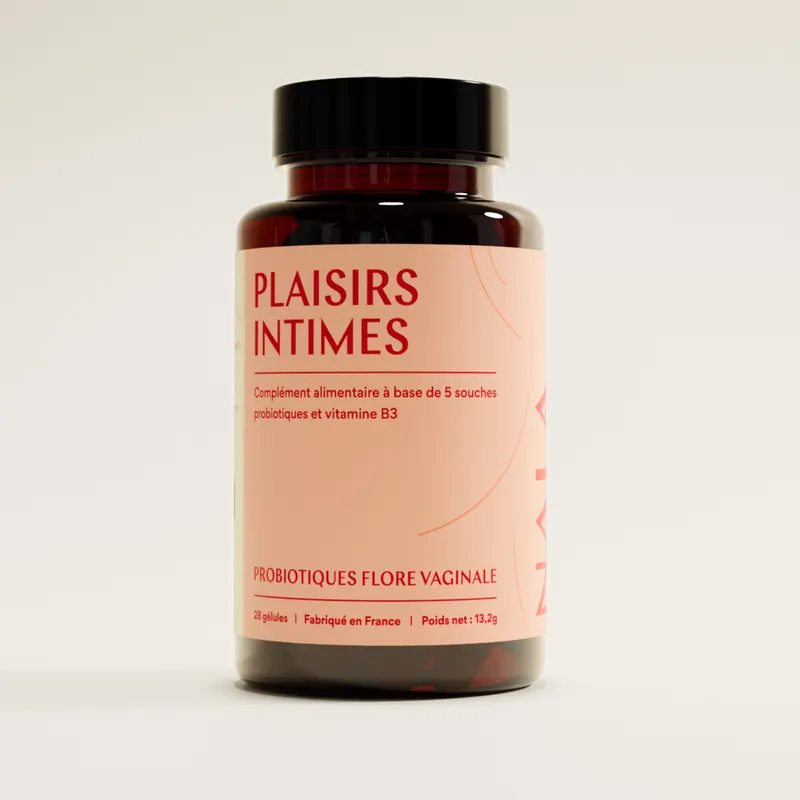
At Nala Pour Elle, a French brand specializing in premenopause and menopause, the Plaisirs Intimes formula stands out for its single daily dose and its gastro-resistant capsules made in Auvergne. The code LMC10 gives you 10% off the Nala Pour Elle store.
What precautions should you take before starting?
Probiotics are for adults only, require medical advice during pregnancy and breastfeeding, and never replace a consultation if you have symptoms.
- Pregnancy and breastfeeding: ask a healthcare professional for advice before any supplementation.
- Weakened immune system, immunosuppressive treatment, ongoing serious illness: supplementing with live microorganisms requires prior medical advice.
- Ongoing antibiotic treatment: discuss the timing of your dose with your pharmacist.
- Stick to the daily dose indicated by the manufacturer, without exceeding it.
- Products for adults only.
And above all, the basic principle: a dietary supplement provides support, it doesn't diagnose and it doesn't replace treatment.
When should you see a doctor instead of supplementing?
Whenever you have an unusual intimate symptom, without waiting. Persistent discomfort calls for a medical diagnosis, not an online purchase.
This is the most important point in this article. Several situations call for a consultation:
- itching, burning, pain or discomfort that persists;
- discharge that's unusual in appearance, smell or amount;
- pain during sex, or bleeding after menopause has set in;
- recurring urinary tract infections;
- dryness that interferes with daily life: local treatments exist and can be discussed with a doctor or midwife;
- episodes that keep coming back despite a course of supplements.
These symptoms have specific causes that can be diagnosed and treated. A probiotic isn't the answer to an infection, and putting off a consultation does no one any favors.
Frequently asked questions about intimate probiotics
How can you tell if your vaginal flora is out of balance?
There's no reliable self-diagnosis. Unusual discharge, a change in odor, itching or burning are signs to have evaluated by a doctor, midwife or gynecologist, who has the right tests. Supplementing without knowing what you're trying to correct doesn't make much sense.
Should you take probiotics in the morning or in the evening?
Manufacturers mainly recommend consistency, at roughly the same time each day. Some advise taking them away from meals, others with a meal: follow the directions for the product you chose, since they depend on the formulation and the type of capsule.
Do oral probiotics act on the intimate area?
That's the logic these formulas claim, and it's also why the gastro-resistant capsule is highlighted. Keep in mind, though, that no health claim is authorized for probiotics in Europe: brands can't promise an effect, and neither can we.
Can you combine an intimate probiotic with a gut probiotic?
Some formulas already cover both, and that's actually a selling point for several brands. If you're unsure about a combination, ask your pharmacist for advice rather than stacking products.
Can fermented foods replace a course of probiotics?
Yogurt, kefir and lacto-fermented vegetables provide live microorganisms, but neither the same strains nor the same amounts as a dosed formula. They're part of a varied diet, which remains the foundation, without being equivalent to a targeted course.
Can a course be repeated several times a year?
Brands often suggest repeated courses with breaks in between. If the need keeps coming back regularly, that's precisely the sign you should talk to a healthcare professional to find the cause, rather than going through box after box.
Key takeaways
Choosing an intimate probiotic comes down to reading a label methodically: strains named in full, CFU counted per daily dose, a gastro-resistant capsule, vitamins with their content displayed, and a course length calculated on the real number of days covered.
These formulas provide support, they don't treat anything, and no health claim exists to date for probiotics. If you have a symptom, the right door is still your doctor's office.
Dietary supplements are not a substitute for a varied, balanced diet and a healthy lifestyle.
References
- Assurance Maladie (Ameli), Menopause: definition, symptoms and diagnosis, updated February 20, 2026.
- Regulation (EU) No 432/2012 establishing the list of permitted health claims: "niacin contributes to the maintenance of normal mucous membranes", usable only if the food is at least a source of niacin within the meaning of Regulation (EC) No 1924/2006. Same wording for riboflavin.
- Regulation (EC) No 1924/2006 on nutrition and health claims, definition of the "source of [vitamins]" claim.
- DGCCRF (French consumer protection authority), practical fact sheet on dietary supplements.

LMC content is written by our editorial team from the information published by the brands. Scores out of 10 follow a public grid of 5 criteria*, supplemented by LMC’s editorial assessment.
To support LMC, some links are affiliate links: LMC earns a commission at no extra cost to you, and some of the brands featured are partners. By using the site, you accept our terms of use and our editorial policy.