
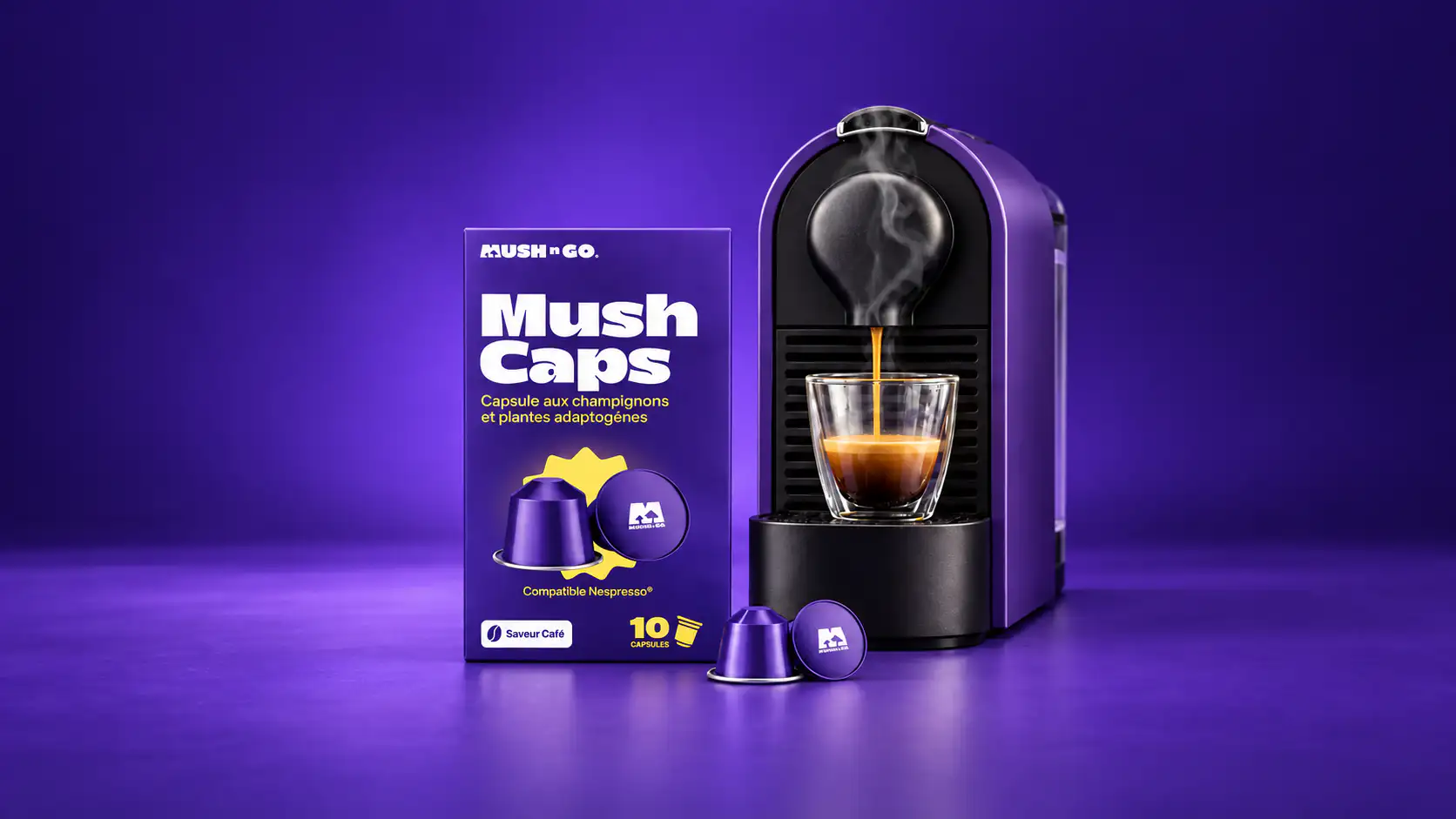

Mushroom coffee has become a modern wellness shortcut: one cup that supposedly delivers clean energy, better focus, lower stress, and none of the rough edges associated with classic coffee. It is an attractive promise, especially for people who feel overstimulated by caffeine but still want a productive morning ritual.
The problem is that many products sell a lifestyle story before they prove the formula. Some blends contain very little mushroom extract, hide their dosages in proprietary blends, or rely on vague terms like “adaptogenic support” without clarifying what the active compounds actually are.
Is mushroom coffee a bad idea?
Not necessarily. A well-formulated blend can make sense if it combines a moderate amount of caffeine with properly extracted mushrooms such as lion’s mane, reishi, or cordyceps. For some people, that translates into a gentler experience than strong roasted coffee taken on an empty stomach.
But “gentler” does not mean harmless. If you are sensitive to caffeine, prone to reflux, or taking medication that affects blood pressure, glucose, or the immune system, a mushroom coffee can still create unwanted effects. The product category deserves the same scrutiny as any supplement, because that is essentially what it is.
The red flags to watch
- No clear dosage for each mushroom.
- No indication of fruiting body versus mycelium.
- Marketing claims that sound stronger than the ingredient panel.
- Added sweeteners or fillers that dilute the premium positioning.
If the label is opaque, the formulation usually is too.


What exactly is adaptogenic mushroom coffee?

In most cases, it is a coffee-based drink mixed with powdered or extracted medicinal mushrooms. Depending on the brand, you may find lion’s mane for cognitive support, reishi for stress balance, cordyceps for energy, or chaga for antioxidant positioning. The challenge is that the quality gap between products is enormous.
Potential benefits : and realistic limits
The best-case scenario is not a miracle transformation. It is a more stable morning routine: slightly smoother stimulation, a bit less crash, and a product that may fit better into a broader health strategy. That can be worthwhile, but it is very different from the dramatic claims often seen on social media.
Clinical data on finished mushroom coffee products remains limited, so the smartest approach is to judge the formula rather than the trend. A premium blend should be transparent, digestible, and coherent from an ingredient standpoint.
Who should be careful?
If you are pregnant, breastfeeding, on anticoagulants, immunosuppressants, diabetes medication, or simply highly reactive to caffeine, take the cautious route. Mushroom coffee may sound softer than espresso, but it is still a functional blend with real physiological effects.
Bottom line
You do not need to fear mushroom coffee, but you should absolutely filter out weak formulations and wellness exaggeration. Buy it only if the dosages are transparent, the mushrooms are credible, and the product fits your own tolerance profile. Trendy does not automatically mean well designed.

How to use this guide before choosing a supplement
A good supplement decision should start with the problem you want to solve, not with the trend around the ingredient. Before buying, check whether the product matches your routine, your budget and your tolerance. The formula should be easy to understand, the dosage should be clear and the claims should stay realistic.
At LMC, we prefer products that explain exactly what they contain, how to use them and who they are best suited for. A strong brand page or a polished ad is not enough. The useful signals are the ingredient list, the dose per serving, the price per month, customer feedback and the transparency around sourcing or quality checks.
LMC practical checklist
- Clear purpose: know why you want the product before comparing brands.
- Readable formula: avoid vague blends when the dose is important.
- Realistic expectations: supplements support a routine, they do not replace sleep, diet or medical advice.
- Cost per month: compare the real cost after dosage, not only the pack price.
This approach helps separate genuinely useful products from attractive marketing. If a product is transparent, coherent and easy to take consistently, it deserves attention. If the promise is unclear or too broad, it is better to compare alternatives before buying.
Extra evaluation points before you buy
To make this guide more useful, keep one simple rule in mind: compare the supplement as a monthly habit, not as a one-time purchase. The label may look convincing, but the real value depends on how the product fits your routine, how clearly the dose is explained and whether the brand gives enough information to make a confident decision. A good formula should be understandable without needing to decode marketing language.
Also look at the context of use. Some supplements are better suited to a morning routine, others make more sense around training, meals or an evening ritual. If the product requires a complicated preparation or an unrealistic serving size, consistency will be harder. For LMC, this practical dimension is just as important as the ingredient itself.
Questions to ask before ordering
- Is the active dose explicit? The useful quantity should be easy to find on the label.
- Is the promise realistic? Prefer support claims over guaranteed or medical-sounding results.
- Is the price coherent? Compare the monthly cost after the real serving size.
- Is the product easy to use? Taste, format and preparation matter for long-term consistency.
This does not mean every product needs to be perfect. It means the best option is usually the one with a clear formula, a realistic promise and a format you can actually keep using. That is the difference between a supplement that looks good online and one that makes sense in a daily routine.
Final LMC verdict
The most useful way to read this guide is to connect the ingredient, the format and the daily use case. If the product solves a real routine problem, has a clear serving size and keeps its claims realistic, it can be worth considering. If the formula is vague, the promise too broad or the monthly cost unclear, compare alternatives before ordering.
For sensitive profiles, pregnancy, medication, chronic conditions or persistent symptoms, the right move is simple: ask a qualified health professional before starting. LMC can help you compare brands and avoid weak offers, but it does not replace personal medical advice.
Practical next step
If you are comparing several options, create a short list of two or three products and compare them on the same basis: dose, monthly cost, ingredient clarity, taste or format, and the quality signals provided by the brand. This prevents a common mistake: choosing the product with the strongest promise instead of the product that is easiest to use consistently.
For supplements linked to energy, sleep, digestion, hormones, weight management or recovery, start conservatively and observe how your body responds. Do not stack too many new products at once, because it becomes impossible to know what actually helps. A simple routine, tracked over a few weeks, is usually more useful than a complicated protocol.

LMC’s editorial line is built around transparency and reliability. Our content is written to help users make better decisions, based on 7 key criteria* that support trustworthy information, verified promo codes, and useful reviews.
To support LMC, some links are affiliate links. Our recommendations remain independent and based on transparent, verifiable criteria. By using the site, you accept our terms of use and our editorial policy.








.webp)