




Sore legs three days after squats, heavy quads after a long trail run, slower-than-expected recovery between sessions: for many committed athletes, recovery is the real bottleneck. Shilajit is still relatively unknown in mainstream sports nutrition, yet this dark Himalayan mineral resin has been studied for muscle damage, fatigue, and cellular energy production.
What is shilajit, and why are athletes interested in it?
An ancient mineral resin sourced from the Himalayas
Shilajit is an organo-mineral substance that seeps from rock fissures in Himalayan mountain ranges, typically at high altitude. It has been used for centuries in Ayurvedic practice as a restorative tonic for vitality, resilience, and fatigue management.
A unique profile: fulvic acid, DBPs, and 85+ trace minerals
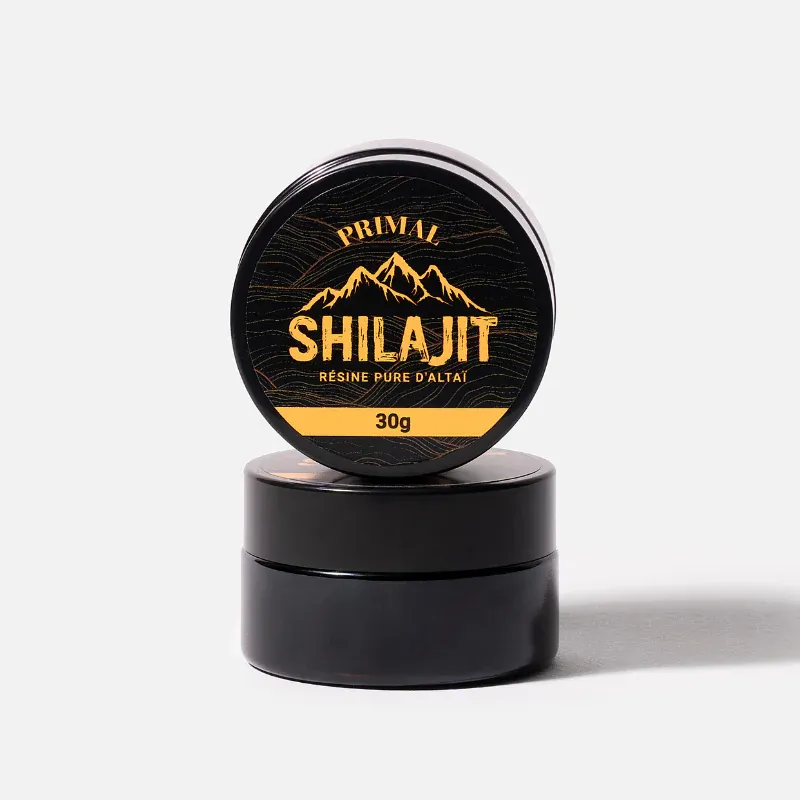
High-quality shilajit naturally contains fulvic acid, dibenzo-α-pyrones (DBPs), and a broad mineral spectrum including magnesium, zinc, and iron. In practice, fulvic acid concentration is one of the best quality markers when comparing products.
Why it stands out for natural performance support
What makes shilajit attractive is its multi-angle potential: it may support muscular recovery, inflammatory balance, mitochondrial energy output, and hormonal resilience at the same time. Very few natural compounds cover all of those recovery levers in one ingredient.

Shilajit for muscle recovery: what the science says
Less muscle soreness and lower damage markers
A clinical study by Keller et al. (2019) in the Journal of the International Society of Sports Nutrition used 500 mg per day for eight weeks. The key finding: subjects supplementing with shilajit showed significantly lower markers of exercise-induced muscle damage, including creatine kinase and lactate dehydrogenase, after eccentric training.
Better force retention after hard training
Compared with placebo, the shilajit group maintained isometric strength more effectively during the 72 hours following exercise. That matters for athletes who train multiple times per week and want to reduce the performance drop between sessions.
Mitochondrial ATP support
A 2016 PLOS ONE paper reported that shilajit combined with CoQ10 enhanced mitochondrial ATP production more than CoQ10 alone. The proposed mechanism is that DBPs help stabilize CoQ10 in its active ubiquinol form, which may improve cellular energy availability.
Fulvic acid and inflammatory balance
Fulvic acid appears to help neutralize oxidative stress and modulate pro-inflammatory cytokines such as IL-6 and TNF-α. In plain English: recovery may feel cleaner, with less lingering soreness and fatigue after demanding sessions.
Additional benefits for athletes
Hormonal recovery and testosterone support
A study published in Andrologia (Pandit et al., 2015) found that 500 mg per day over 90 days increased total testosterone, free testosterone, and DHEA in healthy men. That does not make shilajit a magic performance booster, but it does strengthen its profile as a recovery-focused adaptogen.
Endurance and lactate management
Some data also points to reduced lactate accumulation and improved aerobic efficiency after consistent use, which makes shilajit relevant not only for strength athletes but also for runners, cyclists, and swimmers.
Adaptogenic effects under training stress
Because shilajit acts as an adaptogenic compound, it may help the body restore balance more quickly after intense training blocks, especially when fatigue is driven by both physical stress and nervous-system overload.
How to use shilajit for recovery
How much should you take: 250 mg or 500 mg?
The best-supported clinical dose is 500 mg per day. Two 250 mg servings are effectively equivalent. At this stage, there is no strong evidence that going materially above 500 mg delivers better recovery outcomes.
Best timing
Most users do well taking shilajit in the morning, either fasted or with food. Taking it after training alongside a protein-rich meal is also coherent. Because some people experience a noticeable energizing effect, late-evening use is usually not ideal.
How long before results appear?
For measurable biomarker changes, eight weeks is the most realistic minimum. In practice, a two- to three-month course makes sense if your goal is full recovery support rather than a short-term stimulant effect.
Resin, capsules, or powder?
Resin is often considered the premium format for purity and bioavailability. Capsules are easier to dose consistently. Powders can be more variable, so product testing and origin transparency matter more.
How to choose a high-quality shilajit
The key quality criteria
Look for a fulvic acid level above 60%, third-party heavy metal testing, verified Himalayan sourcing, and clear laboratory documentation. These checkpoints matter much more than flashy packaging.
Our recommendation: Shamballa Shilajit
Editorial score: 9.3/10. Shamballa Shilajit stands out for its high fulvic acid content (75-77%), certified Himalayan origin, and testing through a French laboratory. It is one of the most convincing options for an 8- to 12-week recovery protocol.
Exclusive promo code: LMC10 for 10% off your order. 👉 Discover Shamballa Shilajit →
Mistakes to avoid
Do not judge quality by raw powder weight alone. Prioritize fulvic acid percentage, purification standards, and contamination testing. Ultra-cheap shilajit without documentation is rarely a good sign.
Who benefits most from shilajit for recovery?
Shilajit is especially relevant for athletes with high training frequency, slow post-workout recovery, persistent fatigue, or men over 35 looking to support both recovery and hormonal resilience. Results tend to build progressively: better daily energy in weeks 1-2, less intense soreness in weeks 3-4, and the clearest recovery benefits after 6-8 weeks.

Bottom line: shilajit is one of the rare natural supplements backed by meaningful clinical data for muscle recovery. The evidence-based starting point is 500 mg per day for at least eight weeks, ideally in a purified formula with a high fulvic acid content. Our top pick remains Shamballa Shilajit (9.3/10), with code LMC10 for 10% off.

LMC’s editorial line is built around transparency and reliability. Our content is written to help users make better decisions, based on 7 key criteria* that support trustworthy information, verified promo codes, and useful reviews.
To support LMC, some links are affiliate links. Our recommendations remain independent and based on transparent, verifiable criteria. By using the site, you accept our terms of use and our editorial policy.



.webp)

.avif)