




Marine collagen dosage has a direct impact on your results: take too little and the effects never really show up, take too much without a clear strategy and you simply waste your collagen routine. It is one of the most common questions about hydrolyzed collagen, and one of the most poorly answered online.
The reality is more nuanced than a single universal number. Your ideal daily dosage depends on your goal (skin, joints, sport), the format you use (powder, capsules, tablets) and your current phase of supplementation. This guide breaks down the clinical evidence so you can calibrate your intake with precision.
Why marine collagen dosage makes such a difference
Collagen is not an instant-effect ingredient. Its mechanism is cumulative: you provide the body with the collagen peptides and amino acids (glycine, proline, hydroxyproline) needed to support its own collagen synthesis. That process takes time and requires a dose high enough to trigger a measurable biological response.
Available studies show that results depend directly on the concentration of bioactive peptides, their bioavailability and how consistently you take them. A dose that is too low or too irregular usually produces very limited visible benefits, even after several months.
What the studies really say about effectiveness
📌 A meta-analysis published in the Journal of Cosmetic Dermatology (Choi et al., 2019) reviewed 11 clinical studies on hydrolyzed collagen and concluded that supplementation with 2.5 to 10 grams per day over 8 to 24 weeks significantly improves skin elasticity, hydration and dermal density. The variation in dose across studies reflects the variation in goals: there is no single universal dosage, but a practical range that should be adapted to your objective.
Type I collagen is the most abundant form in skin, tendons and bones. That is precisely the type supplied by marine collagen sourced from fish, with several comparative studies suggesting better absorption than bovine collagen thanks to the smaller peptide size (Avila Rodríguez et al., 2018).

What marine collagen dosage should you choose for your goal?

Here are the dosage ranges supported by the clinical evidence currently available. If you also want to explore the difference between marine collagen powder and capsules, keep in mind that the format directly affects how easy it is to reach these doses every day.
Skin: hydration, elasticity and anti-aging support (2.5 to 5 g/day)
This is the best-documented use case. The minimum effective dose for visible improvements in skin elasticity and wrinkle appearance starts at 2.5 g of collagen peptides per day. A daily dose of 5 g tends to deliver faster and more noticeable results in most studies.
- Minimum effective dose: 2.5 g/day
- Best beauty dosage: 5 g/day
- Typical time to visible results: 6 to 12 weeks
- Recommended course length: at least 3 months
Joints and cartilage (5 to 10 g/day)
For joint support and cartilage health, studies use higher doses. Clark et al. (2008) showed in athletes that 10 g/day of collagen hydrolysate for 24 weeks significantly reduced activity-related joint pain. More sedentary users or people looking for preventive support can often stay around 5 g/day.
- Preventive dose: 5 g/day
- Therapeutic joint-support dose: 10 g/day
- Typical timeline: 8 to 12 weeks
Sport, strength training and tendon recovery (10 to 20 g/day)
The International Olympic Committee consensus (2018) positions collagen as a supplement of interest for tendon and ligament health in athletes. Shaw et al. (2017) also showed that 15 g of gelatin plus vitamin C before exercise increased collagen synthesis in tendons. For muscle recovery and connective tissue protection, endurance and strength athletes typically use 10 to 20 g/day.
- Maintenance sport dose: 10 g/day
- Intensive training / injury-support dose: 15 to 20 g/day
- Best timing: 30 to 60 minutes before training
General maintenance and prevention (2.5 g/day)
If you are under 35 or taking collagen with a preventive mindset, 2.5 g/day is usually enough. It is the classic maintenance dose, especially useful for preserving results after a more intensive marine collagen course.
Quick dosage recap: skin (hydration, wrinkles) = 2.5 to 5 g/day, joints and cartilage = 5 to 10 g/day, intensive sport and tendons = 10 to 20 g/day, general maintenance = 2.5 g/day.
When and how should you take marine collagen?
Timing matters almost as much as dosage. The same product can produce very different outcomes depending on your profile and your goal.
Morning on an empty stomach: why it is often the best time
Taking collagen first thing in the morning on an empty stomach may support faster absorption of collagen peptides, because there is less competition from other dietary proteins. The acidic stomach environment in a fasted state may also help residual peptide hydrolysis.
👉 In practice: dissolve your marine collagen powder in a glass of water with fresh lemon juice (a natural source of vitamin C) as soon as you wake up, then wait 20 to 30 minutes before breakfast. This is the protocol used in most clinical studies focused on skin benefits.
For athletes, taking it 30 to 60 minutes before training is preferable when the goal is to maximize tendon collagen synthesis (Shaw 2017 protocol).
Vitamin C: essential or optional?
It is essential. Vitamin C (ascorbic acid) is the enzymatic cofactor for prolyl hydroxylase, the enzyme that converts proline into hydroxyproline, an amino acid critical to the structure of the collagen triple helix. Without enough vitamin C, the body cannot use supplemented amino acids as efficiently.
- Minimum effective dose: 50 mg of vitamin C with your collagen serving
- Optimal dose: 200 to 500 mg (without going above 1 g to avoid digestive discomfort)
- Natural sources: fresh lemon juice (30 to 40 mg), acerola juice, kiwi
Loading phase vs maintenance phase: the advanced method
Most articles give you one number. Clinical reality is more precise. The advanced method separates collagen use into two phases:
- Loading phase (months 1 to 3): a higher dose based on your goal (5 to 15 g/day) to saturate target tissues and kick-start endogenous synthesis
- Maintenance phase (from month 4 onward): cut the dose roughly in half (2.5 to 5 g/day) to maintain benefits at a lower long-term cost
This approach works especially well for skin and joints, and it can also help optimize your budget over time.
Powder, capsules or tablets: which format is best for hitting your dosage?
Your format choice has a direct impact on how easily you can reach therapeutic doses. If you want to choose the right marine collagen powder, you need to understand the trade-offs of each format.
- Powder: the most flexible format, ideal for reaching 10 to 20 g/day, with strong bioavailability and the lowest cost per gram
- Capsules: convenient for travel and smaller doses (2.5 to 5 g/day), but hard to push above 5 g/day without swallowing many capsules, often 6 to 10 per day
- Tablets: a middle-ground format, sometimes offering more precise dosing than capsules in pharmaceutical-style products
⚠️ Always check the label for the dose of active collagen peptides, not just the total weight of the tablet or capsule. Some products highlight a total gram amount that also includes excipients.
How long should you take marine collagen?
Course duration matters just as much as dose. Clinical studies broadly converge on a minimum of 8 to 12 weeks to observe measurable effects on skin or joints. Practical guidelines are simple:
- Minimum course: 8 weeks (first visible skin effects)
- Standard course: 3 months (meaningful skin and joint benefits)
- Extended course: 6 months (best results for cartilage and tendons)
- Maintenance strategy: 3-month courses twice a year, with a 1-month break between cycles
Visible improvements usually appear in this order: better skin hydration (4 to 6 weeks), softer fine lines (6 to 8 weeks), improved elasticity (8 to 12 weeks), then joint benefits (8 to 16 weeks depending on symptom intensity).
Are there any side effects or contraindications to know about?
Hydrolyzed marine collagen has an excellent safety profile. No toxicity has been observed in clinical studies, even at higher intakes (20 g/day over several months). That said, a few precautions still matter:
- Fish allergy: marine collagen is extracted from fish skin or scales, so it is contraindicated if you have a confirmed fish allergy
- Mild digestive discomfort: possible at higher doses (bloating, nausea); if needed, lower the dose temporarily or split it into two servings per day
- No meaningful overdose risk: above 20 g/day, added benefits are limited but not dangerous. Excess protein is simply eliminated
- Pregnancy and breastfeeding: as a precaution, speak with a healthcare professional before starting supplementation
👉 If you are unsure because of medication use or a chronic condition, professional medical advice is recommended before you begin a collagen course.

Our recommendation: Nutrition Pro marine collagen powder
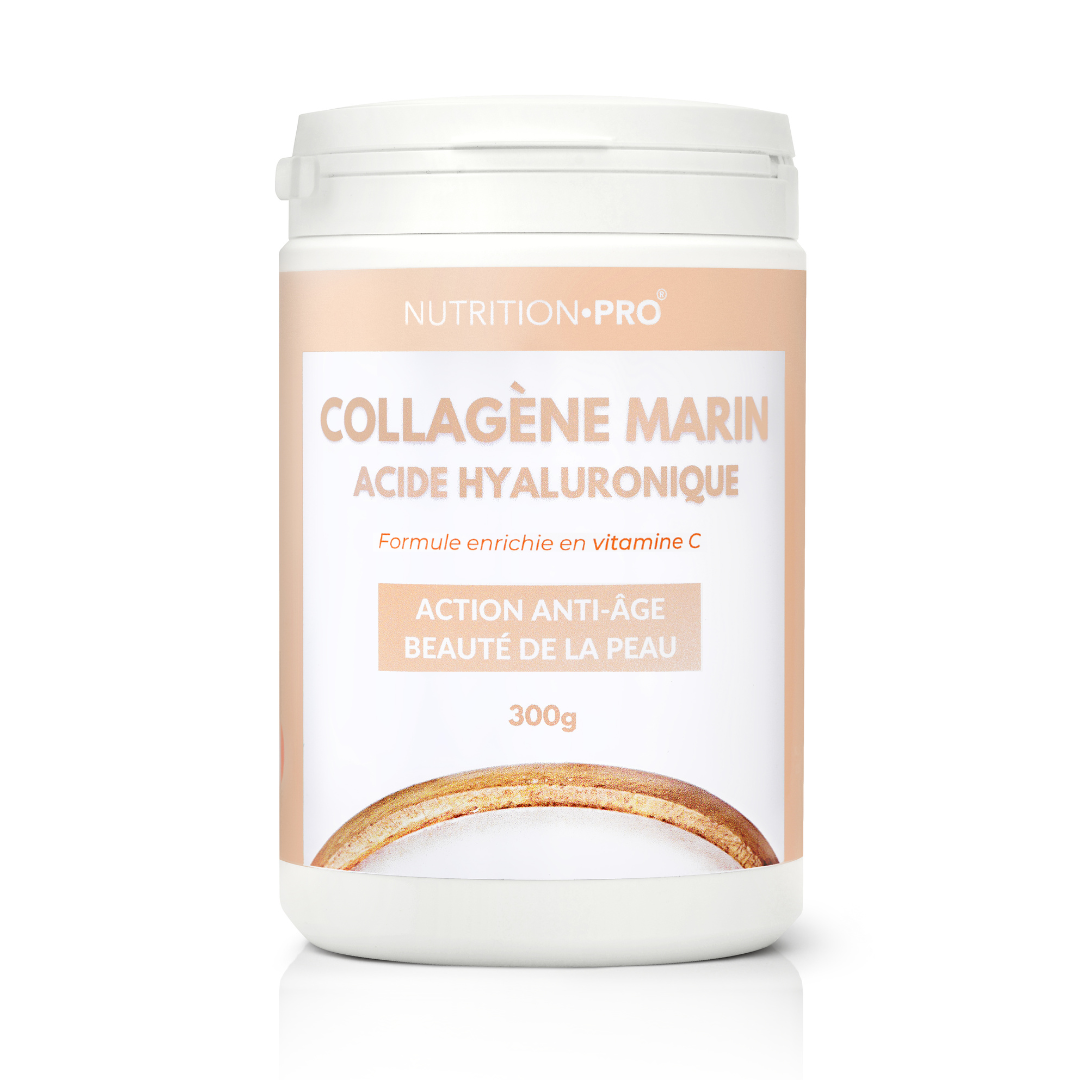
To easily reach a dose close to those used in studies, Nutrition Pro's marine collagen and hyaluronic acid powder is the simplest option: one 10 g scoop per day provides 10 g of patented Naticol® type 1 marine collagen, 210 mg of hyaluronic acid and 80 mg of vitamin C, with no additives or sweeteners. The 300 g tub lasts one month for €39.99, or €1.33 per day.
Use code LMC to get 10% off one-time purchases.
Discover Nutrition Pro collagen powder →
To compare the whole range, read our full Nutrition Pro review.
Common questions about marine collagen dosage
How many grams of marine collagen should you take per day?
Anywhere from 2.5 to 20 g depending on your goal: 2.5 to 5 g/day for skin and maintenance, 5 to 10 g/day for joints, and 10 to 20 g/day for athletes and tendon recovery.
Should you take marine collagen in the morning or at night?
Ideally in the morning on an empty stomach with vitamin C. Morning intake is the timing most often used in skin-focused studies. For athletes, taking it 30 to 60 minutes before training is more effective for tendon support.
How long does it take to see results from marine collagen?
At least 6 to 12 weeks for visible skin results. For joints and tendons, expect closer to 8 to 16 weeks depending on symptom intensity.
Can you take too much marine collagen?
No proven toxicity has been observed even at higher doses. Above 20 g/day, extra benefits are usually marginal. The excess is simply handled like any protein surplus.
Is marine collagen effective for joints?
Yes, especially from 5 to 10 g/day depending on the level of discomfort. Clinical studies over 8 to 24 weeks show meaningful reductions in joint pain and improved mobility.
Should you take marine collagen with vitamin C?
Strongly recommended. Vitamin C is the essential cofactor for collagen synthesis in the body. Without it, some of the provided peptides may be used less efficiently.
What is the difference between powder and capsules when it comes to dosage?
Powder is more flexible and more economical for higher doses (10 to 20 g/day). Capsules are better suited to smaller doses (2.5 to 5 g/day) and to people who dislike the taste. For a full comparison, read our guide on marine collagen powder vs capsules.
Scientific references
- Choi F.D. et al. (2019). Oral collagen supplementation: a systematic review of dermatological applications. Journal of Drugs in Dermatology. PubMed 30681787
- Clark K.L. et al. (2008). 24-week study on the use of collagen hydrolysate as a dietary supplement in athletes with activity-related joint pain. Current Medical Research and Opinion. PubMed 18416885
- Shaw G. et al. (2017). Vitamin C-enriched gelatin supplementation before intermittent activity augments collagen synthesis. American Journal of Clinical Nutrition. PubMed 27852613
- Avila Rodríguez M.I. et al. (2018). Collagen: A review on its sources and potential cosmetic applications. Journal of Cosmetic Dermatology. PubMed 29144022

LMC’s editorial line is built around transparency and reliability. Our content is written to help users make better decisions, based on 7 key criteria* that support trustworthy information, verified promo codes, and useful reviews.
To support LMC, some links are affiliate links. Our recommendations remain independent and based on transparent, verifiable criteria. By using the site, you accept our terms of use and our editorial policy.






.webp)

.avif)